Transformation of Jobs in the AbilityOne Program: Disability Advocacy, Leadership, and the Power of Concentrated Action
by Chai Feldblum
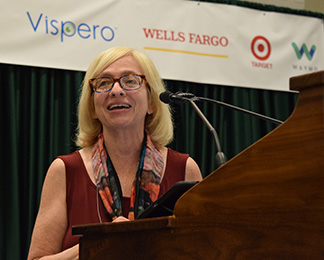 From the Editor: For a very long time we have been fighting against the concept of subminimum wages. The AbilityOne Commission has been responsible for overseeing the AbilityOne program, and one of our long-term goals has been to have more than token representation on the Commission, understand its inner workings, and develop significant relationships that could lead to building bridges and changing the program. In this presentation, we hear from an excited presenter who believes that the stars have aligned and we are beginning to see the progress we have so long sought. May I offer in this note my support to mostly unsung heroes who have gone where Federationists were not initially welcomed and who managed to build bridges that have led to further understanding and significant progress. Here is what Chai Feldblum said on the last afternoon of our 2023 National Convention:
Hello, everyone. Actually, I'd like to call myself a freelance troublemaker—making good trouble. And I know I am in great company right now in terms of making good trouble.
First, thank you, President Riccobono for extending an invitation to me to speak at this convention. It's really an honor and also very exciting to be talking to a group that I am hoping will work in great partnership with what I and my fellow three citizen members are trying to do right now at the AbilityOne Commission.
I actually believe we are at a potentially transformative moment for increasing employment of people who are blind. That is due to a lot of work that NFB has been doing since 1940 when it was first established, and a lot of that success is due to the fact that NFB is an organization of the blind and not for the blind. I love your tagline: "Live the life you want." A life like that would include having a good job, and by a good job, I mean a job that provides real economic security by providing solid wages and benefits; a job that uses a person's full potential and offers the opportunity for career growth; and a job that provides a sense of self-worth and meaning.
So what I want to talk about today is how the AbilityOne Program can be a player in helping to achieve that outcome for people who are blind. I will tell you, this is not really the role that the AbilityOne Commission has played over time. Indeed, NFB has legitimately criticized the AbilityOne Program for its philosophical underpinnings, for its use by many of the nonprofit agencies in the Program of 14c certificates to pay sub-minimum or sub-prevailing wages, and, to be honest, the practical manner in which the program runs. The mindset of any number—not all, but any number of nonprofit agencies—that they are successful if they find a blind person a job, a person with a significant disability a job, and that person is in that job for thirty years. That's success. That is the mindset that has been in play for a long time. That's the mindset we are now trying to change.
I want to say something about technology in terms of this being a potentially transformative moment. There are amazing advances in technology happening now that are creating a whole new range of access for people who are blind that will help them be very successful in jobs, help them demonstrate their full potential, and there are companies that are aware of the financial benefits in developing and disseminating this technology. We need to leverage that.
I love saying "Let's capitalize on capitalism. Let's make it worth it for people to do things that will help us get employed." So I want to call out particularly Gina Kline and Margaret Knowles. They're in the audience here today. They're in the forefront of leveraging this effort. Gina founded two entities. One is called SmartJob. You can check it out on the web. It is developing an ecosystem of companies, developing new access technologies. And the second is Enable Ventures, which invests in these companies to help them scale up.
We at the AbilityOne Commission now are putting different expectations on our nonprofit agencies. We are telling them we expect them to work with their employees to understand what jobs they could have outside of their AbilityOne contract and to help them get that job. How different would that be? We're working with Gina and her group because there is technology out there to help make that move into the competitive economy, and we will make sure that NPAs (nonprofit agencies) know how to use those.
Now, any type of change requires stars to align. I will tell you something a lot of you know: There have been a lot of efforts to transform the AbilityOne Program over the course of time. In fact, a lot of those efforts were done by NFB. NFB in fact ran a successful campaign to get Anil Lewis, whom you're going to hear from soon, appointed as a citizen member of the AbilityOne Commission during the Obama administration. He served from 2012 to 2017.
I'm guessing that he can share many stories with you of trying to make change at the AbilityOne Commission and not getting anywhere. Anil, would you feel you had been a lonely voice crying in the wilderness sometimes? [Anil yells out yes.] Let me tell you, you need the stars to align to have social change be successful, and the stars are aligning now. That's why it's so important for NFB to be involved to keep pushing what the four citizen members of the Commission are calling the "grand experiment" to transform the AbilityOne Commission. So, these stars are aligning.
Number one, four new citizen members of the Commission were appointed at the same time in August 2021. I was on the transition team for the Biden Administration. I was given the job of analyzing the AbilityOne Commission, and one of the things I said was, there's room for four citizen members, there are only two there, they've been there for a really long time. How about having four new citizen members all appointed at the same time, and that's what happened.
Two years ago, August 2021, we came on as a critical mass. So, we didn't have to be the lone voice in the wilderness. Not only that: let's just say that we are a critical mass to be reckoned with. Two of the citizen members, Bryan Bashin and Gabe Cazares, are longtime members of NFB that many of you know. Let's just say they're not exactly shrinking violets. Our fourth citizen member, Chris Brandt, has been a leader in closing sheltered workshops, stopping 14c, and advancing employment for people with intellectual and developmental disabilities. Go, Chris!
The second star to align has been the career staff at the AbilityOne Commission. As a former political appointee at the EEOC for nine years, I can tell you that a political appointee might have the best idea about new initiatives, and if the career staff doesn't like it, it's not going to happen. No one even says anything negative. Just somehow, it just doesn't happen.
Well, we are lucky now in how the career staff has responded to the changes that the citizen members have been pushing. Kim Zeich, who had been the deputy director during many years that the AbilityOne Program operated in one way, totally got and supported two years ago what we started to do. She totally got and supported what we started to do as citizen members. That was hugely important in terms of success. And we got a new general counsel, Marlin Paschal, who knew a lot about procurement. Let me say he has learned a lot in the last two years about disability rights and ideology, and he has been very open to helping with change.
There is a new approach, again by people changing who have been there for a while and new people coming on. You've got three people from the AbilityOne Commission staff attending this convention right now: Amy Jensen, acting deputy executive director; Bradley Crain, our specialist in CIE and getting people out into the competitive employment—not a skill set that the AbilityOne Commission has had before; and Chris Stewart, who's the first blind lawyer working at the Commission. This makes a difference. Let me tell you, they all rock.
Again, simple things like budget: We all know what's in the budget is what matters. After I got invited to speak here, I checked to see whether the agency would pay. Yes. Not only that, but Kim was really sorry she couldn't come. She had another engagement.
She says, "Let's make sure Amy Jensen can go. Let's make sure Chris Stewart can go. Let's make sure Bradley Crain can go." What you spend money on tells you a bit about what you care about. So, I'm very glad to have Amy, Bradley, and Chris here. Let me tell you, I think we're coming every year.
The third star to align was the report issued by the National Council on Disability in October 2020. You got to hear from Andrés Gallegos earlier this morning. You know how important NCD is. In 2020, they issued a report calling for the complete dismantling of the AbilityOne Program because it is so flawed at its core, according to the report. They said yes, we want to use federal contracting dollars, which is what the AbilityOne Commission does, right—having these dollars to give contracts to help people who are blind and people with significant disabilities. The way we do it is get rid of this program that has these special set-aside jobs, and we have Congress pass a law requiring every federal contractor to hire a certain percentage of people who are blind and have significant disabilities.
Now, that report was my first exposure to the AbilityOne Commission. I read it and thought, ha! That's an agency that needs some reform.
As someone who likes challenges, I decided to say to the White House that I'd be interested in going inside to try to help, so long as I have some other good troublemakers. But I've worked with Congress my whole life on the ADA and other laws. There's no way I saw the chance of Congress passing a law requiring every federal contractor to hire a particular percentage of people who are blind or have significant disabilities. It wasn't going to happen. Even if it did, what sort of enforcement was there going to be, if people didn't meet their quota?
But the report was a catalyst for change. It was a catalyst for change because it was a dramatic statement that the AbilityOne Program was so flawed at its core that it had to be done away with.
So, the question is, can one actually transform the program even given some of its inherent flaws? And that's what I and the other three citizen members took on as a challenge and what I believe we are now starting to do.
Just for those who don't know, in terms of reminding ourselves of the flaw inherent in the program, it was begun in 1938. It was premised on the assumption that blind people couldn't do anything in the general economy. In fact, they weren't being hired in the general economy; they were working in sheltered workshops doing simple manual production and not getting paid very much. But that was the reality in 1938. The NFB was still two years away from being established, so the organized blind movement at the time focused on getting a law that would require the federal government to buy products from these workshops employing blind people. One advocate said this: "The best way for the federal government to help blind people is to buy the brooms and mops that blind people are making." That was the idea. Okay, well, that was fine at the time because they weren't able to get jobs elsewhere.
That's not what we want, having jobs where you're making brooms and mops. They set it up to not have integration because the whole idea was to create jobs for people who are blind; they made a requirement that 75 percent of what they called "direct labor hours" in making the products had to be done by blind people. They didn't include supervisors because hey, how could blind people be supervisors, right?
So the premise was not a premise that any of us would accept today in terms of the capacity of blind people to work. But that was the initial basis. This program has been updated, has been changed, only once, in 1971—fifty-two years ago. And it was changed to expand it so it was also contracts for services, not just for products, and to include people who were called severely disabled, which was actually defined as people whose disability made them unable to work in the "normal competitive economy."
Those are the flaws: the premise on which it's based, on the fact that it's contrary to integration at its very core, and, as I said, for years using 14c certificates.
How are we changing it? Well, number one, we issued a regulation prohibiting the use of 14c certificates on any AbilityOne contract. Thank you, NFB, for your consistent advocacy in this area.
Let's be clear: a number of these non-profit agencies have other contracts, not AbilityOne, where they are still using 14c certificates. One of the requests that came from the disability community is that we should consider another regulation that says that, if you're using 14c anywhere in your contracts, you can't play in our game of AbilityOne. We said in our preamble that we were certainly looking at that, but look, that's just the minimum threshold—a minimum threshold.
Here's what we're doing to really make this change happen. First, we're going to Congress with the legislative proposal that says, give us pilot project authority to award a contract, especially in skilled professional work, where the ratio will be less than 75 percent and where we can count supervisors. Give us the pilot project authority to show that this program that leverages government contracting money can create integrated work settings and a chance for upward and outward movement. We have that pending before Congress.
I talked with John Paré and the legislative team to help us get this. That's one thing. That's changing the statute itself a little by giving us pilot project authority.
But the second way we're moving is not dependent on Congress. We are changing the mindset—let me restate a bit. We are trying to change the mindset of nonprofit agencies that think all they have to do is get someone a job, let them stay there for thirty years, and everything is great. The way we're doing this is by saying, we have the following expectations of you.
Number one—this is in draft guidance that I hope will be finalized in a few months—for every employee that comes in, you have to do a job individualization. You have to make sure that you're giving the person the right fit of a job and you're giving them all the accommodations they need—job individualization, right from the get-go.
Number two: You need to have a qualified professional working with each of those employees to have a personalized employment plan. In fact, we call it a Person-Centered Employment Plan to reinforce the autonomy of the employee in figuring out a plan that will move that person forward in their career. PCEPs: Person-Centered Employment Plans. And then, finally, we are saying to the agencies: You need to have a career advancement program to help employees on your contracts move upward or outward. Let me tell you: employers do not usually want attrition. If you are having a worksite with a lot of attrition, you probably don't want to go work there. We're saying attrition is good in this respect: What you've done is counter the discrimination that happens out there every day against blind people who are trying to get a job, and who, of course, have never been told that the reason they're not getting it is because they're blind. But they don't get it.
We have a program now where being blind is the plus to get that job. Again, being blind is the plus to get that job. That is expensive real estate, that AbilityOne job, right?
Let's have this program be a launching pad for people who are blind and have other significant disabilities to get started in a job where they're getting a plus. We want the program to be the place where they get training, get good experience on their resume so they have a chance to get that next job. That's what we're trying to achieve.
I mean to close out with just two things that I think NFB could be incredibly helpful with in helping to make this change. One, you passed a great resolution in 2020 for nonprofit agencies for the blind to pledge to have 50 percent of their managers and 50 percent of their board be comprised of people who are blind. That is awesome because the way to change the mindset is to change the people who are running the program.
So, we're going to do everything we can to create different expectations, to reward the agencies who are doing this well. Let's give them some extra credit in getting new contracts. But the best way to change the mindset: Change the people who are running it.
I think you have something very concrete now to offer to nonprofit agencies, because we are now expecting them to give their employees a sense of what jobs outside the AbilityOne Program might look like so they can make an informed choice as to where they want to work. Well, NFB affiliates could be excellent ambassadors for educating blind employees about that. How about being value-added in this way?
Let me end with a reference to Jacobus tenBroek, an amazing human being, as you know—one of the founders of the NFB. He wrote a book in 1959 with Floyd Matson called Hope Deferred: Public Welfare and the Blind. It's a remarkable book, really. It gives a history of the sheltered workshops that is just so magnificent in understanding what was going on.
But it's also filled with heart-wrenching descriptions of where we have been as a nation with regard to respect for blind people and where we need to go. Well, tenBroek's book was called "Hope Deferred" because of how much still needed to be changed in 1959 when the book was published. I hope we are now on the threshold of hope achieved. I look forward to working with all of you as we transform the AbilityOne Program to be one small piece of the puzzle in getting to hope achieved. Thank you so much.