It’s More About the Fellowship than the Food
by Eileen Rivera Ley
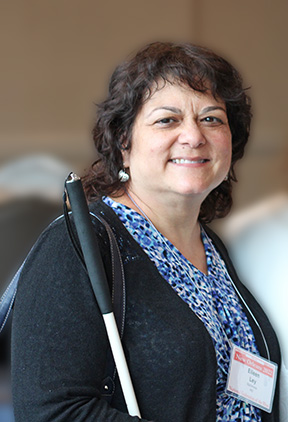 From the Editor: This article was written for Future Reflections, but the Braille Monitor received a copy. With the concurrence of Editor Debbie Stein, we decided that the Braille Monitor could run this, and it will appear in Future Reflections, which is devoting an entire issue to cooking. Here is the way Debbie Stein has written her introduction for the article:
Eileen Rivera Ley graduated from Harvard University and the Wharton School of Business, where she learned the fine points of communication in the business world. She first met the Federation when she won an NFB National Scholarship in 1986. For many years she served as editor of the NFB’s publication Voice of the Diabetic.
Eileen Rivera Ley and her husband, Tom, who was a blind IT manager at UPS, recognized that blind people are at times challenged when it comes to navigating social settings. As innovative entrepreneurs, they founded Blind Savvy USA to teach blind people success skills that enhance community and professional engagement. All over the country, Blind Savvy conducts workshops that introduce people of all ages to the blindness nuances of networking, conversation, dining, etiquette and more.
Helping blind people shine is our mission. We at Blind Savvy work on the premise that by teaching essential life skills, we are making a real difference in people's lives.
Throughout our career journeys and our advocacy work with the Federation, Tom and I had wonderful opportunities to network and collaborate, often during receptions and over meals. We realized that many blind people don't have practice navigating these social settings. One very practical confidence building skill is refining our table manners. Surprisingly, poor table manners can hold us back socially and professionally. We deliver practical, empowering workshops to blind people in these crucial areas.
Mysteries and Manners
I grew up in a family of seven children. Three of us were blind, my sisters Millie, Suzanne, and me. We were rather poor, but we didn’t know it. Like most Puerto Rican families we subsisted on rice and beans, eaten with a fork or spoon. We rarely had much meat that we would need to cut up. We never went to restaurants or other settings where we could observe people using knives and forks. As blind children, we also missed visual cues about table manners.
When I was five years old, our dad used to say, “Keep your elbows off the table!” That admonition made me aware of table manners for the first time. My siblings and I were very competitive, and we worked hard to sit up properly at mealtimes. We always ate dinner together and were encouraged to practice our conversation and listening skills.
As in the past, blind and low vision children were typically encouraged to use fingers or to hunch forward to figure out what was on the plates. But there is a better way. Through our Savvy workshops, we work on truly practical skills such as examining our plate nonvisually by using our knife and fork in the Continental style of dining and finding our beverage without toppling our water glass. In addition, we problem solve those minor catastrophes and blindness bloopers, such as forking a lemon wedge into our mouths or managing an extraordinarily long piece of pasta.
One thing I learned as an adult was the correct way to manage my utensils—fork, spoons, and knives. Too many blind kids hold silverware by wrapping the palm of their hand over the handle. Regrettably, we often find some blind adults using this childlike technique. The palm is on top, and they use the fork to shovel the food in. They are never challenged to practice using a more graceful technique.
Parents, who are naturally protective, are too often tempted to cut up the food for their blind children. Frequently, families have so much on their minds that they don’t make table manners a priority. They are focused on securing Braille instruction and orientation and mobility training for their kids. Parents are arranging transportation to appointments and after-school activities. They manage family problems and deal with issues at work. Parents simply don't have the bandwidth to focus on their child's table manners, and they may not recognize the importance of social integration. Parents understandably become accustomed to how their kids eat, and practicing table manners never gets onto the to-do list.
Founded on Food
When I grew up, I moved out into the wider world to go to college. I ate with enough other people that eventually I realized that proper manners made a difference. Some people were fun to dine with and some people were not, either because of their table manners or their conversation skills. I discovered that most professional and personal relationships begin over food. Eating is a foundational aspect of how we connect with other people. I wanted to teach blind people to be successful in the sighted world, and I understood that dining could play an important role in that success.
With my husband's encouragement, I started to study proper etiquette. I wanted to discover the right and wrong ways to do things in various settings. My husband and I pondered everything I discovered. Then we set out to teach what we had learned.
We did a lot of teaching through sessions we called practicums. We would break down each task into its various steps. How do you slice a piece of chicken? How do you get the right amount of food onto your fork? How do you eat spaghetti without making a mess?
Continental Dining
One of our priorities is to teach the Continental style of dining (as seen on Downton Abbey). In this style, you hold the knife with your dominant hand, and your other hand holds the fork. You use the knife to explore your plate, much as you use a long white cane to explore your surroundings. I tell students, "Think of the knife as your white cane on your plate."
When stopping for conversation, or to take a drink, you can rest your knife and fork on the upper edge of the plate. The tip of your knife might be at two o'clock, and the tip of your fork at eleven. I think of them as the tip of a pyramid. Your utensils are always in the same place. You never have to search around for them, because you know exactly where you put them!
Another nice thing about Continental dining is that you use the side of your knife to push food onto the tines of your fork. When you pick up your fork, you will know by its weight whether it contains food.
Napkins are very important. I love teaching students to use cloth napkins. Fold the napkin in half like a taco. Wipe your fingers between the layers, keeping all the sticky mess in the middle, away from your clothes. That way, the outside part stays clean. If you need to wipe your mouth, pick up your folded napkin and use a clean corner.
Once we had the privilege of collaborating with a blind woman who was a national advocate and had been a model in Brazil. She was a very accomplished person. When we introduced to her the Continental style to cut her steak, she started to cry. She told me that whenever she attended an event, even if she was the keynote speaker, her mother would cut up her meat for her! She had always believed that blind people could not cut up their food independently.
The Great Buffet Challenge
Buffets and networking receptions are often part of social and professional gatherings, and buffet dining can be quite a challenge. It's hard simultaneously to balance a plate full of food, carry a drink, and use a cane to find a table. We encourage participants, "Don't overfill! You can always go back later for more."
As you go through the buffet line, it's perfectly acceptable for you to ask the person ahead of you what's coming up next. Usually, the handle of the serving utensil is extended over the side of the bowl or platter. If someone offers to put some food onto your plate, it's perfectly alright to accept the favor. It's even fine for you to ask for help as you go through the line. Interaction can be an opportunity for you to get to know someone new. We want to be especially careful about spreading germs, so use a napkin to reach for and pick up finger foods.
Keep in mind that dining with people is less about the food and more about the fellowship. We encourage people to think about conversation. One way to help people feel comfortable is to ask them open-ended questions. Most people are pleased when they realize you are interested in getting to know them.
We have practice banquets, and we talk about all the things that could go wrong. For instance, what do you do if you get a piece of gristle in your mouth? You can't spit it into your napkin; that would be gross! I suggest you bring your fork to your mouth, get the gristle onto the fork, and slide it off to the side of your plate. Fortunately, people aren't as observant as you might expect. Just remember where you put the gristle, so you don't pick it up again!
Blind Savvy Strengths Training
We conduct workshops all over the country, focusing on how to be savvy physically. For instance, how can we make the maximum positive impact at a professional reception? At such an event, many participants will be milling around in a big noisy room. There are folks you would like to meet, people who might help you professionally—but how are you going to find them?
One idea I suggest is to contact the event organizers ahead of time and ask for a list of participants. In that way you'll have people's names and the names of their organizations or companies. Then, when you attend the event, you can tell people who you are looking for. You can get people to tell you who's in the room and help you find them.
Never let someone stick you in a chair with a plate and a drink! Don't let anyone put you in a corner! And do not go to a reception hungry; you are not there for the food. Carry either a plate or a drink, but never both. You need to be able to use your cane in one hand so you can move around freely.
In a social situation such as a professional gathering, we can get our blindness to work to our advantage. We are noticeable, and we should not be ashamed of it! We stick out, and we can turn that to our advantage. If employers are in a room with a hundred people, who are they going to remember? They'll remember the person who is unique, the person who stands out from the rest of the crowd.
In Blind Savvy workshops we frequently discuss nonverbal communication. Your posture, your hairstyle, and how you dress communicate nonverbally about who you are. Take the initiative and offer a warm, friendly handshake with a smile. Say, "I'd like to shake your hand," and hold your hand out to the other person. Once you shake hands with someone, you're in the perfect position to have a conversation. You're facing them, and you're at just the right distance.
So now you're standing with someone you wanted to meet. What do you talk about? One thing you don't want to talk about is your blindness! If the person focuses on your blindness for more than thirty seconds, it's up to you to change the topic. You might transition to technology or travel. Show them you have many dimensions.
Naturally some people go home after our workshops and slip back into their old ways. But some people take what they learn and build upon it. We love sharing! We love that we've found a niche where we can make a difference in people's lives.
To learn more about Blind Savvy, visit https://blindsavvyusa.com.