Artificial Intelligence Directed by the Blind: Progress and Possibilities with Be My Eyes
by Mike Buckley, Chairman and CEO, Be My Eyes; San Francisco, California
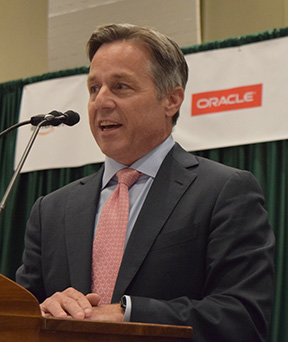 From the Editor: In response to reader suggestions, we have tried a new experiment this year. The request was that we make some room in the August-September issue of the Braille Monitor for news that might not be related to the convention, when previously the issue was devoted exclusively to convention activities. The thought was that we should also stretch out some of the convention articles so that they appeared later in the year. As you will see from this article, there is a downside to this which perhaps we could have avoided with more skill. Some of what you are about to read you already know because it has happened, but we think you will find the article enjoyable anyway.
On Thursday, July 6, 2023, Mike Buckley, Chairman and CEO of Be My Eyes addressed our national convention. Here are some of the remarks President Riccobono made in introducing him.
PRESIDENT RICCOBONO: Let me ask by show of voice: how many of you are familiar with Be My Eyes? [Cheers and applause] Okay. Well, you know they launched in January of 2015, and in 2018, Be My Eyes received our highest award. It was in October 2018 that our next speaker started at the company as an investor and board member. So I tend to think that it was the Bolotin Award that encouraged him to get involved with Be My Eyes. In December 2020 he became the new CEO and chairman for Be My Eyes, and he has been working diligently to get to know the community and to bring his extensive business and technical experience to leverage new opportunities for us and the Be My Eyes platform. I met him in March at the CSUN conference, and I was immediately impressed with how down to earth he is, but also how passionate he is about using the power of technology and putting it in the hands of blind people to do what blind people want it to do. I appreciate his coming to this convention, and he's working and rooted in the wisdom of blind people. I would like to welcome to this podium for the first time, Mike Buckley!
MIKE BUCKLEY: My name is Mike Buckley, I am chairman and CEO of Be My Eyes. It is an honor to be here. I thank you, and I thank President Riccobono for the opportunity. In addition to being chairman and CEO, now that we know from Mark's personal AI he's a guitar player, I can share with you that I am a guitarist and vocalist for an '80s cover band called "The Love Handles," and I am hopeful we can play at next year's convention. Mark, that's a plug.
I also want to say the vice chairman of Be My Eyes, Mr. Bryan Bashin, could not be here today. Thank you for clapping. Those of you who know Bryan know he is a remarkable human being. He was the former head of the San Francisco Lighthouse for the Blind. He misses you and wishes he could be here. I miss him. He is my friend and also has been my professor to help me learn as much as I can about this community and our issues. I love Bryan.
You know, I have given speeches in front of thousands of people before, but a couple of days ago, I realized I have never been as nervous as I am today. And I was trying to think about why that is. The first reason is my mom taught me that you have two ears and one mouth for a reason, and I think it's really important that I listen and ask questions and learn. So it's a little odd to be up here in any capacity opining to you, but I'm here, and I want to listen and learn at all times, so please know that. But that's one of the reasons I'm nervous.
The second reason I'm nervous is that two nights ago my wife said to me, “I know exactly why you're nervous, Mike.”
I said, “Tell me, tell me.”
She's like, “Well, everyone likes Be My Eyes, and you better not screw it up.” [Laughter] You have to appreciate that your spouse as the most honest person in your life....
I know you know Be My Eyes. We have more than half a million blind and low-vision people on our platform. We have an astonishing 6.7 million volunteers who are available to assist. We are available in 150 countries, and provide service in 180 languages. You know what? The volunteers love your calls. In every survey we do, they say it's the best moment of their day. The other thing we have learned is that more than 90 percent of our calls are successful. So the product works. The way I think about Be My Eyes is that it is a beautiful merger of technology and human kindness, and that's one of the reasons I love it. [Cheers and applause]
Our values are about choice. Our values are about empowerment. Our values are about openness. And, of course, one of our big values is our products and services are and will always be free. [Cheers and applause]
When I think about the future of our products and I think about our responsibility to this community, I think of three words: safety, efficacy, and choice. I'm going to talk more about each of these later, but they're really important. They're important to me, to Be My Eyes, and they are important to our community. Now, I know President Riccobono asked this, but I'm going to ask one more time. How many of you have used Be My Eyes? [Cheering] As many of you know, we recently partnered with Open AI to deploy what is called a text-to-image model that promises to help our community interpret the world around them. We call this currently "Virtual Volunteer." The way it works is it allows you to take a picture, which the technology then describes in fantastic detail.
Now, why did we do this? Why did we introduce a machine and introduce technology to answer questions like this? It's because of you. There are two big reasons you have told us why sometimes you're hesitant to use Be My Eyes. The first reason is sometimes we just don't want to talk to a stranger. I talked to a woman the other day who said, “You know, Mike, I don’t always want to call a volunteer because maybe my kitchen is messy.” So we wanted to be responsive to people in our community who maybe were wary of calling a stranger.
The second reason people don't make calls is they don't want to bother a volunteer. They think that the volunteer might be needed more by someone else. Now, I remind you again how much these volunteers love the calls. So, please call. But working with artificial intelligence and trying to put an assistance tool into our hands was directly responsive to the surveys and needs of our community. That's why we are moving forward with this.
Now media podcasters, Mark, and a ton of people have asked me what the experience is like. I'm very, very wary of the artificial intelligence hype cycle. I'm very, very wary of technology companies overpromising and underdelivering. I am very, very wary of technology companies saying, oh, I'm going to build this for you rather than with you. Right? [Applause] My words don't mean as much as the words of the blind and low‑vision beta testers who are using this product. I'm going to read a few for you, because their words have more meaning than my own.
“It's so exciting it feels like 1976 and the NFB's first reading machine.”
“This is so far superior to any tool on the market that it's tough to describe.”
“I’d feel an incredible loss if I no longer had access to this technology.”
“This is life changing.”
Again, these aren't my words. These are the words of the community. But why don't we do a quick demo for you right now.
What we're going to do is take a picture of this room. No, not me. Audience, smile. Are you smiling? [Sound of screen reader]
SPEAKER: Dressed in casual business casual attire… [Laughter] Atmosphere seems to be relaxed and people are engaged in conversations and waiting for an event to start. [Cheering]
MIKE: Pretty cool, right? Let's do one more. Mark, would you stand up for us. Gotcha. Thank you.
SPEAKER: This is a new picture, same conference room as the previous picture. A man is wearing a suit and tie. The text is not clearly visible. Standing near a podium with a microphone, which suggests he might be a presenter or speaker at the event.
MIKE: You see this is a pretty cool piece of technology. We have seen our beta testers use this in airports, in hotels, on subway maps, weather maps, reading electronic schematics in academic papers, helping orient photos, describing things, describing colors and patterns, describing comics, figuring out just what the vegetarian option is on a menu. I have never been more excited about a piece of technology in my life.
So the first piece of news today is that we are renaming this tool. We're not going to call it "Virtual Volunteer" anymore because the blind and low‑vision beta testers asked us to change the name. They didn't think Virtual Volunteer was apt or appropriate. As of today, this tool will be called "Be My AI."
I want to report on what the beta testers discovered. But before I do that, I have to tell you something. Artificial intelligence is not perfect. Artificial intelligence is powerful and awesome and sometimes scary. Suman's product is really cool. But AI Mark Riccobono freaked me out a little! [Chuckles] Our app told my colleague Bryan Bashin that his cane had a red tip. It does not. AI does something called hallucinations. It's really a term they use in the academic literature where sometimes the AI not only gets something wrong, but occasionally it makes something up out of thin air. So you can get an incorrect answer, and there are times when the AI is confident in its inaccuracy.
There are other problems and issues. The picture that I took of Mark, the AI system blurred out his face. How are we going to go on social media with it then? What if I want it to look at my holiday cards and explain the pictures of my grandkids or aunts and uncles. There are very real questions we have to answer together as a community, and we probably have to lobby some regulators to make sure that the power of these tools in our hands works for us the same way it works for anyone who is sighted. [Applause]
This is exactly why Be My Eyes is being cautious and deliberate about rolling out this technology more widely. But it's coming. [Applause] We expect to get this in your hands later this year, and we're working with Open AI to do so. Now, over the years you have heard a lot from tech companies, this and that. But it's not about us on this. It's about you. And I'm here to tell you that the blind people that are in this beta test are shaping this technology to bend it to your needs. A fundamental design principle of Be My Eyes is "with not for." So we've been developing with the community hand-in-hand, from our founder, Hans, to our Vice Chairman Bryan, to the nearly two hundred blind and low-vision beta testers. Ryan, Chancey, Gary, Everette, Anil, Mark, and a man behind me, Mr. Jonathan Mosen, and a guy named Mark Riccobono. [Applause]
Thank you for your passion, your intellect, your direction, your frankness, and for occasionally kicking our ass a little bit, to help shape this technology. Thus far this group has conducted more than 7,000 AI sessions, more than 5,000 chats with the AI. There are one hundred new tests performed every day, and we have one of the most robust conversation and feedback groups I have ever been involved in. It started out with WhatsApp with over one thousand messages, and now we’ve moved it to a multi-channel Slack group, and every day there are dozens of messages talking about how to improve the UI, talking about how to make the technology better, talking about bugs and things that aren't working well. I think this is the most exciting project I have ever been involved in, and it's functionally being directed by blind and low‑vision people around the world.
We also engage in wonderful, complicated, messy discussions about privacy, about facial recognition, about ethics, about where this works and where it doesn't work. But it just underscores the fact that safety is our most important value, and efficacy is mandatory. And we are going to work with Open AI to improve the accuracy of information at all times. But we're going to make sure that we put this in your hands so that you have the choice for how, if, and when to use it. [Applause]
We will also absolutely maintain our network of volunteers. Why? Do you know what I think the secret ingredient of AI is in the near and intermediate future? Humans. People. Suman said this when he talked. This is an extension, not a replacement. And there are times when we need to verify results, double-check results, and always make sure we have the option of a human in the loop. So when we put this tool in your hands, you will always have the option to call a volunteer to either double-check the results, or if the AI fails to answer your question, to get an answer in the first place. That's our pledge and that's our commitment. I'm also excited that we're going to launch a new product that we're announcing for the first time today. The product is called "Be My Eyes Groups." And how I want you to think about "Be My Eyes Groups" is you will have the power to set up a network, a closed network, of fifteen to twenty of your most trusted family and friends who could be the recipient of your first call.
So you will have the power to set up a circle of trust—in case you don't want to call the volunteer because your kitchen is messy—right? In case you have something that is more high stakes that you want to ask about. So a trusted circle will be another choice that we're offering to the community through "Be My Eyes Groups" and another extension of our principles of safety and efficacy, and another extension of choice for our community. By the way, what do you think we're going to charge for it? [AUDIENCE: Nothing!]
MIKE: Ding,‑ding,‑ding, ding! You won! [Applause]
I'm going to wrap up. But here is where I think all of this ends for us. Suman's demonstration was this wonderful window into the power of AI to assist us in multiple facets of our lives. I hope where this ends—is this community has an affordable, accessible, brilliant, wearable that is your personal digital and visual assistant, that you can choose to use when you want, how you want, why you want, whenever you want. I want it to go there. [Applause] We're committed to building to that future.
I also want to do two things. I want to thank a couple people and I want to ask a favor. The first is... I do want to thank our corporate customers. The reason why is they pay the bills. They help us keep this service free. [Applause] Microsoft, Google, Sony, Open AI, P&G, Spotify, Barilla, AARP, and so many others. They help us fulfill our mission and work with you every day on our products and services. And by the way, thank you to the NFB for everything that you do for us. [Applause]
Lastly, I'm asking you for something. Call us. Yell at me on email: [email protected]. Tell us what you need. Tell us how it's going. Help us get more people in the community on to this application. There are so many people, particularly in developing nations, who don't have access to tools that they need. And we think that we have so much work to do expanding the availability of this across the community of more than a quarter billion people who are blind and low-vision. And we won't stop until we get to all of them. I want your feedback. I want your ideas. I want your criticism. I would love your love, if we deserve it. [Applause] I have learned more in the last seven months of this job than at any point in my life, and I will forever be grateful. Thank you very much.