Is It Better at the Airport or Are We on a Merry-Go-Round?
by Patti Chang
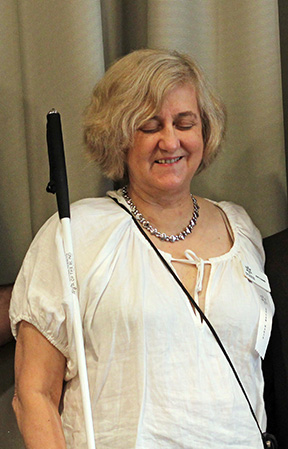 From the Editor: I love it when Patti Chang writes an article for the Braille Monitor. The ones she writes about fundraising are good, but I love it when she gets all steamed up.
The question she raises in this article sends me back to a time when I thought that my job in the Federation was to work myself out of a job. I suppose the goal was more aspirational than something I really thought through. My goal is more modest now; I work with people when I can, and I try to rate my effect on the way I change a few people’s lives rather than the idea that I will change the world. Much work remains to be done, and I think you will come away after reading this spirited article knowing that Patti Chang is still ready to educate, express frustration so others know that blind people too have tempers, and insist on living the life she wants.
I travel often and have been contemplating the question: are airport experiences improving for blind people? So far this year I have travelled to Austin, Texas; Belize, Central America; and Baltimore, Maryland from O’Hare by air.
My most recent experience has left me angry, contemplative, anxious, and a little discouraged. The trip out to Baltimore was good because fellow passengers, TSA, and airline personnel all expected me to know how to travel independently and to know what I did or did not need to do; but let me tell you about my horrid trip back.
For those of you who heard Scott LaBarre’s speeches, you will recall Airport Girl and Airport Guy; I encountered both of Scott’s friends and then some.
First, while I was standing at the gate, a man approached and demanded my phone. Of course, I said no. I thought he was just being creepy. He may have been, but no, it turns out he was an airport assistant who did not even know how to introduce himself to the blind woman he was assuming could not negotiate the tunnel that leads to the plane.
But my no did not end the colloquy. This gentleman proceeded to tell me he was going to escort me onto the plane. When I responded that I did not ask for or want that assistance, he had the audacity to ask if I wanted to be safe. Okay, so now I was angry. Those that know me know that my voice gets lower when I am truly upset. I stepped close to the man and explained in a whisper that I decide for myself when it is safe and that I know perfectly well how to get down to the plane.
That encounter ended, and I boarded the plane and found my seat, expecting my bad experiences to end for the day, but alas, this was not to be. The flight attendant asked the man behind me if he was travelling with me. Admittedly, my response was snarky. I shared some things like, “I am sorry, I left my babysitter at home,” adding that I hated that question. Next, I heard the flight attendant ask another flight attendant if I was allowed to travel alone. The second flight attendant knew that despite blindness I could exercise my right to live in the world and travel without a personal assistant if I chose to do so and answered the first attendant accordingly.
My unsettling adventure did not end there. After embarking at O’Hare, I walked toward the down escalator which takes passengers to baggage from Concourse C. Just as I was stepping onto the down escalator, someone grabbed my cane arm, pulling it back. I insisted he let go and said that what he did was dangerous. I gave him “the look,” and that person had the nerve to be angry with me.
But that is still not all. As I was walking through the psychedelic tunnel between Concourses C and B at O’Hare, I heard a cart beeping behind me. The driver wanted to know if I wanted the cart. After I shook my head, she proceeded to tell me that the cart would be faster. Riding in a cart will take more time, and this I know because I travel O’Hare frequently. I was about two-hundred feet from the up escalator that goes directly to baggage and my husband who picked me up. If I believed her falsehood and rode the cart, a large elevator would have been necessary, and those elevators were further away than the escalator I was fast approaching.
By the time I met my husband, Francisco, I felt discouraged and furious. The timing was awful since our fortieth anniversary was coming up in three days and I wanted to focus on it. Since the trip back from Baltimore, my thoughts have returned to these experiences repeatedly.
Reflecting on my earlier trips in 2024, I must remind myself that trips to Austin and to Belize were without incident beyond people initially addressing my spouse for me, so my general feeling before my return from Baltimore was that things at airports were improving. Now I am not so sure, and I contemplate whether we must constantly work to improve our experiences. Employees leave employment, and people need retraining. Is this the way we should view the public awareness education we must do? Is it cyclical, or do we go forward overtime with the proverbial two steps forward and one step back? Should we expect a merry-go-round where it gets better when training is done and then people inevitably return to their biases and misconceptions? I’ll keep thinking, but share your thoughts, and help me and others figure this out.