Sighted Saviorism in the Education and Rehabilitation of the Blind
by Justin Salisbury
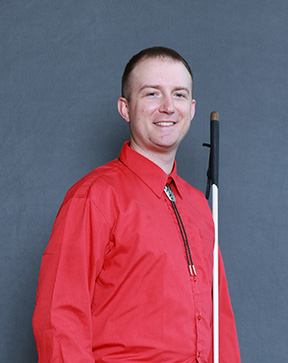 From the Editor: Justin is a frequent contributor, and usually what he brings causes me to think. In this article, he attempts to call out and define sighted saviorism. I’ve never heard this phraseology before, but I think I have known sighted people, some of whom come to help us and some of whom actually become a part of us, who demonstrate what Justin is articulating.
Initially I rejected Justin’s first contribution on this subject, suggesting that it was too abstract and lacked real world examples. I hope you will agree with me that his article is worthy of thought and some planning as to how we can prevent this without pushing away sighted people who want to help us while at the same time figuring out how we will deal with situations in which our life decisions are taken away by someone else by virtue of their vision. How do we bring into the fold people who are willing to become blind people at heart and not encourage participation by those who firmly believe that in the world of the blind, the one-eyed man will and deserves to be king?
I have been blessed with the opportunity to be a national representative for about thirty-five years. In one of my visits to an affiliate, there was no food served at the hotel. This was not a large convention, so many of us went to a nearby restaurant to eat. It took longer than we wanted for the food to arrive, and before many of us had finished eating, one of the sighted people at the table got up and said it was time to get back to the hotel and that the time for convention to start was quickly approaching. The president objected, saying that our goal was to get breakfast, and now that it had come, we were going to eat it. At this point the sighted person made it clear that he was the one driving the van and that the van was leaving to go back to the convention. The sighted man said that the president, and those of us who wished to remain with him, could decide whether we were going back to the convention or whether we would find our own transportation. This was before the days of Uber and Lyft, and the town in which this convention was being held had a taxi system that was unreliable at best. Here is Justin’s article:
To many who read this, I will be introducing a new term, but I expect that most blind people reading this will recognize the phenomenon that I am describing. Let’s call it “sighted saviorism,” which comes with derivatives like the “sighted savior.” In preparing this article, I searched the internet to see who else had ever written about this. I found a few mentions, but it does not seem to be used very often. I want to examine this concept. I have not found a direct definition of sighted saviorism or the sighted savior. I would like to attempt this myself and urge any readers who have a better one to publish it so that I can cite it in the future.
Let me define “sighted saviorism” as “the belief that sighted people exist to protect, save, help, and teach their blind counterparts.” Let me define the “sighted savior” as “a sighted person who embodies sighted saviorism.” Not all sighted people working with the blind embody sighted saviorism, but everyone is harmed and limited by it, regardless of their role. Sighted staff in blind service agencies may exhibit sighted saviorism. They may have been attracted to that job or work setting because it would feed their desire to be sighted saviors. This does not apply to all sighted people working in blind services, but it does happen. When it does, we need to be able to interact with the phenomenon effectively.
If anything undermines the culture of low expectations for the blind, the sighted savior’s ability to be a savior is diluted, so the sighted savior is likely to oppose efforts to raise expectations of the blind. Consider a scenario where a nonprofit blind services agency hires a local NFB leader to a leadership position overseeing adjustment-to-blindness training. This NFB leader is competent and puts forth positive messages about blindness. The development director, who is responsible for marketing the agency to corporate donors, had previously been marketing the agency with sighted savior narratives at cocktail parties over wine and cheese. The organizational culture had been living out the sighted savior narratives, but that old culture is now being disrupted by the positive blind role model in a leadership position. Students begin asking for new program offerings from management because they start to realize that it is okay to want something and ask for it. The sighted development director complains to the sighted executive director about how this blind employee’s positive messaging and role modeling is disrupting the way that business had always been done in that agency. The sighted development director is promoted to a newly created position where they supervise and shut down the positive messaging of the blind role model, gradually stripping her of responsibilities until they terminate her employment. A sighted savior will not want competent and independent blind people in their presence. Their self-knighted identity as a sighted savior requires an understanding of blindness that frames us as helpless. As soon as we are there, in the flesh, demonstrating that we are not helpless, this pulls the plug on their ability to be a sighted savior.
Sighted saviorism can conflict with chains of command. When competent blind professional staff of equal or superior power are present, it can disrupt their position of savior. I believe this is also true for blind professional staff of lower rank but still close proximity. In such a system, the blind professional staff are expected to embrace their role as the person who is to be protected and saved by the sighted savior. A blind person who appears to be in a top role and supervises a sighted savior may find that subordinate trying to exercise sighted saviorism on their supervisor. For example, a sighted orientation and mobility specialist sees his blind supervisor standing up in the same train car as they commute home. He approaches his supervisor, puts his hands on his supervisor’s shoulders, and encourages him to sit down in a nearby vacant seat. His supervisor declines, noting that he’d been sitting all day and is fine standing. The sighted savior persists, and his supervisor decides to sit to end the interaction. The protective and custodial actions of the sighted savior are not overtly hostile, but they constantly nudge us, individually and collectively, toward an identity that inherently needs their protection, saving, and help. However we choose to react, we must not allow ourselves to get sucked down that drain. We may not confront every instance of sighted saviorism because we have to pick our battles, but expanded awareness helps us to evaluate the battles before we pick them.
Many professional preparation programs for pre-service professionals in the blindness field, such as master’s degree programs in teaching the blind, are constructed and maintained by people who are programmed to reinforce the Vision Industrial Complex. They may be aware of it, or they may not be. They may be sighted, or they may be blind. If they operate under the Vision-Centered approach, they reinforce the Vision Industrial Complex. Sighted saviors are entangled in the Vision Industrial Complex. Sighted saviorism frames blind people as perpetually needing protection, saving, help, and teaching, and this idea seems to be both an input and an output of the self-perpetuating Vision Industrial Complex. The faulty concepts lead us through a circle: if blind people are helpless and need perpetual saving, then we need more service provider sighted saviors, and the sighted saviors teach us that blind people are helpless and need perpetual saving.
Institutions within the Vision Industrial Complex are now following national trends and using performative inclusivity to lure in blind people who want to make genuine improvements in the blindness field. Then, they condition them to support the Vision Industrial Complex. By doing this, they lure in the people who might have otherwise stayed outside the institution and fought publicly for reforms and turn them into agents of their own marginalization. Performative inclusion often becomes predatory inclusion, where the people from the marginalized group are welcomed into a space but included only on the terms that they will be exploited and held at lower status. As one of my mentors explained to me, these faculty may bring us in so that they can harvest our insider knowledge as members of the blind community and then try to brand it as their own, gaslighting and silencing us while they take credit for our work and the wisdom we have gained through our lived experiences.
Consider a well-adjusted blind student who enters a Vision-Centered orientation and mobility master’s degree program. The program faculty ensure that he and his cane are noticeable in all group photos. When they recruit the next cohort of students, they’re proud to say that they’re so good at training orientation and mobility specialists that they can even train a blind person to do the job. When he speaks his ideas in class, he is repeatedly gaslit and dismissed, but his professors make note of his ideas so that they can market them as their own at conferences and in journal articles. Part of sighted saviorism is the assumption that knowledge is much more credible when it comes from a sighted person and that sighted people have a greater right to know something than a blind person does. Throughout the program, he is expected to use a sighted “reader” to assist with visual monitoring of students. Upon graduation, the program faculty tell him and prospective employers that he is best for a non-teaching role. For years to come, they tell prospective students about the blind orientation and mobility specialist they trained. He went there to learn how to help blind people, but they used him to advance themselves while sidelining him within the profession.
Sighted saviorism includes a harmful approach to epistemology, which is a fancy way of saying “ways of knowing.” Epistemology includes the concept of who gets to know something and what ways of producing knowledge should be privileged above others. In the National Federation of the Blind, we come together and produce knowledge about blindness based on the lived experiences of blind people. If someone wants to know the truth about blindness, they inherently make a decision about where they go to get their information. I always try to use the information coming from the National Federation of the Blind as my starting point. Sighted saviors will often encourage others around them to not trust or not listen to the Federation about blindness because not every blind person is a member of the NFB. Realistically, we will never get to a point of having every blind person as a member of the NFB, so, if that is the requirement, then the NFB can never be trusted to provide credible information about blindness. If they choose to reject NFB knowledge as their starting point, then they have to choose something else. Those who reject the wisdom of the NFB typically default to the mainstream narratives in the broader society about blindness. This is not only illogical, but it perpetuates harmful ideas and invalidates the wisdom of the organized blind. In summary, decentering the collective voice of the organized blind in favor of centering the dominant ableist societal narratives is a form of epistemic ableism, or ableism in ways of knowing.
There is good news in all of this. In 1940, sixteen blind people gathered in Wilkes-Barre, Pennsylvania, because they were tired of the way that we were being treated. They knew that we, the blind, had a right to speak for ourselves and to drive the depictions of blindness in public discourse. They founded the National Federation of the Blind, and they dreamt that we would reach the day when the blind could name the sighted savior and the Vision Industrial Complex. They dreamt of the day that blind people would have the right to vote, the right to bear and raise children, the right to earn the same minimum wage as our nondisabled counterparts, the manifested right to equal access in education and employment, the right to accessible prescription drug labels, and full integration into society. Increasing public understanding of sighted saviorism will help us to address it, which is helpful in our quest to raise expectations of blind people. We, the organized blind, get to tell our story, and the knowledge generated by our movement should be treated as the baseline for knowledge about blindness. Helplessness can happen at the beginning of blindness, and sighted saviorism cannot free us from that initial helplessness. We need empowerment and independence, and we will not let sighted saviorism stand in our way.