We Belong: A Report on Our Collective Progress toward Equality in America and Beyond
by the Advocacy and Policy Team
From the Editor: Here are the words President Riccobono used to introduce our Advocacy and Policy Team:
PRESIDENT RICCOBONO: All right. Our next presentation to continue hearing from our fine Federation staff says it all in two words: “We belong.” Here to talk about our collective progress toward equality in society, we have our Advocacy and Policy Group. I’m sure that they will tell you they’re only part of the group because another significant part of it is everybody else sitting in this room and folks who are listening virtually. But these are the ones who day to day are tracking, keeping up on things, helping to create a strategy, along with the board of directors, finding opportunities for us. I sometimes say that John Paré’s job is to make sure that no conversation in Washington, DC, happens without someone saying National Federation of the Blind when what is talked about might impact blind people. He does a great job at that, along with the other members of our group who all bring different talents to the work, and they’re all supported by a number of great folks. So, I’ll let John Paré introduce the rest of them. Here in what is now his seventeenth year as our executive director for advocacy and policy, John Paré!
 JOHN: Thank you! On July 26, 2010, Anil Lewis and I, along with hundreds of our friends with disabilities, were on the South Lawn of the White House. We were there to celebrate the twentieth anniversary of the Americans with Disabilities Act and to witness President Obama sign the Americans with Disabilities Act Website and Software Application draft regulation.
While the Americans with Disabilities Act requires websites and applications to be accessible, many public and private entities were saying that the law is not clear on exactly what this means. The National Federation of the Blind carefully reviewed the document, did research, and drawing on our lived experiences submitted comments reflecting the voice of the organized blind.
Nearly six years later, instead of proceeding to a Notice of Proposed Rulemaking, the typical next step in the regulatory process, the Department of Justice asked over 120 questions in what amounted to a lengthy questionnaire.
Then on December 26, 2017, the Department of Justice suddenly announced that they were stopping all work on the website accessibility regulation. [Booing] We were shocked. We were incredulous. We were furious.
While the law is still on our side, with websites and applications becoming more and more integrated into everyday life, we knew that regulatory clarity was important.
Over the next several years, we broadened our reach, increased the intensity, and doubled down on our advocacy. On February 28, 2022, the National Federation of the Blind, along with over 180 other disability groups wrote the United States assistant attorney general for civil rights, urging her to move forward on the website accessibility regulation. Then, at our 2023 convention in Houston, we passed resolution 2023-01 demanding that the DOJ move forward on the regulation.
One month later, on August 4, the Department of Justice released the long-awaited ADA website Notice of Proposed Rulemaking. While there were many regulatory details which we agreed with, there were also seven exceptions which would not require content to be accessible. There were seven exceptions, two especially pernicious exceptions: one related to education for K-12 students, and one related to education for students in higher education.
We are sick and tired of blind students not having accessible instructional material at the same time as their sighted peers! [Cheers and applause] We prepared over twenty pages of well-documented, persuasive arguments urging the Department of Justice to eliminate the seven exceptions, especially the two related to education.
On April 24, just a few months ago, the Department of Justice released the ADA Website Accessibility final regulation. The two educational exceptions had been removed, and the remaining five exceptions had been brought substantially in line with the existing statutory principles of undue burden and fundamental alteration. It was our relentless determination that refused to quit after even more than a decade of delays, denials, and withdrawals. This regulation is a substantial step in the right direction won by the organized blind.
While it only covers state and local governments, we will apply the same relentless determination to advocate for regulations applicable to places of public accommodation. [Applause]
And to those still developing inaccessible websites, we want to be clear: the National Federation of the Blind will never stop advocating until all websites are fully accessible to all blind Americans.
Scott White is responsible for our NFB NEWSLINE® service. NFB-NEWSLINE is the largest, most effective audio newspaper service available for the blind anywhere in the world. It is available over the phone, the web, the Victor Reader Stream, the NLS Digital Talking Book player, the Amazon Echo, and the iOS app.
We also are working on an Android app which should be available later this year. We have 595 publications, and some portion of NFB-NEWSLINE is accessed every 1.85 seconds. Recent additions include Midwest Living, Chicago Defender, Time for Kids, Rapid City Journal, and the Colorado Springs Indie.
We have television listings for every cable and satellite provider, seven-day weather forecast, emergency alerts, and job listings. If you don't already use NFB-NEWSLINE, I urge you to sign up.
Sean Seward is our manager of the Independence Market. We have over four hundred items in our catalog, including white canes, Braille and audio watches, kitchen aids, measuring tools, and games. Some our most popular items include the Braille cell model fidget, our tactile Braille playing cards, our atomic talking watch with buckle band, and our regulation-size soccer ball with rattles. You can also get NFB logoed hats, shirts, and jackets. You can order items by calling our main number, and you soon will be able to order items using our new e-commerce system.
Sanho Steele-Louchart is our legal programs coordinator. Over the past year we have assisted with over 450 advocacy matters in the areas of parental rights, K-12 and higher education, test taking, employment, physical and digital accessibility, and social security.
We intend to fully participate in all aspects of society, and our advocacy work and legal work will help ensure that we are able to live the lives that we want.
Now, over to Jeff!
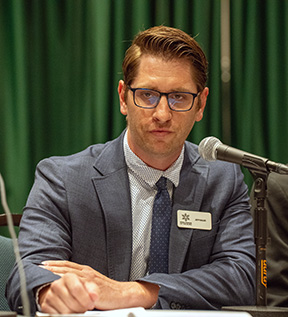 JEFF KALOC: Thank you, John. The Website and Software Application Accessibility Act, H.R. 5813 and S. 2984 was introduced in the House of Representatives by Congressman John Sarbanes from Maryland and in the Senate by Senator Tammy Duckworth from Illinois. Over the span of the 118th Congress, this bill gathered thirty-six cosponsors in the House and five in the Senate. This legislation is critical to making sure websites and apps are accessible by creating a statutory definition for accessibility, holding third-party vendors accountable, and providing Technical Assistance Centers to help businesses understand and comply with accessibility requirements.
The National Federation of the Blind will never stop fighting until all websites and apps are fully accessible to all blind Americans. [Applause]
High access technology prices have placed unrealistic burdens on those in search of employment. Many of these devices cost more than $4,000 per device, which is why the Access Technology Affordability Act is so imperative. The Access Technology Affordability Act, H.R. 3702 and S. 1467 was introduced in the House of Representatives by Congressman Mike Kelly from Pennsylvania and in the Senate by Senator Benjamin Cardin from Maryland. It currently has ninety-one cosponsors in the House and eighteen cosponsors in the Senate. Provisions in the bill will allow blind Americans purchasing access technology devices to utilize a $2,000 refundable tax credit. This bill will put more access technology in the hands of blind people, increase employment opportunities, and ensure independent living for blind Americans. The National Federation of the Blind will never stop working until this bill is signed into law. [Applause]
This is an election year, and ensuring voting is conducted both privately and independently is crucial to free and fair elections. Having accessible ballot marking devices or accessible remote options is critical to make certain that blind and low-vision voters can express their voice.
Thirty-four states plus the District of Columbia permit electronic ballot delivery, allowing blind and print-disabled Americans to mark their ballot accessibly and return their ballot. Thirteen states allow electronic ballot delivery and return, thereby allowing a blind or print-disabled voter to mark, cast, and verify their ballot from the comfort of their home. Those states are Colorado, Delaware, Hawaii, Indiana, Louisiana, Maine, Massachusetts, Nevada, North Carolina, North Dakota, Rhode Island, Utah, and West Virginia.
We have always understood that remote voting needs to be fully non-visually accessible. It didn’t take a pandemic and countless natural disasters for us to recognize the benefits. This process provides full accessibility as it does not require the voter to print and sign a hand-marked paper ballot.
While we have made great progress in the area of website accessibility, the ability to purchase access technology, and accessible voting, there is still work to be done.
None of this is possible if we do not organize, strategize, and mobilize to ensure that our voices are heard by those in power. And with that, now over to Justin. [Applause]
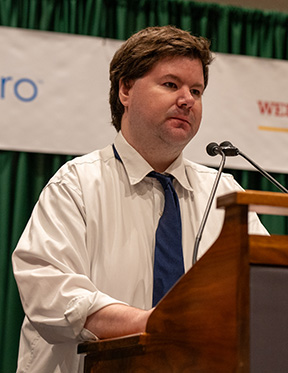 JUSTIN YOUNG: Thank you, Jeff. We continue to make great progress on the Medical Device Nonvisual Accessibility Act in the 118th Congress. In the House of Representatives, H.R. 1328 currently has eighty-four cosponsors, and some notable names include representatives Brian Fitzpatrick from Pennsylvania and Debbie Dingle from Michigan, who serve as the cochairs of the bipartisan Congressional Disability Caucus.
On January 18, 2024, the Medical Device Nonvisual Accessibility Act was introduced in the Senate as S. 3621 by Senators Maggie Hassan from New Hampshire and Mike Braun from Indiana. We need to keep up the effort to build more bipartisan support, ensuring these bills both in the House and the Senate one day soon will get passed. [Applause]
As it relates to accessible prescription labeling, in 2024, the governors of Virginia, Minnesota, and Colorado signed bills into law requiring the state board of pharmacies to begin the regulatory process. The states of Nevada, Oregon, and Tennessee have concluded the regulatory process and have fully implemented their bills on this topic.
It is anticipated the State of Washington's Board of Pharmacy will issue their rules by the end of this year.
Through our advocacy, we will make it possible for blind people to safely, effectively, and accessibly use medical devices and correctly identify our medication. [Applause]
We continue to approach the topic of ending subminimum wage with a two-pronged approach. At the federal level we continue to advocate for the passage of the Transformation to Competitive Integrated Employment Act, H.R. 1263 and S. 533. Currently, H.R. 1263 has thirty-three cosponsors, and S. 533 has three cosponsors.
During the week of May 20, 2024, the National Federation of the Blind and SourceAmerica, an organization dedicated to increasing employment for people with disabilities, sent a joint letter to the United States Congress urging further support for these bills.
At the state level, there are twenty-one states plus Washington, DC, and Puerto Rico that have either completely eliminated or reduced the payment of subminimum wages. [Applause] In 2024, the states of Kansas and Florida passed laws that we believe will reduce the numbers of people with disabilities being paid subminimum wages. It is time this discriminatory employment practice once and for all be eliminated. [Applause]
This year, the National Federation of the Blind strongly advocated for changes in the Federal Aviation Administration Reauthorization Act. These include better training for airline staff on how to interact with blind passengers, improving the ability to nonvisually access the in-flight entertainment features, and being able to fly with our guide dogs without having to provide documentation related to our guide dogs for every single flight.
The FAA Reauthorization Act instructs the United States Department of Transportation to create a Known Traveler Number system for service animal users, thereby eliminating the need for these burdensome forms. We deserve the right to fly with our canes and our guide dogs everywhere and anywhere we please without interference from airline staff. [Cheers and applause]
We will continue to advocate for accessible use of medical devices, accessible prescription drug labeling, the right to earn a fair wage, and the right to travel independently, ensuring we may live the lives we want, being productive members of society.
And with that, over to Jesse.
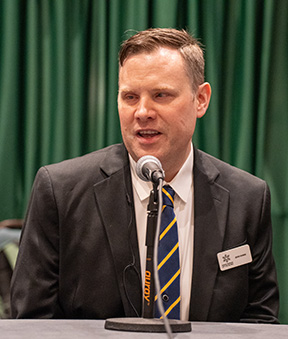 JESSE SHIREK: Thank you, Justin. On January 30, 2024, at the Washington Seminar Congressional Reception, Representative Pete Sessions from Texas made a promise. He pledged to introduce the Blind Americans Return to Work Act to Congress. And you know what—he’s kept that promise! [Applause] On June 28, 2024, H.R. 8878 was introduced by Congressman Sessions with lead cosponsor Kweisi Mfume from Maryland.
Now that we, an army of the Federation advocates have a bill number to fight for, we will change our collective future. In case you’re not aware of the problem, let me introduce you to David, a fellow Federationist from Wabasha, Minnesota. David’s journey reflects the struggles faced by many of us. Raised on a Texas cattle ranch, David later joined the Navy, ready to defend our country during the Iran hostage crisis. An honorable discharge led him to work in the Texas oil fields, where he soon learned to drive commercial trucks delivering construction materials.
But he didn’t know what his future had in store. A sudden accident left David blind. He didn’t give up. He received SSDI and acquired blindness skills training at BLIND Incorporated. His dedication led him to work at the Center, even volunteering during the Summer Buddies Program with blind youth.
Yet, the earnings cliff loomed over him. Earning more than $1,640 in 2009 would have cost him his entire benefits check, slicing his income in half. In 2017, David entered the Randolph-Sheppard Vending program, excited about his future in becoming a blind business owner. In 2020, the pandemic forced the closure of his vending stand, leaving him without income. He lost his house, and now, on the brink of retirement, he lives benefit check to benefit check. David’s story is not unique. Unfortunately, thousands of us face the same struggle. We are not mere numbers. We are human beings with our own lived experiences that deserve to be shared.
It is time we transform the earnings cliff into a true work incentive fostering financial security for all blind Americans. [Applause]
Unfortunately, the earnings cliff is not the only SSDI issue in need of a solution. I want to draw your attention to the We Can’t Wait Act, S. 4129 sponsored by Senator Debbie Stabenow from Michigan and lead cosponsor Susan Collins from Maine. Current law mandates that five months after the first full month after the beneficiary has been determined eligible for SSDI, they will receive their first benefit payment. This bill would give applicants the option not to wait and receive their benefit checks in exchange for a 6.1 percent reduction in total benefits. We believe the beneficiaries should have the choice to have financial security when it is needed most.
The Autonomous Vehicles Accessibility Act, H.R. 7126, sponsored by Congressman Greg Stanton of Arizona and lead cosponsor Brian Mast from Florida, protects the rights of all blind Americans. It ensures that eyesight is not a requirement to use fully autonomous vehicles. No driver’s license should be a barrier. We thought we won this battle long ago, but on February 9, 2024, we learned of H.B. 1447, a bill in the Maryland General Assembly threatened to strip away a fully autonomous vehicle technology by mandating a licensed driver behind the wheel of every autonomous vehicle in Maryland. Can you imagine in the backyard of the National Federation of the Blind, the home of our headquarters, our dreams were threatened. And how did we respond? We did not hesitate for one second. [Applause] We rallied our members and took action. Led by the fierce testimony of our own Federation affiliate President Ronza Othman, [Cheers and applause] we killed this bill in committee.
Now, let’s move together as we did in Maryland and fight for the Autonomous Vehicles Accessibility Act to ensure that we will always be in the driver's seat of our future.
Thank you. Back to you, John.
JOHN: Thank you Jeff, Justin, and Jesse. As you can see, we have a strong government affairs team with strong specialists in this area. I want to emphasize what President Riccobono said: our government affairs team consists of everybody in this room. It’s the big “we.” It’s we who are doing the collective action, that is making the progress over the past year, and we’re going to work even harder together as a team to do even more in the next twelve months, so we have more to report at our next convention.
So, for all of us, this is our report. Thank you, President Riccobono. [Cheers and applause]
PRESIDENT RICCOBONO: Let’s hear it for “We Belong!”