Reflections on and Appreciation for My Time as Editor
by Gary Wunder
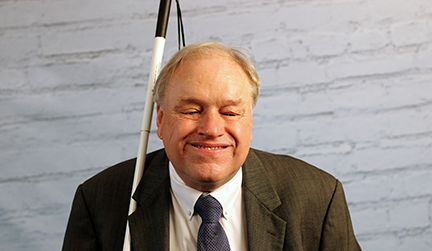 As you know from President Riccobono’s article, the Braille Monitor now has a new editor. Although I have loved this role, I am grateful for this transition and delighted to be a part of it.
Before becoming editor, I loved writing for the Braille Monitor. The articles were usually fun to do, but the real thrill was listening to them being professionally read by folks such as Will Schwatka and his predecessors. I knew that part of what made my articles sound so polished came from the editorial staff’s work, but my ego never allowed me to sit down and compare the draft I had sent and the material that got published under my name. There is much I likely would have learned and mistakes I might have avoided if I had been just a bit more humble and a bit less arrogant.
In May of 2010, while sitting at my desk at the Cerner Corporation on what I believe was a Thursday afternoon, I was pleased to take a call from then-President Marc Maurer. As a board member and an officer, I wasn’t surprised by an afternoon call, but the question he asked me took me completely by surprise. “Would you be interested in editing the Braille Monitor?” he inquired. Though I instantly knew the answer was yes, I also knew that respect for the opinion of my wife and tranquility at home demanded that I hedge just a bit. I asked him if I might have a day to think about it and he agreed. He said that he supposed I would like to continue to live in Columbia, Missouri, and when I answered yes, he said that he thought there would be no problem with me working remotely as long as I was willing to travel occasionally to the Jernigan Institute. I don’t think I’ve ever turned down the opportunity to go to the Jernigan Institute, so this was a no-brainer for me.
After talking with Debbie and accepting the job, I thought with some irritation about how often I had ignored instruction that would have been very helpful to me in the job I was about to assume. In my school days it was fashionable to say that students should be more concerned with getting their ideas down than in the formatting and grammatical construction that would make a respectable essay. Though I don’t think I verbalized it to anyone, I wasn’t quite sure I was up to the job of following Barbara Pierce, Kenneth Jernigan, Hazel tenBroek, Jacobus tenBroek, and Perry Sundquist. I figured all of them could diagram a sentence with one arm tied behind their back. The only thing that I had going for me was an ear for what sounded good, and I knew well that that ear was sometimes fallible. There was a time early in my Federation career when I refrained from writing important letters articulating Federation positions because I knew that I would not write them as well as Kenneth Jernigan. For me, he was the gold standard, and I didn’t want to do anything to tarnish the Federation’s name or the professional writing for which it has so long been known.
With a couple of seminars from Marc Maurer, a few tapes from Dr. Jernigan, and a couple of years of repeated help from Barbara Pierce, I came to think that I just might make it and that it was more important for me to worry about turning out the best issue that I could than to worry about contributing to the demise of a magazine I dearly loved.
I have been extremely fortunate to work with people who have trusted me without reservation. Never have I been asked to send articles for their approval before publishing. Never have I been criticized for an article that I chose to publish, even though I have been told that some of them have generated a bit of political heat. I have received plenty of critical feedback from readers, but by and large it has been constructive and helpful rather than personal and hurtful.
In my time as the editor, I wish we had had the kind of investigative reporting that used to thrill me when I read the magazine. Certainly I wrote a few such articles and saw that several got published, but more often than not I found that some of the material submitted to me for publication that pointed to scandal was either wrong or outright fraudulent. I think that investigative reporting should always be a part of what the Braille Monitor does, but I think it must be very clear when we publish something that we have researched it as well as we can. We have the ability to enrich or destroy careers, and this kind of power and trust comes with tremendous responsibility.
I want to thank Immediate-Past-President Maurer for trusting me to be our editor, President Riccobono for exhibiting the same level of trust, and Stephanie Cascone for believing in me and giving me enough additional work that I know I’m a part of the Communications Team but not so much to do that the Monitor ever had to take second place. Dan Frye was very helpful in the beginning for his encouragement and continues to give support and advice. I also wish to give special thanks to Debbie Wunder, who has listened to my occasional complaining when promised articles don’t materialize or when an article I’ve already edited is once again submitted a week later with changes that absolutely, positively must be incorporated.
I want to thank everyone who has contributed to this magazine through their articles and all of you who have been loyal readers, even when you have questioned some of my editorial decisions. There are several things in my life in which I would’ve written the script differently, but it has been a real joy to work with all of the people who have made this magazine what it is. I am not at all artistic, but Suzanne Schildwachter, our art director, is fantastic. Will Schwatka is a superb narrator, and it is when I hear him reading during audio proofing that I believe the issue being worked on is real. Our proofers have included Monica Blount, Marsha Dyer, Tony Cobb, Jesa Medders, Chris Parsons, Joe Miller, and our longest-serving proofer, Lorraine Rovig. Sometimes the mistakes they catch are as simple as a comma or a semicolon, and sometimes as important as their observation that “This makes no sense. What in the world was that editor thinking?”
No list of appreciation would be complete without acknowledging the work of Elyse Bryan. She looks at the format of each article we send her and actually builds the magazine from the list of articles we’ve prioritized. I also want to acknowledge the everlasting work of Grace Warn. She spent a lot of time helping me transcribe and doing the work of Elyse before she came on board.
Now to the future: I look forward to continuing to contribute and be of what help I can to Chris Danielsen. I think he is a tremendous choice, and although I’m happy to mentor him, I think he has a good grasp of what he needs to do as editor, a real understanding of this magazine’s past, and some clear ideas of where he’d like to see it move in the future. He has and will continue to have my unflagging support.
My hope is that I will branch out a bit and be involved in other things, but this I will negotiate with President Riccobono and anyone who might appreciate my help. I look forward to this change in my life and promise I will continue for as long as I can to further the efforts of this Federation we love and its flagship publication.