Leading Courageously in Art: Poetry, Sensibility, and Aesthetics of Sharing Our Unseen Stories
by Set Hernandez
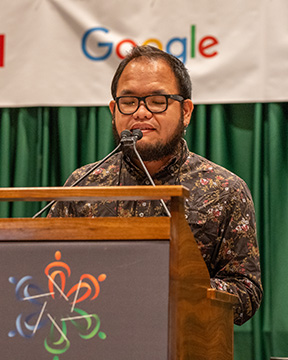 From the Editor: We talk a lot about STEM, but more recently about STEAM and for good reason. We want to be represented everywhere, and this includes the arts. The presentation you are about to read speaks not only to making a film about a person who is both blind and undocumented, but to the blessings one should rejoice in by virtue of being alive and sharing this world with friends and loved ones. This articulate presenter reaches both the head and the heart with logic, passion, and a call to observe and follow the Golden Rule.
On the final morning of our 2024 National Convention, we heard from a filmmaker and producer who served in both roles in the movie Unseen. Here is some of what President Riccobono said in introducing him:
We have with us an individual new to our community, first time on this stage, but who has already made an impact by telling the story of a blind person. Some of you may have had the opportunity to meet Set Hernandez during the screening of Unseen. Anybody make it? [Cheers]
Good. They're a filmmaker and community organizer. We like community organizers around here, right?
Bringing that experience to highlight communities of intersectionality, their film in particular documents the experience of a blind individual who is aspiring to be successful but faces various challenges because of their intersectionalities. The film Unseen debuted in 2023, and we were happy to bring it here to our national convention.
Now, when I asked Set to come to our stage, they said, "Well, don't you want the blind person?" Great point. But I suggested to Set that we love blind people, right? We believe in blind people, but we need to hear from the allies who get it right! [Cheers]
So here, I'm very pleased to say, is one of those allies who gets it right. If you haven't had a chance to see Unseen, I encourage you to do it and definitely to meet this individual as well as Pedro, who is with us at this convention. Here is Set Hernandez!
SET: Good morning, everyone. Hey! Yes! I am so privileged to be here with you all this morning. Of the many brilliant leaders and thinkers in this room today, I get to be so privileged as a sighted person to offer some remarks.
Thank you so much to President Riccobono, who literally this is my first time meeting him in person after so many emails. Thank you to John Berggren and of course to Ms. Beth Braun for opening the doors of the NFB convention for a person like me to speak. I have already made so many new, lifelong friends, like Gabe Cazares and Erick Galindo, and many people whose last names I didn't catch because we were all having too much fun these last few nights.
I was told, though, that's what convention is all about.
Thank you to brilliant leaders like Joe Strechay, whose artistry and uplifting narratives about the blindness experience has served as inspiration for the work I have been able to do. Thank you to my mentors, most of whom are Black and Brown—blind people of color—who have taught me so much not just about accessibility, but about life at large.
These include Raquel O'Neill, Thomas Ried, Day Al-Mohamed, Nefertiti Matos Olivares, Qudsiya Naqui, Amir Rahimi, Dr. Sachin Pavithran, and, of course, Dr. Conchita Hernández Legorretta whose championing of our film is probably the single most important reason I'm here today. So thank you to Conchita, who is actually enroute back to DC right now, and thank you so much to my dear friend Pedro for trusting me to amplify his story by capturing six years of his life through our film Unseen. I get to be so lucky to learn from you and to be called your friend.
For those that have yet to watch Unseen, our film, like President Riccobono has said, follows the story of Pedro as an aspiring social worker who happens to be a blind, undocumented immigrant. Considering the circumstances of his life, Pedro must confront the imposed political restriction he faces to get his college degree and support his family. As he graduates from college, however, Pedro realizes that attaining his goals does not resolve his challenges. If anything, uncertainty looms over him even more. What starts as Pedro's journey to provide mental health care for his community as a social worker ultimately transforms into Pedro's own path towards his own healing.
Life brought me and Pedro together, because like him, I too am an undocumented immigrant. Because of my immigration status in high school, it's not that I was not eligible to receive scholarships to go to college. I wasn't actually allowed to access the application portal to begin with because I did not have a Social Security number, even though I achieved every benchmark of success society told me to accomplish as a teenager.
But because my high school teachers, friends, and family believed in me, they fought tooth and nail for me to be able to live up to my potential. At a time when policies like DACA or the Dream Act did not exist, my educators in community did bake sales and yard sales to fundraise for my first quarter in college, dollar per dollar. They even brought me to the game show "The Price Is Right," which is ultimately how I got a $5,000 scholarship directly from the host, Drew Carey himself—Shout out to Drew Carey and to Cleveland, Ohio!
But when I finally graduated from college, accessing opportunities in the film industry presented a whole new set of barriers. Even though I had a work permit by this point through DACA, I was excluded from applying for grants to work on my projects like Unseen, which is why it took so many years for Pedro and me to finish our film. The irony is that, while these grant-making institutions excluded undocumented filmmakers like me to receive opportunities, they were actively funding filmmakers who are not even immigrants to make films about our community. Unfortunately, this experience is not unique to the undocumented immigrant filmmaking community.
When Pedro and I met in 2015, I was a coordinator for a fellowship program that provided professional development opportunities for undocumented young adults like both Pedro and myself. Even though I have been a community organizer since I was eighteen, Pedro was actually the first undocumented individual with a disability that I have ever met. It made me realize that the immigrant rights movement that I have been a part of did not just overlook the experience of disability, but even perpetuated ableist notions around worthiness. Whenever we advocated for a pathway to citizenship, our talking points argued that undocumented people have "earned" citizenship because we are hardworking, taxpaying, exceptional human beings. We were unwittingly saying we are only deserving of a dignified life because of how much we can produce for a capitalist society, regardless how many barriers that same society imposes on us to live up to our potential.
Getting to work with Pedro presented an opportunity to deconstruct these notions and maybe advocate for people who live at this overlooked intersection. [Applause] Because of my own background in grassroots organizing, I profoundly believed that the most impacted people in any project should always have agency over the decisions affecting them.
Since Unseen is about Pedro's life, from the very beginning I've always told Pedro that the only audience member I really ever care about was him. If ever we would finish this film and he finally watches it, my main goal was for Pedro to tell me, "Set, you understand who I am! This film is indeed about me." But Pedro wouldn't be able to say that if the film is not accessible, much less enjoyable. I don't want a sighted individual to watch the film and enjoy it more than Pedro. [Applause]
Considering that cinema is presumed to be a primarily visual medium, how can we create a movie that prioritizes blind and undocumented audiences at its center? How can we subvert the proverbial gaze and invite sighted viewers to not rely on visual information as much as listen to a film? How can we imagine what the equitable enjoyment of cinema could look like for people with different kinds of access needs?
It took some experimentation, of course, but from the very beginning, I filmed Pedro using unusual cinematographic techniques to create an out-of-focus aesthetic. There were times for example when I would film with a tilt shift lens or a camera lens that bends. There were times I would even film with no lenses at all. I would put tape over the aperture or the cavity in the body of the camera, poke a hole in the tape just so that flat shapes and colors could be captured. But because it's tape, there's no way to focus the image.
I wanted to create sound designs for our film that were so dynamic that there would be no need for audio description, or so I thought. As a non-blind person, I have come to realize that it's really not my place to tell blind audiences and blind artists how to reinvent the wheel of accessibility. Instead, I should humbly learn how to follow their lead. [Applause]
When I started requesting feedback on our film from blind collaborators, they told me straight up about the importance of including audio description and that my idea of a one-size-fits-all approach to accessibility might actually have the reverse effect and make our film less accessible, especially for blind audiences. I might share some of the same challenges with Pedro as a fellow undocumented immigrant, but I don't know what his experiences are around blindness. That's why it's so important for me to build a coalition of a diverse group of artists to bring our film to life. To my knowledge—and this is something I'm very proud of—our film is the first in the history of cinema to be led by an intersectional team comprised of undocumented blind and queer filmmakers of color who collectively reflect the sum of Pedro's lived experiences. From producing to accessibility to the social impact campaign of our film, the only reason we have been able to capture Pedro's story in a way that truly reflects his reality is because our team all knows what it's like to be in his shoes one way or another. The unfortunate reality, however, is that many films about blind people don't even have audio descriptions, which indicated to Pedro and me that these films cater more to sighted audiences than to blind people themselves. What that means, as you all probably know full well, is that we are left with either survival porn or inspiration porn for sighted audiences about a larger-than-life disabled person overcoming all odds to become a success story. If not, another trope is that too many films about blind individuals dwell too much on the biological technicalities of blindness, as if a person's vision loss is for the scientific amusement and curiosity of others.
Film protagonists who happen to be blind end up being defined solely by their blindness. It doesn't take into account their intersectional realities, whether they are an immigrant, a queer blind person, a trans blind person, Muslim, Black, a woman, or beyond. I argue that every scene in our film Unseen is not only shaped by the aesthetics of accessibility, but also by the aesthetics of intersectionality. With Unseen, Pedro is not portrayed solely as a person with vision loss or as an undocumented immigrant. He is indeed all of those things, and then some more at the same time.
Beyond the circumstances of Pedro's life, our film seeks to explore what it means to be a sentient human being who feels the gravity of life just through the lens of a blind undocumented individual. At the end of the day, our film is ultimately an invitation to reveal the most authentic version of ourselves to others.
But you know what? Why take my word for it? Here is a two-minute trailer of our film with open audio descriptions in English.
AD: A man walks with his guide dog. Almost everything in this trailer is blurry.
PEDRO: Keep going, Tyler.
SPEAKER: The bus is coming.
PEDRO: Okay.
SPEAKER: Just right around here.
AD: A halting bus fills the view.
SPEAKER: Oh, that's a dog.
PEDRO: Yes, it's a service animal.
SPEAKER: What kind of service does your dog do?
PEDRO: He's a guide dog.
SPEAKER: You're blind now?
PEDRO: Uh huh.
SPEAKER: Do you want me to describe myself to you?
PEDRO: Sure, why not?
SPEAKER: Oh, I’m so cute. Got a nice smile.
AD: A man in a dress shirt and sunglasses.
PEDRO NARRATING: After you have a disability, you’re going to have some type of impediment. With intersectionality between being undocumented and having a disability, it places a lot of stress and anxiety into you.
AD: Orientation and Mobility Training
PEDRO NARRATING: I decided to study social work. I wanted to help people. I wanted to give an opportunity for those who didn't have an opportunity. On our path there are going to be some obstacles.
PEDRO INSTRUCTING STUDENT: So I want you to go and swipe left and right, cover from shoulder to shoulder, just to see that you can find obstacles.
Here is an obstacle.
Hey, man! You're doing quite good.
AD: A man waits at a bus stop at night, colorful lights twinkling.
PEDRO NARRATING: I hate that narrative of like I'm a good immigrant, especially when it's like "He's blind, he's undocumented, he's going to college. He must be a saint."
AD: He leans down to bite into a birthday cake, a joyful dinner with friends, on one knee serenading his grandma.
PEDRO NARRATING: Yes, I'm here. I was able to make it this far, but how many people have to sacrifice for me to get a chance?
AD: The man is in focus. He glances toward the camera. This film is Unseen. For more info, visit unseen-film.com. [Applause]
SET: Thank you so much. Shameless plug for those who want to host a screening of our film, you can go to unseen-film.com.
Unexpectedly, the more specific and granular we became with our target audiences, the more universally the film has resonated with audiences. One of my most favorite audience responses to our film happened around this time last year at the Black Star Film Festival in Philadelphia. A nondisabled non-immigrant attendee approached me after our screening, telling me, "You know, Set, I came here hoping to learn about another person's experience. Instead, I learned more about myself."
I know President Riccobono invited me here to talk about my role as a sighted ally working in film to uplift the intersectional experience of blindness. This might be a controversial idea, okay, but I want to complicate what it means to be an ally. For me, being an ally implies that I have no stake in the lives of the community I am working with. It usually implies that I'm there to help. It implies that none of the systemic barriers Pedro experiences affects me. Instead, I want to uplift the framing of the aboriginal organizer, Lilla Watson, who said, "If you came here to save me, you are wasting your time, but if you came here because your liberation is tied to mine, then let us work together." [Applause]
Remember how I started my process of filming with Pedro, hoping to advocate for blind, undocumented individuals? Eventually, I realized that approach is actually paternalistic, with a tinge of saviorism. It assumed Pedro needed my help even though he never asked for my help to begin with.
By the end of six years working on our film, I realized that I actually ended up continuing to work with Pedro because we each contributed to each other's healing journey. Even though I am not blind, I am not Latina, and don't share Pedro's identities, we both shared the experiences of being immigrants navigating trauma, searching for a balm for the spirit. I ask then: Where do the boundaries of our community lie? At what point do my shared experiences with Pedro cease to exist, that I no longer belong to the same community as him? At what point do our differences allow us to create a new language to understand each other's humanity, becoming an entry point for each of us to be part of the same community?
There are many things that Pedro can do that I cannot do. One of them is ride a bike. I am now thirty-two years old, and I have yet to learn how to balance myself on a two-wheeled bicycle. When I was nine, my family and I used to live in Japan where riding a bike is the norm. Yes! Blue collar workers go to work on a bike while wearing their suit and tie. Kids as young as five or six get sent to the grocery store by their parents on bikes. One time in the fourth grade, my classmates and I were supposed to go to a field trip riding a bike. I was nervous, though, because I don't know how. Does that mean I won't get to participate in the field trip? What my classmates and their moms ended up doing, however, was that they walked with me from our meeting place to our destination. Instead of leaving me behind on their bikes, they made sure I was included in the activity. So we walked together. In other words, they met me where I was with my access needs.
To quote Dr. Cornell West, "Justice is what love looks like in public, just like tenderness is what love looks like in private." [Applause]
You know, it never crossed my mind that I wanted to make our film Unseen accessible for Pedro because I wanted to be a good ally to the blindness community. To be honest, I did it because Pedro is one of my dearest friends whom I love profoundly, the same way I love all of my friends and family. Just as my teachers and high school friends went the extra one thousand miles to help me go to college because they love me, I wanted to make Pedro feel that same care I have experienced from others.
I profoundly believe that a world run by love instead of productivity, ableism, and all the other isms inevitably becomes accessible too, because as Alice Wong and many other disability justice leaders have said, "Access is love."
If a low budget Indie production by a first-time filmmaker like me can find a way to center the sensibilities of blind audiences, I challenge every nondisabled filmmaker and production company to do the same. And if a team of undocumented and blind disabled filmmakers can bring a film like ours to life, I really encourage every emerging blind filmmaker here in the audience today to seek out mentors and collaborators to help you navigate your filmmaking journey, because we need you and your storytelling. Because when the world is more accessible and we center the leadership of those that have been historically pushed to the margins, all of us benefit, all of us win. [Applause]
I feel so moved and honored to be in this room and to be in this convention, because love is so very palpable. I want to give a shout out to the blind mentors who love their blind students and mentees so much, hoping that the next generation will be more empowered and equipped to not go through the same ableist barriers they faced. There are the parents and also the siblings who love their blind family members so much because they want their loved ones to live lush, fulfilling lives.
Everything that you all have done this past week is what it looks like when we turn love from an abstract experience into material reality. For the past few months, I have been telling people that I wake up every day feeling so blessed and grateful, not because of any material reason. I'm beyond blessed and grateful because I am surrounded by so much love. That love is what propels me to wake up every morning, empowering me to live up to my potential and be the best version of myself that I can be. The thing is that I didn't do anything to deserve that love. It just was given to me because I'm inherently—we are all inherently—worthy of love. I'm cognizant that not everyone gets to feel the love I wake up with every day. So my prayer is that, for each of you who gets to watch our film, especially our undocumented and blind audience, I hope you are reminded how inherently worthy you are of love. We do not need accolades or to meet some ableist benchmark of success to be treated with tenderness and care. I remind you that whatever you are going through is valid. You do not have to carry it alone. Whenever you are ready, I hope you can let yourself be vulnerable and be reminded that you are worthy of everything your heart desires. [Applause]
Thank you all so much for having me this morning. [Applause]