A Blind, Black Education Pioneer
by Peggy Chong
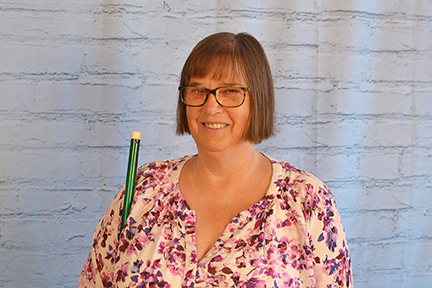 From the Associate Editor: Peggy Chong, also known as The Blind History Lady, continuously provides an invaluable service to our community by discovering and relating the stories of blind people about whom we may know little or nothing. For her research and writing, she has twice received the Federation’s Dr. Jacob Bolotin Award. To schedule her for a presentation to your business, church, or community group, email [email protected].
In this article, she tells of a blind man who made significant contributions to Black history, culture, and civil rights:
Dr. Herman Cleophus Hudson was born on February 16, 1923, into an educated, aspiring Black family in Birmingham, Alabama. His father Bertram, born in 1889, was a college graduate who had a good job as a bookkeeper in a Black-owned bank. Later, Bertram worked as a porter and then became a public-school teacher and principal. Herman’s grandfather, Burton Hudson, was born about 1850, most likely into slavery. He became a cashier at the bank where his son worked. Burton and his wife Hattie adopted several children. They had twelve of their own, but only seven survived to adulthood. Hattie, born in 1865, most likely was the child of parents born into slavery. Several of their children grew up to be educators.
In 1929, Herman’s parents separated, and his mother took him and four siblings to Detroit, where they lived with a great-uncle who worked in an automobile factory. The move turned out to be a major benefit to Herman’s education. Although his family always valued a good education, there had been no services for the blind available to Blacks in Birmingham. In Detroit, there was a sight-saving class that helped him access the educational system.
Herman attended Northwestern High School. Although the school was integrated, race relations there were not good. When rioting broke out, Herman went from class to class, hoping to instill tolerance among students. Already his leadership, determination, and sense of purpose were evident in his actions. Herman had the ability to see the bigger picture at a young age.
In 1940, he worked with students from other high schools to organize and host a youth rally at a local YMCA to discuss the problems of Black youth in Detroit. More than two hundred students attended. Panels focused on interracial clubs and education. They also discussed the need to understand their rich Black heritage to best eradicate the myth of racial inferiority that pervaded American society at that time. Herman felt that if Black youth learned of their rich heritage and accomplishments, more Black teens could shed their feelings of inferiority and achieve greater goals.
Herman served as captain of the Northwestern High School debate team. He was well known at the school as an orator and won first place in the 1939 Century of Progress Club annual oration contest. He went on to compete nationally in 1942.
Herman’s work to empower Black youth was not limited to his school. He attended meetings at the Antoine YMCA. He spoke to other Black and white teens about the issues affecting them at school and in the neighborhoods. He learned from others and gave suggestions on what teens could do about their concerns. Already his skills as an educator were showing.
As a teenager, Herman met Judge Ned Smith, a White blind man who became a mentor. They visited frequently, and Smith taught Herman how to use readers effectively to enhance his studies. Smith continued to help Herman when he entered the University of Michigan in 1941. Herman had no family or friends to help pay for his college, so Smith aided him in finding financial support. He took Herman to the many White service clubs he belonged to and convinced them to financially support Herman’s education.
In college, a club on campus offered nine women to read for Herman without charge. Herman knew from what Judge Smith had taught him about his own experience that if the women read for free, they would not take his studies seriously enough to show up every day. So, he paid them thirty cents an hour.
The two blind men corresponded during college. Judge Smith sent money to Herman when he fell short of the expenses for the University of Michigan and during his studies abroad at the National University of Mexico in the mid-1940s. Later, Herman wrote letters of support for Judge Smith’s campaigns.
Herman received his BA in 1945 and an MA in 1946 in Spanish, English, and history at the University of Michigan. On June 8, 1946, he married Catherine Pope, a nurse. They had three children: Karen, Brenda, and Margaret. After teaching Spanish at Florida A&M University beginning in 1948, the University of Puerto Rico in the early 1950s, and after receiving his PhD from his alma mater in 1961, he served as Director of the English Language Program at Kabul University in Afghanistan.
Herman modestly described his duties in Kabul: “It was a program of English as a second language that… by that time, the government had decided to make English the second language of the country. English was being taught in grades seven through twelve, and thirteen through sixteen at Kabul University, but the whole instructional apparatus was at a very primitive stage. There were very few textbooks and very few Afghans trained to teach English, so, the project that I headed for six years involved the writing of textbooks for all those grades, training Afghan teachers to teach English, and setting up English departments in various high schools in the capital of Kabul, and regional English language centers in the provinces. All of this was done with the assistance of a number of teachers from Columbia University and a number of Peace Corps volunteers.”
Traveling around the world was not only an education for him but for his children as well. Daughter Karen recalled her real education in life in Puerto Rico, followed by a short stint in Durham, North Carolina, during the Civil Rights Movement in the late 1950s. In Durham, she attended a segregated school and witnessed the sit-down strikes. She traveled extensively from Kabul with her family to Europe, Pakistan, India, Iran, Hong Kong, and a class trip to Russia (the then Soviet Union). Karen went on to receive her BA and MA at Indiana University and to become news director at WGPR TV Channel 62, the first Black-owned TV station in the United States.
In 1968, Herman became the first Black teaching staff member at Indiana University, where Karen would matriculate. He founded and chaired the institution’s Afro-American Studies department in 1970, the second such department in any United States university. The department was a response to protests by Black students on campus. Herman now had a greater opportunity to teach the history of Black people, which he had long believed was critical to improving his own life and that of others. The program explored Black culture, Black accomplishments, race relations, and the potential for the future. His department was the first to collect Black history, Black-authored books, artwork, and more.
Herman wrote several influential works that are still being used in university programs today. One article written in 1972, “The Black Studies Program: Strategy and Structure,” in The Journal of Negro Education, highlighted the concerns of the Black community regarding the restricted educational systems on campuses across the country. Black Americans attended colleges and universities, but the institutions did not provide curricula about or for African Americans. His presentation of the issues was factual, well thought out, and helped to improve race relations not only at Indiana University, but also in its hometown of Bloomington and across many other college campuses throughout America.
Herman and other professors also organized high school programs for Black youth. Some classes focused on academics, while others explored the arts or social justice. He served as vice chancellor and later as dean from 1970 until June of 1981 and from 1990 to 1993. In 1971, he began the Soul Revue, an all-Black music ensemble. The participants were recruited from the Black student body, not from the music department.
Herman created and expanded the department of African American Studies throughout his tenure. He created the first version of what is now the Neal-Marshall Black Culture Center, then known as Black House, located in a former fraternity house on campus. It focused on supporting the teaching, research, and service missions of the university, while also providing a positive and hospitable social environment for African American and African students, faculty, and staff.
In 1975, Herman played a crucial role in helping to form the National Council of Black Studies. Today, the council holds conventions annually and encourages papers on the African American experience.
But it was his mentoring and encouragement that stood out to those who remember him to this day. He recruited Black students and faculty not just for his department but for the entire university’s programs. He became a father figure to many of the students he followed during and after their years at the university.
His proudest accomplishment, according to a 2001 interview, was the creation of the Archives of African American Music and Culture in 1991. “Besides being a building, it is a symbolic structure indicating that Blacks are part of this institution, and a kind of home away from home for them to conduct both academic and social activities,” Herman said.
Today, the Hudson and Holland Scholars Program honors his achievements as a Black leader, mentor, and educator. It is the largest merit-based scholarship on the Indiana University campus. Symposia are named after him. When the department celebrated its fiftieth anniversary, Herman was credited for its founding, expansion, and creativity. It is still the only African American Studies program with a Creative Arts component.
Herman died on February 18, 2003, at his home in Michigan. Blindness did not stop Herman from achieving his aspirations and helping others to do so.