A New Editor's Introduction
by Chris Danielsen
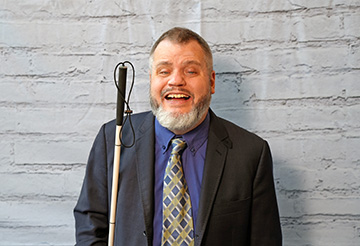 When I was a child, I became a voracious reader, after some initial hesitancy about “books with bumps” that weren’t like the glossy, smooth pages my older sister got to read. My mom kept after me to use Braille, and eventually there was a tipping point where I started reading at every waking moment that I wasn’t doing something else. This led to a desire to emulate the writers I was enjoying, and before long I was composing short stories and then light verse. (The latter was inspired by reading Shel Silverstein’s classic children’s poetry book Where the Sidewalk Ends in Braille.) By high school, I thought I wanted to be a writer. My parents were understandably concerned about whether I could make a living that way, and my dad urged me to focus on acquiring a marketable skill. I considered majoring in journalism but settled on political science and pursued a law degree; lawyers, after all, do a lot of writing. Six years of private practice, however, convinced me that lawyering was neither my particular talent nor my joy. Fortunately, as it had already done at some other pivotal moments in my life (more on that shortly), the National Federation of the Blind gave me an opportunity to apply my skills to our communication needs. For that, I am eternally grateful to two mentors: the late Donald C. Capps, then president of the National Federation of the Blind of South Carolina, who let Dr. Marc Maurer, then President of the national organization, know that I was looking for opportunities to leave my Myrtle Beach practice, and Dr. Maurer himself, who hired me. Twenty-one years later, I am embarking on an exciting new opportunity in our organization: editing its flagship publication. Over thirty years after considering a career in writing and journalism, here I am with a job that involves both. My late father used to joke about how my career in the Federation had proved him wrong about whether I could make a living as a writer, since my role before this one involved cranking out press releases, statements, and the like. I hope he knows that I’ve come full circle and is proud; I know my mom is. I thank them both for the love and encouragement that led me here, even though none of us knew the destination at the time. I also thank President Riccobono for selecting me for this important new role: the level of trust and confidence in me that he is showing is both humbling and gratifying.
Now for my history in our movement: I joined the National Federation of the Blind in 1989, just before my freshman year in college, because some other mentors at the South Carolina Commission for the Blind encouraged me to attend a state convention. I was part of a summer program at the Commission that was intended to provide blind teens with pre-employment transition services. There were classes during the week, and we stayed in the dormitories at the Commission’s Ellen Beach Mack Rehabilitation Center, usually heading home on the weekends. But I stayed in Columbia for the weekend and attended the convention. I had a wonderful time, and decided that getting involved with the organization would be cool. But although I was immediately recruited to be part of the Student Division, I didn’t live near a Federation chapter, so my involvement was limited, and the Federation wouldn’t become a bigger part of my life until a couple of years later.
In 1991, I was honored to become a finalist for a National Federation of the Blind Scholarship and, consequently, was invited to the national convention in New Orleans. That convention changed my life. I know that sounds like a cliché, but like most clichés, it has become one only because there is truth in it. National conventions have changed the lives of many blind people, and the 1991 convention certainly changed mine. Not only did I make new friends who are still friends today, and have a great time exploring the city of New Orleans and its various party spots, but I learned for the first time that I wasn’t the “amazing” blind person many folks had always told me I was. I met blind people who had achieved things I had never thought blind people could achieve. More importantly, however, I got my first inkling that my blindness skills were perhaps not commensurate with my beliefs and ambitions. Growing up, my parents had always encouraged me, and I had better access than many to the services blind children and youth need to succeed, including cane travel instruction. But at the convention, I found that with my short folding aluminum cane and less competence and confidence than other travelers, I could barely keep up, literally, with the blind mentors with whom I was assigned to spend each day; in fact, I usually became separated from them and had to find them again. After chasing one such mentor through the mall attached to our hotel, and finally arriving at the spot in the food court where we had agreed to have lunch, I sat down with the mentor, Melody Lindsey (now Melody Roane, director of the rehabilitation training program in Virginia and still a dear friend), and some colleagues of hers. Those included Joanne Wilson, Director of the Louisiana Center for the Blind, and the late Jerry Whittle, the center’s Braille instructor. It was Joanne who finally told me what I had needed to hear for many years: “Chris, you’re very smart and you’ve got plenty of guts, but you’re just not a very good cane traveler, and you have some other blindness skill deficits. I think you should consider coming to Louisiana.”
I told Joanne that I would indeed consider the comprehensive training available at the Louisiana Center for the Blind, and I may have even meant it at the time. But when I returned to school in the fall, it soon became the farthest thing from my mind. But then, something else happened that gave me a gut-check. In the spring of 1992, I was encouraged by my faculty advisor at Furman University to pursue an internship as part of my major in political science. There were several positions for which I could apply in Washington, DC, through a collaboration among Furman, American University, and several employers based in the nation’s capital. As I reviewed the application materials, however, I became alarmed. While the partner school would provide housing in one of its dormitories, I would be on my own for the summer, expected to do my own shopping, prepare or acquire my own meals, and arrange transportation to and from my internship location. I wasn’t at all sure I could do these things, despite reassurance from my advisor and from friends also considering the internship. “We’ll be there to help you,” some of these friends said. But I realized that if I had to depend on the help of others, the whole enterprise might not be very successful, and frankly the idea of trying to navigate the experience without help left me terrified.
Could I have managed the internship? I’ll never know; I didn’t apply. The very fact that I didn’t have enough confidence in myself to try told me something important. There was a gap between what I wanted to do and what I believed I could do, and I needed to bridge that gap for myself. So I gave up on pursuing an internship, and instead I called Joanne and told her that I wanted to start training at the Louisiana Center for the Blind as soon as possible.
I spent that summer, and the following fall, at LCB. The experience did improve my existing blindness skills and provided me with skills that I had not yet mastered, such as maintaining my own apartment, doing my own grocery shopping, and cooking my own meals. I became an accurate user of the slate and stylus, although still not an extremely fast one. But the most important thing I gained at LCB was confidence, specifically the belief that I could overcome any problem that blindness might present or appear to present. I’ll give just one example. Part of our training included certain activities that were unlikely to play any part in our daily lives as blind people, but which were intended to help us build confidence and learn how to solve problems. One such adventure involved traveling to New Mexico to join students of its own rehabilitation center for a rock-climbing expedition. On the first day of this adventure, we hiked up a long mountain trail to a plateau, from which arose several steep rock faces. Each of us were expected to attempt to climb at least one of these rock walls. On our first attempt, we would receive advice from the experienced rock-climbers who were leading the course, but as we tried more climbs, we would receive less and less of this “beta” (that’s mountain climber-ese for help.) Rock-climbing is, at least initially, daunting for most people, blind or not. On the other hand, it’s a great activity for many blind people. That’s because your success at rock-climbing depends on your ability to feel for crevices in the rock wall where your hands and feet can be positioned and leveraged to lift you higher. Sight is not required for success; only your sense of touch and your agility are needed. I was not, and am not now, the most physically fit person in the world, nor do I have the best balance. But I was able to make two successful, although short, climbs on our first day out, and I began to realize that if I could meet this challenge, I could meet others.
That afternoon was even more of a revelation. When we traveled down the long trail that we had climbed that morning to reach our plateau, I found myself between the group of climbers that had started down before mine and the one behind me. For a while, I was alone on the trail, parts of which were treacherous and most of which was bordered by sharp drops on either side. A wrong step could mean serious injury, or worse. But as in other situations during my training, I found that my white cane told me everything that I needed to know. Slowly, I navigated my way down to ground level, a little dirty but without even a scratch or a cut. I was exhilarated. I had just used my blindness skills to manage something much more challenging than crossing the average city street or locating an unfamiliar address. Pushing my blindness skills to the limit had given me more confidence in their everyday use.
Training is one of the many ways that we raise expectations in the National Federation of the Blind. Another is through the stories we tell each other and share with our allies in the blindness field and beyond. We share those stories in speeches, in conversations, and of course through this, our flagship magazine. I am excited to receive your stories and help you share them with our readership. Like my friend, mentor, and predecessor, Gary Wunder, I encourage you not to be intimidated by the prospect of writing an article for the Braille Monitor. Give writing your story a try, even if it’s just as a paragraph or two; we can always work together to make it something more. You can also reach out to me to set up a conversation from which we can help craft an article. And of course we want more than stories: tips on dealing with blindness, reviews of technology, observations about our collective work, and discussion and debate around our philosophy and how we apply it are most welcome as well. And if you’ve never seen an article quite like the one you’re thinking of writing in these pages before, you may just have a new idea that we’ll want to run with.
I want to close this brief introduction of myself as the tenth editor of this publication with two final thoughts. First, by coincidence, I am taking the helm at the start of a new presidential administration in our country. The incoming president, Donald J. Trump, who is entering his second nonconsecutive term, has promised nothing less than revolutionary change in government structure and policy. Many people, including in our community, are enthusiastic about the prospect of such change; many others are apprehensive. As a nonpartisan organization, we will seek opportunities to work with the new administration. As the nation’s transformative advocacy organization of blind people, we will simultaneously remain vigilant and call out the administration when we believe it is steering the wrong course for blind Americans. This magazine will, as it always has, speak the truth about what is happening to the best of our ability. Our President, Board of Directors, and National Convention determine how we will respond to new policies announced by our nation’s leaders, and we will share news of those decisions. We will also share civil but frank discussion when our community disagrees on the proper response, as indeed we will on other topics. Our commitment is to be fair but fearless, to amplify the Federation’s views while being open to candid discussion about them, and to use this forum to find a path forward when it is unclear.
My final thoughts come from one of my great loves besides books and the Federation—the movies. One of my favorite films is The Shawshank Redemption. If you are not familiar with it, be advised that mild spoilers follow. The movie tells the fictional story of a wrongly convicted prisoner, Andy Dufresne (played by Tim Robbins) and his ultimate triumph over this injustice. More importantly, however, the film focuses on Andy’s effect on the prison environment and other inmates, especially the story’s narrator, Ellis Boyd Redding, known as Red (played by Morgan Freeman). Andy resists being beaten down by the cruelty, corruption, and hopelessness that surround him. He maintains both a willingness to make positive change and hope for the future, attitudes which many of his fellow inmates eschew or even discourage and which the prison administration tries to crush. He fights his battle against soul-destroying despair with quiet determination and even cheerfulness, and he improves his surroundings in both material and spiritual ways. He thereby imparts hope to Red and to others.
This movie has always struck me, among other things, as a metaphor for our work in the National Federation of the Blind. I may take some personal privilege and expand on why in a future article. For now, I will just say that one of our critical functions is to give hope to others, particularly those who are new to vision loss and who struggle to see how their lives can move forward, as well as to blind people who have been beaten down by the vision industrial complex, the failures of our education system, or any number of other manifestations of society’s low expectations. Individually, many of us do what Andy does for Red in the movie; collectively, our movement brings the blind as a whole forward into a brighter future. Our flagship publication, as a purveyor of our message and a chronicle of our work up until now and going forward, is a critical piece of that work. I am committed to being a good steward of its longstanding role in our movement, even as I think about how it might evolve to better serve it. And I look forward to collaborating with you, the readers and contributors, in that effort.