Our Federation of the Blind and Physician-Assisted Suicide: When Shall We Speak, and What Strategy Shall We Use?
by Nathanael T. Wales
 This article addresses suicide. Suicidal thoughts or actions (even in very young children, older adults, and people with life-threatening illness/disability) are a manifestation of extreme distress and should not be ignored. If you or someone you know needs immediate help, call or text the National Suicide & Crisis Lifeline at 988.
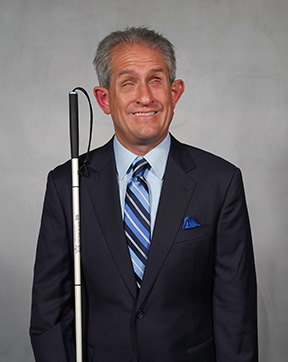
From the Editor: Nathanael T. Wales has been a member of the National Federation of the Blind since he was in high school, is a past scholarship winner, and currently serves as first vice president of the National Federation of the Blind of Connecticut. The article he has contributed expands upon the discussion of how the Federation should respond to the growing movement for the legalization of physician-assisted suicide, and specifically its potential expansion beyond cases where the person desiring such aid in dying does not have a terminal condition or illness. As both the author of the prior article he references and the editor of this publication, I welcome his contribution to this important conversation. Here is what Nathanael has to say:
I appreciated and enjoyed Chris Danielsen’s article “The Federation and Physician-Assisted Suicide” in the June 2024 Braille Monitor. I believe that his expression of what the National Federation of the Blind’s philosophical starting point on physician-assisted suicide as it affects the blind and deafblind is right, authentic, and true to who we have always been. My purpose in this article is to consider additional information that Chris’s article did not consider and then to ask when and how we advocate on this issue while continuing to keep rightly, authentically, and truly to our philosophy of blindness.
Chris’s article considers only laws in effect in the ten of our United States and the District of Columbia where physician-assisted suicide is legal. And as he reports, at present these laws only apply to patients rigorously determined to be terminally ill. He merely imagines that there may be potential evidence of broader eligibility for physician-assisted suicide, not just for terminal illness, in other countries. And he does not consider at least one attempt in one of the ten states where the practice is already legal to broaden its existing law to include others not yet terminally ill, although in fairness this attempt was made at around the time that his article was published and possibly after he had written it.
Multiple countries allow physician-assisted suicide not just for those who have a terminal condition but also for those having “a permanent, debilitating condition” (Austria) or a “grievous and irremediable condition” (Canada). This information can be found also on Wikipedia in the article at: https://en.wikipedia.org/wiki/Assisted_suicide and in articles linked to it (the one for Canada and the one for the United States that Chris cites, for example). Additional countries with these broader laws include The Netherlands and Switzerland.
Furthermore, early in 2024 the California legislature considered broadening eligibility for physician-assisted suicide to those with a “grievous and irremediable medical condition,” echoing the language used in Canada. Again, the timing of the bill may have overlapped Chris’s article submission, so it is possible the bill wasn’t introduced until after Chris wrote his article. The bill, SB 1196, was later withdrawn by its author, likely before our NFB of California affiliate could consider its position (if it would have wanted to). Consider the following reporting from Politico: “Sen. Susan Talamantes Eggman, who authored the original End of Life Options Act in 2016 [the current law that Chris’s article lists], came out against the most recent expansion, posting on X that, ‘While I have compassion for those desiring further change, pushing for too much too soon puts CA & the country at risk of losing the gains we have made for personal autonomy.’” (https://www.politico.com/news/2024/04/17/lawmaker-withdraws-california-bill-assisted-dying-00152840). Note that the senator does not oppose the idea of broadening physician-assisted suicide to others who are not terminally ill but rather has concerns about asking for too much too quickly.
We as the National Federation of the Blind must be just as strategic in this evolving aspect of our advocacy for the rights for the blind and deafblind. And we must be clear. And finally, if possible while keeping truly and authentically to our philosophy of blindness, we must speak in a way that brings members from various backgrounds, especially various faith traditions, together behind a unifying consensus. My own faith tradition opposes suicide without exception, including physician-assisted suicide, even to shorten or alleviate suffering. I recognize that many members of my Federation family may support physician-assisted suicide as a choice to alleviate suffering, but we can all agree that blindness and deafblindness are not inherently a reason for physician-assisted suicide. If we stick to the thing we all know best—blindness—our diverse movement can be unified and clear in our assertion that blindness and deafblindness are not a justification for physician-assisted suicide.
Assuming we agree on this philosophical position, the next question is: When shall we speak? Shall we wait to react to legislation when it is at risk of passing, such as some sort of a smaller step toward broadening eligibility in California? We should consider how important a priority opposing physician-assisted suicide with blindness and deafblindness as its justification should be among many other priorities, such as access to medical devices and pedestrian safety related to quiet large vehicles (we already have made great strides with the much more ubiquitous quiet cars and SUVs). I would personally favor clear advocacy opposing physician-assisted suicide on the grounds that blindness or deafblindness is “grievous” as pre-imminent among our priorities; the dignity of our very lives is the foundation upon which all of our other civil rights and calls for accessibility and equality are built.
Additionally, there are those who oppose physician-assisted suicide more broadly who argue that it is harmful to people with disabilities. They themselves are not disabled. Shall we let them speak for us? I do not think so, even as I agree with the argument they make. Would it not be better for us to have a clearly articulated policy or statement?
As for strategy, should we consider an improved Federation resolution? I trust Chris Danielsen, Anil Lewis, and our other leaders to speak clearly and focus on the thing we all know best: blindness and deafblindness (not, indeed, my church’s theology on physician-assisted suicide). Even before a resolution, I know they will advocate for us and represent us rightly and truly. Chris’s article laid out a position that I’d be happy for him to share with any media outlet that approaches him.
I offer my fellow readers one final piece of information, and perhaps an approach, to consider. Our Federation family members in Canada, through the Canadian Federation of the Blind, which proudly advertises “US National” events such as our national conventions and some of whose members you will likely find seated in the international section on our convention floor, have articulated a position in response to broader access to physician-assisted suicide in their country. (Note again that the language of Canadian law was echoed in the bill proposed in California.) Their position is prominent on their web homepage https://www.cfb.ca. As a technical matter, the term for physician-assisted suicide Canadians use is “medical aid in dying.” Here is their position statement:
This position seems right, authentic, and true to our philosophy here in the US. And it is consistent with all of the thoughts of our leaders including Chris and Anil.CFB’s Position Statement on Medical Assistance in Dying (MAID), Regarding the Blind:
The Canadian Federation of the Blind deplores any attempts by those responsible for decision-making in the Medical Assistance in Dying (MAID) program to consider impending blindness as a potential reason to end a life. In the case of blind individuals, employing MAID is a stark example of the common, and tragic, misunderstanding of blindness and its consequences. Adjustment to blindness is difficult, and blind people face their own particular challenges, but it is well known that these challenges can be met, and the technology and services available today have vastly improved prospects for the blind. That someone facing blindness might want to die is tragic; that the state might sanction and aid the suicide of blind people is a total betrayal of trust and decency. The Canadian Federation of the Blind invites any blind person or their supporters to connect through our email group or our contact form and we will be here to support. We also stand willing to actively oppose this program and its devastating ramifications for the blind.