Breaking Barriers: My Journey as a Blind Juror
by Marilyn Green
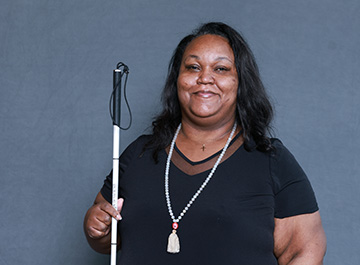 From the Editor: Being selected to serve as a juror has been difficult for blind people because of the assumption that critical evidence will be visual and that we have no alternative ways to get needed information on which to make judgments. In this case we had a willing judge, as well as a prosecutor and defense team that did not use their challenge to remove Marilyn. This is yet another step in our ongoing attempt to be fully integrated with sighted society, to show that judgment comes not from the eyes but the brain, and the desire to serve burns in all of us unless it is smothered by denials and low expectations we as blind people adopt as our own.
Marilyn is a member of the National Federation of the Blind Board of Directors and the state president of the National Federation of the Blind of Illinois. In this article, she recounts her excitement in the challenge of serving on a jury, her concern that she might be denied, and the appreciation that comes when one encounters people really willing to make accommodations that can make the most of citizens wishing to serve. Here is what she says:
I recently had the honor of serving as a juror in a narcotics and firearms case, marking a significant milestone for blind people in Illinois. Though I have received a jury summons or two in the past, I had declined to participate, knowing how many people are turned down for service. I checked the box saying it would be an undue hardship, and never was I challenged. But when I received a summons just prior to our state convention, I had second thoughts. As the state president of the Illinois affiliate and a member of our national board, I felt it might be a profound moment for our community—a step forward in our journey toward full inclusion in civic life. So after a full weekend of convention, I got up Monday morning prepared for the challenge of service but knowing how often the goodwill of people like myself had been rewarded with “No thank you.”
Ready to be of Service
My journey began with the jury selection process, which was, unsurprisingly, the first hurdle. You will not be surprised to learn that there was the issue of an inaccessible kiosk, and I needed human intervention. It’s when they called my name and I got in line with no one saying anything that I saw this as an encouraging sign but knew there would still be several hurdles to come.
As perspective jurors, we were told to start by reading page 2 of the form we were handed, and, with my cane visible, I wondered how they thought all of this was going to work. No accommodations were offered, and soon we were told that if we were finished with page 2, we should go on and finish filling out the form. The person I had talked with as I navigated the kiosk and the line said that he would talk with the judge about helping me complete the form. It was a long fifteen minutes before the deputy came back and said one of the law clerks would assist me by being my reader and scribe. Together, we completed the form, addressing questions about my background and eligibility. Though this accommodation was met with patience and goodwill, it was clear the process wasn’t initially prepared for a blind juror.
Moving to the Jury Room
Once in the courtroom, the potential pool was asked whether there are hardships that would keep them from serving. Among the hardships described were blindness and the inability to hear. I did not signal that I wished to be dismissed because of hardship. The judge asked me directly whether my blindness would present an obstacle. I explained that, with accessible information, I could perform my role as well as any sighted person. When asked if I would be able to follow video evidence, I suggested that the court would need to provide verbal descriptions to ensure I had equal access to the content. “The burden will be upon the court to make sure I can understand what’s happening, just as any sighted person would,” I explained. I wanted the court to see that judgment comes from intellect and understanding, not eyesight.
Questions from the Prosecution and the Defense
Like other potential jurors, I was asked about my education and career. I noted that I had worked for the city of Chicago and that I had a friend who worked in the public defender’s office but that we never really had an in-depth discussion about any of the cases. As the selection process continued, I sensed that I might actually be chosen. Sure enough, I was called back into the courtroom and sworn in—a milestone moment for me, and perhaps for some of the others who would make up this fourteen-person jury.
Necessary Accommodations
The initial relief and joy I felt soon gave way to the realization that my service would involve further negotiation for essential accommodations. Recognizing that standard juror notes were taken on paper, I requested permission to use my laptop, equipped with screen-reading technology, for my notetaking. After consulting with counsel, the judge approved my request on the condition that my laptop, like all other jurors’ notebooks, would remain in the court for security. A concern was raised about the fact that I would be using earbuds and that they might interfere with my ability to hear evidence. I noted that I only used one earbud and would have no difficulty in listening to the proceedings. The use of the laptop and the earbud were accepted as reasonable accommodations. This arrangement, reached through mutual respect, allowed me to participate fully and independently.
Listening to and Weighing Evidence: The Trial Begins
Once the trial began, I found myself navigating both familiar and new challenges. Evidence was often presented visually, and while the judge was open and willing to make it accessible, some witnesses were less prepared to provide verbal descriptions. In one instance, a witness described a photograph of bullets simply by saying, “It’s bullets. I took pictures of them.” At the judge’s prompting, the witness described the arrangement and quantity in more detail, offering a clearer picture for all jurors. These moments showed me that while the courtroom’s willingness to adapt was encouraging, there’s a need for better training on how to communicate effectively with blind jurors. With all due respect to the defense and the prosecution, the judge was the best person in the courtroom to make sure that I received a good explanation of videos and other visual evidence. When one juror was describing the evidence that had been bagged, they kept saying “right here” and the judge would say “top right corner.”
The Time for Deliberation Arrives
In the jury room, the experience deepened my understanding of how our legal system, while willing to be flexible, is still navigating how best to accommodate us. My laptop allowed me to take notes, but at times I felt that more preparation could have made the experience seamless. Document preparation in advance would have helped immensely, eliminating the obligation for other jurors to read to me and sometimes to repeat the process if I had questions about what had been read.
Work to do after the Trial
The judge made himself available to members of the jury after the trial, and I took that opportunity to thank him for not summarily dismissing me. He credited the prosecution and the defense for not using their peremptory challenges, and I respectfully countered that his attitude was significant in setting the tone for their consideration. Not surprisingly, some of our discussion focused on accommodations. I suggested to the judge that having accessible digital versions of documents such as jury instructions would allow blind jurors to review the material on their own without depending on others. I expressed how important it is to fully understand everything we’re deliberating, especially when it could mean years of a person’s life. The judge readily concurred. I further suggested that having a protocol ready when a juror with a disability is selected would help ensure that everyone knows what to do, saving time and enhancing the experience.
I was so taken with the judge that I invited him to next year’s state convention. I explained that his presence might do a lot for the morale of blind people who have too often been dismissed, and he agreed that, if his schedule allowed, he would be delighted to come. In a previous article about me, I opined that I had all the joy that comes with advising young children but none of the responsibilities. But I have to tell you that I was so impressed with the openness, intelligence, and compassion of this judge, that I would be glad to marry him and have little judge babies who might inherit from him the commitment to fairness, openness, and seeing that all could participate in the justice system.
Marching Toward Equality One Step at a Time
Serving on this jury taught me how critical it is for blind people to be seen as full participants in society. We are capable of understanding evidence, deliberating carefully, and making informed judgments. My experience was empowering, but it also reinforced the need for systems to evolve and better accommodate people with disabilities. Blindness is not the characteristic that defines us or limits our abilities; it is simply a trait that requires some adjustments.
Ultimately, this experience wasn’t just about me but about all blind people. It was about the larger message that judgment and civic duty come from our brains, our minds, and our hearts, not our eyes. My hope is that sharing this story will encourage future courts to make necessary accommodations and consider blind people as fully capable jurors. It is also that more of us will accept the challenge and not take the easy out of saying that we are blind and should not be asked to serve. With openness, collaboration, and a commitment to accessibility, our society can continue moving toward true inclusion, and you can bet that the National Federation of the Blind will be the motivating force that sees that it does.