Always Partisan for Blind People: A Podcast Discussion with President Riccobono
From the Editor: The following is a lightly edited transcript of excerpts from a recent episode of the Nation’s Blind Podcast, which is one of two podcasts produced by the Federation at the national level. (The other is Access On, which is hosted by Jonathan Mosen and is dedicated to access technology and our work in that area.) Melissa Riccobono and Anil Lewis are the usual co-hosts, but Anil was unavailable to record this episode, so I stepped in for him. I am including this content here, however, not because I participated in its creation but because President Riccobono did. He provided critical insights into recent actions that we have taken that some have perceived as politically partisan. I felt that these insights were important to share with Monitor readers and that the content paired well with Gary Wunder’s piece also appearing in this issue. I do urge those who can, to listen to the entire podcast. The full transcript is also available on the podcast’s page on our website. If you’ve never listened to the show before and like the episode, please do subscribe to this podcast and to Access On as well. You can find them both on the National Federation of the Blind website or by using the search function of your podcast client of choice. Here is the excerpted conversation:
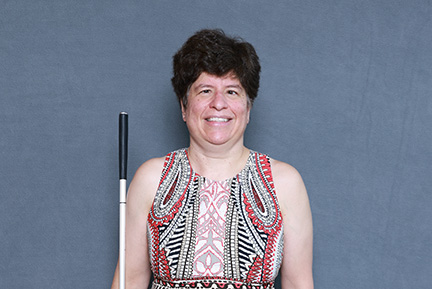 Melissa Riccobono: Hello and welcome to the Nation’s Blind Podcast. I’m Melissa Riccobono, and I am joined today by a gentleman that we haven’t heard from in a little while, but he is not a stranger to the podcast. Here is Chris Danielsen. How are you, Chris?
Chris Danielsen: I’m doing great. It’s great to be back on the podcast. I’ve shifted roles and I’m primarily working on the Braille Monitor now, of course, but it’s fun to have a chance to come back on the podcast, so it’s great to be here and great to talk with you, Melissa. How are you?
Melissa Riccobono: I’m doing well. I’m actually traveling in Wisconsin, so I have been enjoying time with my family and I got a chance this morning to be with my great niece for a little while, so that was very fun. She just turned a year old, so family time is wonderful, but we’re not here to talk about family time, although incidentally we do have a family member of mine on the podcast, so that actually worked out really well. Not only are we joined by Chris Danielsen, but we are also joined by the President of the National Federation of the Blind, Mark Riccobono. I am going to just let him have the floor so that he can begin the discussion and sort of frame what we’d like to share with you today.
President Riccobono: Well, I appreciate that. In a time like this where there is, I would say, a lot of political discourse happening, we have a challenge as the National Federation of the Blind because we are America’s civil rights membership organization of blind people, and people expect us to speak out on issues related to programs and services that impact blind people. Our membership is a very diverse cross section of blind people who come from all perspectives on almost any issue you can think of, and it’s difficult in any environment to advocate for something because generally someone else wants to make it about something that it’s not. So a lot of times when we speak out as the blind of America on an issue, there’s someone else who wants to make it about something else. And for us it’s always about blind people. I like to say we’re always partisan for blind people. We’re not particularly interested in whether an issue is a conservative issue or liberal issue. For us, it’s does the policy being considered, does the issue being considered have a direct impact on blind people? And if so, what should it be? So that’s the framing for why we’re here today to talk about that because especially in today’s general political environment, I would say a lot of people tend to make any kind of public statement a political statement, either for or against somebody, and we wanted the opportunity to talk about the work that we do as a diverse organization and how it is always driven by and intended to benefit blind people.
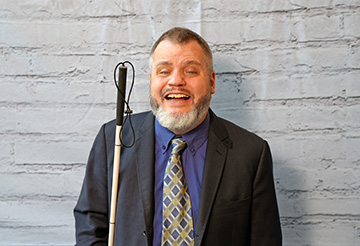 Chris Danielsen: Yeah, I think that’s a really good framing. And it is difficult, right? Because people want to read into any action that any organization takes, it seems like they want to read into it, “Oh, well, you’re here or there on the political spectrum,” and it’s not really about that for us. Now, obviously it may seem like that because we may be responding to a particular thing that a particular political entity has done or failed to do, but the reality is we’re just concerned about the policy implications for blind people. So, let’s just dive right into it and let’s just talk, for example, about how we have responded and why we have responded to the, I guess what I’ll call it is the debate about the future of the United States Department of Education.
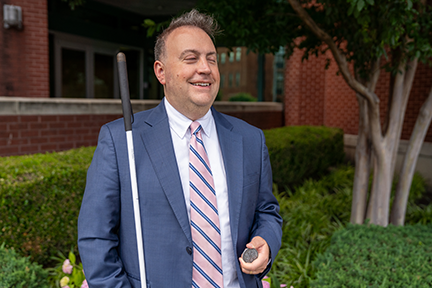 President Riccobono: Yeah, that’s a great place to start, Chris. And what I would say is, just to put a fine point on what you said, it’s not as simple as saying we’re not a partisan organization; we don’t get into party politics in America. It has to be a conscious choice on our part, and it has to mean that as elected leaders in the organized blind movement, we have to listen to what the members of the Federation are saying, talking about, dealing with, and then also make very conscious decisions about not just the policy, but the actions to be taken. And we can talk a lot about historical examples of that. So I don’t want to make it sound like it’s easy to not get dragged into some things. As everyday Americans who happen to be blind, we have opinions about many things. But as elected leaders of the organized blind movement, we have a very specific responsibility to the organization and to its members to make sure that our actions are always partisan for blind people and don’t get dragged into what sometimes becomes political argument for the sake of that. So elimination of the Department of Education is an interesting one because the fact of the matter is there are a lot of important programs that impact blind people that are currently housed at the Department of Education. So for historical context, of course, there was a time when very important programs for blind people were not housed at the Department of Education because it didn’t exist. And our concern is those programs, and in fact, we came to our Washington Seminar in February—our annual time of bringing our members together to do advocacy work in DC—and we already knew that elimination of the Department of Education was going to be a topic in Washington, DC. And so we at a leadership level talked about, well, what is the Federation’s position on the Department of Education? Well, organizationally, we don’t have a policy. We don’t really care how government decides to organize itself. At least so far, the convention’s never taken an opinion on that. But we do care about the programs. And so we identified the key programs within the Department of Education and have said to Congress and to the administration that those programs need to be protected. And furthermore, we’d like to have a voice, a say in what the plan is, where those programs land, what they look like, how they could be better, because we always want to have the blind at the table in having a say like that. So I know that one of the areas that we have been vocal about is that one of the first steps was to dramatically reduce the Office of Civil Rights at the Department of Education. We don’t have a particular opinion about how many offices there should be and how many people there should be employed. But we do know that with respect to violations of federal law as it relates to blind people that are enforced by the Office of Civil Rights at the Department of Education, that enforcement is already dramatically slowed, dramatically underfunded, and to eliminate those offices will further erode our ability to help blind students in higher education settings to get their concerns heard when their universities implement an inaccessible learning management system. And so we’ve spoken out quite vigorously that we’re very concerned about it. Now, maybe there’s a better plan out there, and we will praise that plan if it gets implemented. But since we don’t have any idea what the plan is or where it’s going, all we can say as blind people is that we are very concerned about what happens to the enforcement of our rights.
Melissa Riccobono: Absolutely. And very similar for Social Security, right? Do you want to talk a little bit about the lawsuit that was just filed?
President Riccobono: To begin, let me remind us that one of the principal motivating factors for the development of the National Federation of the Blind, bringing together blind people from various states, was having a voice in the national Social Security program, which was of course developed in the 1930s. And we came together in 1940, and Social Security—making sure that blind people and our interests were represented and that those programs really created opportunity for us—was a very important part of our organizing. So we’ve been giving opinions on what Social Security and the agency should do since 1940. We also know that a lot of blind people have difficulty with the Social Security rules. The Social Security Administration often gets the rules wrong. There are very specific rules related to blind people, for example, receiving Social Security Disability Income, and a lot of times the wrong rules are provided. So the customer service element is really important. Also, we’ve worked closely on making sure to eliminate barriers in Social Security, whether it is making sure blind people can get accessible documents, whether it’s your statement of your benefits or that sort of thing. And then more recently we’ve worked to eliminate barriers, especially during the pandemic where the only option for applying for benefits was actually giving a physical—what they call a wet ink—signature, and then taking your document and dropping it in the mail. And during the pandemic, that was a disparity for blind people and other people with disabilities. We worked to get really good changes at Social Security for verification of identity and electronic signatures. And all of these things lead up to now, where the current effort is to reduce the customer service function at the Social Security Administration. And we already know this is going to have an impact on blind people because blind people were having trouble before the reductions in staff. And we know that the closure of offices is a problem for blind people because we face transportation difficulties and disparities already. And so we looked hard at what to do about that, and we decided to join in this case with other organizations who have an interest in this issue, other disability organizations and also organizations that deal primarily with senior citizens, because these really are the populations of people who are going to be harmed by these reductions. And so we joined together and we thought carefully about the right approach, but the changes were so dramatic and so fast, and we were already hearing from blind people who, I mean, we have people who have been waiting for a year or more to hear about their application for Social Security Disability Income. So these are blind people who have been in the workforce, they’ve paid into the workforce, they’re now in a situation for whatever reason, they’re clearly eligible for Social Security Disability Income, and they’ve been waiting a year. And that is the exact kind of barrier that we’re concerned about. In this case, we felt it was necessary to bring a case because swift action is needed. We don’t have time for the standard advocacy work. In fact, we don’t even have a disability point of contact at the White House at the moment, which we’ve had in almost every administration going back many decades now. So we felt that a lawsuit was needed, and fortunately, we’re already seeing—and it’s not just because of our work, there’s a lot of activity around Social Security around the country, but I think our lawsuit helps—we’re seeing now the Social Security Administration saying they’re walking back some of those cuts, and we’re going to hold their feet to the fire and make sure that really happens.
Chris Danielsen: Yeah, I think that’s really important. And again, it’s because of the impact that Social Security has on blind people, and Social Security has always been frustrating, at least in my experience. But we don’t need it to become even more frustrating and even less responsive. And another issue where we’ve weighed in—and we talked about it at Washington Seminar and we are engaging about it—is library services. And again, to me, that issue is not about the structure of the government, because we talked at Washington Seminar about the Institute for Museum and Library Services [IMLS], but that as an agency as such hasn’t always existed—it was created in 1996—but there is federal involvement in the provision of library services to blind people and to others as a matter of fact. And we’re seeing, in the wake of the effort to close the Institute for Museum and Library Services, we’re seeing reports of libraries that are having to cut back staff and are having to shut down particular programs. And they’re not all libraries for the blind, but some of them are. So again, this is an issue where we needed to weigh in because whatever the structure is behind it, we have to have the library services. And I believe in that case, what we did was we reached out to the appropriators and basically said, how are you planning to make sure that the funds are appropriated so that library services continue?
President Riccobono: So one of the things, and I think this came up in some of the Facebook comments with listeners, and I think we’re going to get to some of those, is a concern that, well, maybe the Federation’s not telling the whole story. So let’s make sure that everybody who’s listening really understands that the National Library Service for the Blind—which is actually part of the Library of Congress, so it’s under the jurisdiction of Congress—is the library entity that helps to produce Braille and audio books in an accessible format. It’s not a library, in that it doesn’t lend books to anybody. The National Library Service provides those materials at no charge to state libraries, or they’re often called regional libraries. And so in Maryland, we have the Maryland Library for the Blind and Physically Disabled. Those entities exist in states to the extent that the state has, through its government processes, developed a library for the blind. There are states, take Wyoming for example, which does not have a library for the blind and has contracted out its library services to the Utah Library for the Blind. So Utah, thankfully, provides library services to blind people in Wyoming. In many of these states, blind people have advocated for state funding for the library, which is wonderful. In a lot of states, there’s a lot of competing interests for library services. And so in some places, Minnesota I believe is one, a hundred percent of the funding for the Minnesota Library for the Blind comes from the federal dollars that flow from IMLS. And so in some states, the impact might only be partial, maybe not at all, because the state’s really fully funding the library for the blind. But in a state like Minnesota, it’s a hundred percent. And the issue becomes, it’s not like a blind person has the option to just go down to the local library and get their Braille books and get accessible formats, because most public libraries don’t offer that. We’d love it if every library did. So we’re in a difficult position.
We may or may not have an opinion about IMLS, how it operates, but those dollars and the elimination of those dollars without a plan are going to have real impact on blind people’s ability to get information, books, resources. Think about if you’re a blind student in one of these states and you need books from the library for the blind for your schooling, an immediate shutdown is going to have really dramatic impacts. So you’re right, Chris, in that case, we wrote directly to the appropriations committees. Of course, they’re responsible for that anyway. The Federation, we don’t care in one sense, if those dollars go directly to the states as some sort of block grant program or whether they flow through an agency. But right now, those states and those libraries are left not knowing what’s going to happen. And that means blind people don’t know where they’re going to get their books.
Chris Danielsen: Exactly. And it’s important to remember that really is the case, because some listeners might be thinking, “Well, yeah, but the NLS has BARD and you can download the Braille and audiobooks,” and that is true. And in that case, you are getting them directly from NLS. But the fact is that depending on the technology that you have available to you and the ability that you have with it, or just the other factors, BARD may not be a resource. And not everything is on BARD. I mean, some libraries—some state agencies that deal with blindness and sometimes they are libraries—are also doing things like helping to provide school materials, as you said, that aren’t necessarily going to be up on the BARD site, as I understand it. So there’s lots of pieces to this, and because we’re an organization that advances the lives of all blind people, we can’t have blind people left behind. So we can’t just say, “Well, the NLS is chugging along and it’s run by the Library of Congress and BARD is still up, so we’re not going to worry about it.” We’re not in a position where we can say that.
President Riccobono: But as an organization, of course, we should think about, well, what kind of access do we want blind people to have, and what do we want to advocate for? Is the system we have through NLS the best one we could have? Do we want something different? And what are the trade-offs for that? And I think the beauty of the National Library Service System—and of course as blind people, as the organized blind movement—we have significantly shaped it over the last fifty-plus years, including the fact that when there are hearings about appropriations for the National Library Service, we testify. And sometimes we bring many people to those hearings, and often the committee staff say, “Oh, we never see citizens come in interested in this particular appropriation.” But the point being, we don’t have to settle for what we have today. We should always be thinking about is there a better system that benefits blind people? And for that matter, we’re for saving America money too. We don’t want to be a burden, but we also believe that we contribute to America in a better way when we have equal access. And knowing that we don’t have equal access, something like the National Library Service is an amazing way to bring that to scale, and it’s actually more efficient for the country overall. So really just wanted to make the point, we can always change our mind about what the system should be, and that’s what we should do as an organization.
Melissa Riccobono: That’s a really good point. I was just going to say really quickly that BARD, you don’t usually get your BARD account unless your state library can verify that you are a member, and they often have to be the ones to reset your password if you forget it, and all sorts of things. So even if NLS is chugging along, people that want a new account or people that need help with their account might have a lot of problems even with BARD chugging along. So that’s definitely a problem. And I guess the other thing is you were talking about people thinking that maybe we’re not telling the whole story. I just want to point out that NFB-NEWSLINE® is a way to get lots of different sources for news, different perspectives, different editorials. We have access to over 500 publications on NFB NEWSLINE. So that’s a really, really great resource at any time to read local, national, international news and then figure out the whole story, as much as you can piece it together, and do that research and not just rely on one source or social media to get news stories. So I think that’s really important.
Chris Danielsen: It is really important. And I think another thing that is important, and this goes back to President Riccobono’s point, is that we do listen to our members. And so as we inform ourselves, all of us, about what is going on, we do and should exchange ideas about, well, is this the best system, and what do we want ultimately in this environment of change? It can seem like there are not, but maybe there are opportunities to increase efficiency and to make sure that services are delivered in a better way to us. But we’re the ones who need to be engaged and talking about that because as we always say, we are the nation’s blind. We are the people that have the lived experience and the expertise to design these things. So really being engaged is not optional. And we can express concern that things are not being done or that we don’t know how they’re being done and what the plan for them is. But we can also say, here’s an opportunity to build an even better system and a system that uses our nation’s resources wisely, but also benefits blind people and gets more of us into the mainstream of society.
Melissa Riccobono: It reminds me a lot of the Help America Vote Act that happened because the 2000 election had difficulties, and we knew that election reform and ballot reform were going to be on the table. And so we as the nation’s blind jumped in and said, when you’re talking about this, don’t forget about the blind. We need a secret ballot just like everybody else. We deserve that right as citizens. And so I think that just over and over, this has really been what has helped us to make things better for blind people over all the years that we’ve been here, really taking advantages of those opportunities.
Chris Danielsen: You’re right about that, of course, Melissa, but we don’t even have to just look to the past because we know right now that there is going to be a discussion of taxes and tax reform on the table. And so we are trying, once again, to get the Accessible Technology Affordability Act folded into that discussion and say, hey, while we’re talking about how the tax system can work better for everyone, let’s talk about making it easier for blind people to afford our own technology so that we have more opportunity. So we’re always looking for those synergies, and we’re hoping to see that legislation folded into a tax package because we know that’s on the table.
President Riccobono: So I want to bring us back to this idea of our organization being steered by blind people. And I think what happens in today’s environment is some people, they dip into Facebook and they figure if they comment on a post that the Federation has put there, that they’re giving their feedback. And of course, that’s not really engaging with the organized blind movement. And this is why a lot of things that we do as an organization come up through our local chapters and our affiliate conventions or happen through discussions at our national convention. And a lot of these ideas are shaped over time. So I know there was a comment about our statement of concern about the Office of Civil Rights at the Department of Education, which said, “Well, what’s wrong with education being managed by the states?” Our statement doesn’t say anything about that. In fact, organizationally we don’t have an opinion. If it’s going to be managed by the states, we’re still going to require the same level of oversight and protection for blind students in those schools.
In the same way, we’re also very critical of the Department of Education and have been for a long time on certain issues. The Department of Education has responsibility for overseeing the Randolph-Sheppard Act, which protects and creates business opportunities for blind people. Our organization, our Association of Blind Merchants as part of the National Federation of the Blind, has been exceedingly frustrated with the Department of Education for, I don’t know, maybe decades now, and I would say rather weak enforcement of certain aspects of the protections that we believe exist in the Randolph-Sheppard Act. And there’s some great staff at the Department of Ed, but the department structure as a whole has not viewed the Randolph-Sheppard priority as one of its primary concerns, even though there’s great competent staff at Department of Ed working on that program. So maybe it’d be better at Department of Labor, maybe it’d be better in another agency where it’s not a sideshow, but they really view it as an opportunity to create business opportunities for blind people to contribute their time, talent, and taxes to the efforts of America. …
Melissa Riccobono: … Well, I think this has been an incredible podcast, lots of wonderful information shared. And I guess before we go, President Riccobono or Chris, do either of you have anything else that you’d like to share with our listeners?
President Riccobono: What I would say is that we live in a time where our country is pretty much equally divided. And because that’s the environment, it’s very difficult for the Federation not to get sucked into the current political discourse of the time. We should remember, history will show that we’ve always been partisan for blind people. We’ve criticized almost every administration, I can’t think of one actually that we haven’t. We’ve taken action and pushback against political leaders, commentary, folks that make commentary, social media stars, all of the above from all walks of life for using blind people as their tropes, as they’re examples of what not to do. And we criticize all of those, whether you’re from one party or the next, because it’s not helpful to blind people. And at the end of the day, we shouldn’t get lost in the day-to-day political arguments. We should stay focused on what are the policy implications for blind people and how do we shape them?
That feels increasingly difficult. But what gives me a lot of hope is that we have an organization where we have real everyday blind people living in local communities who all come together and we find a way, despite all the noise, we find a way to sit down and have the conversation about what’s good for blind people and trying to bring the focus to what can we do to advance blind people. I think that gives us an opportunity to get out of the standard echo chambers we might be in as individuals. I think the Federation offers us a really amazing environment to speak to people from backgrounds that we might not otherwise come across. You go to our national convention and there are people with backgrounds that you may not have ever experienced but for the Federation, and I think if we can lean into that, not get caught up in what’s happening in the day-to-day news environment, and remember that we are all coming together to advance blind people in society despite our own personal views, I think we’ll be able to have some really amazing, sometimes difficult, conversations. But at the end of the day, if we can still link arms and walk in the same direction, blind people are going to be better off for it.
Chris Danielsen: Well, I got nothing after that [Chris and Melissa laugh]. I mean, I can’t really think of a more inspiring, motivational way to end the podcast. That, and I feel like the president should have the last word anyway, but I definitely think that that’s where we need to be. That’s what we need to focus on. And so there you go.
Melissa Riccobono: Absolutely. Well, thank you all so much for listening to the Nation’s Blind Podcast. As always, if you have things that you’d like to share with us, please be in touch via social media or email or our phone number. We always love to hear from you. And remember, you can live the life you want.
Chris Danielsen: Blindness is not what holds you back.