Dedicated Determination Can Help Create Change
by Cindy Scott-Huisman
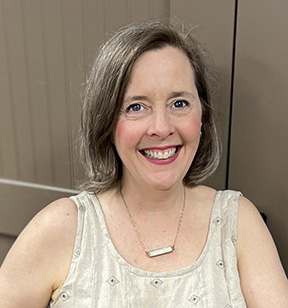 From the Editor: Cindy Scott-Huisman is a leader of the National Federation of the Blind of Arkansas. She lives in Little Rock, where she also owns an art gallery. Although much research, some of it nonsensical, is done on blindness, blind people often find ourselves denied the chance to participate in research studies and clinical trials unrelated to our eye conditions. Indeed, the 2022 National Convention passed Resolution 2022-07 to address this problem. In this article, Cindy tells about such a situation and explains what she, along with an ally on the research team, was able to do about it. Here is what she says:
I am a patient in the Mitochondrial Medicine Frontier Project Clinic in the Children’s Hospital of Philadelphia (CHOP). The research site coordinator, Sara Nguyen, contacted me about a clinical study for a medicine for primary mitochondrial myopathy, because she thought I would be a viable candidate for this research trial.
Sara has conducted clinical research for over a decade at CHOP, readily and straightforwardly enrolling diverse patients into various studies. This is the story of what happened as we explored my participation in the study and how it ultimately led to positive, if perhaps still evolving, change. I have incorporated information from Sara’s notes so that readers have the complete story.
Regarding reaching out to me, Sara recalls, “It was not until January 2022 [that] I encountered a profound challenge in enrolling patients. We had recently received approval for a promising drug trial, and our division initiated outreach to pre-eligible patients for enrollment, including Cindy Scott-Huisman. I still remember our first conversation when I had called Cindy in Arkansas to introduce this study; she was curious and thoughtful in understanding our research. I also recall her warm and kind Southern drawl.”
Sara became interested in learning more about my level of independence when she found out about my central sight loss. She and I went into a phase of her learning a lot about how people who are blind or low-vision access printed materials, as well as our rights.
She did not consider my blindness to be a significant issue for participating in the drug trial.
Sara remembers, “After our discussion, Cindy requested additional time for review of the study and to discern if she would ultimately decide if the study opportunity aligned with her personal priorities and schedule.”
I looked up the trial online and read about it. I was kind of sitting on the fence—going back and forth in my mind, weighing the pros and cons, when I got a call from Sara letting me know that the study sponsors did not approve of participants who would be accessing the paperwork and other study materials nonvisually.
Sara explains, “We let our sponsor know we had received strong interest in the study, including a vision-impaired patient. Although not discouraging, they responded with concern regarding if Cindy could provide fully informed consent, safely perform study exercises, and complete paper surveys and questionnaires. Overall, the sponsors’ initial response was they couldn’t ‘modify the study to accommodate significant visual impairments in subjects’.”
I am not sure why this shocked me so much, but it did. Perhaps it has to do with me not being disabled until shortly after I turned fifty-one; consequently, I had not experienced this type of situation before, and the thought of being excluded for a reason that did not make sense was something I could not wrap my head around.
Sara recalls, “When I called Cindy to explain we likely could not enroll her into the study for reasons related to her eyesight, it was as if I had lit a glowing fire in Cindy. She was initially stunned [by] her potential exclusion and grew increasingly impassioned to pursue her opportunity in this study, if not just for her, then for other blind/low-vision patients in the present and future.”
Even though I wasn’t sure if I was going to participate in the trial, I wanted to use my advocacy skills to hopefully open up the trial to other possible participants who would qualify. I’d like to add that I never became cross with anyone about this potential exclusion. I remained calm. It helped that Sara was completely on my side.
Sara shares, “As an experienced study patient advocate, I had supported and resolved different issues; however, this was the first instance when I needed a patient to help me. After unequivocally deciding to campaign for Cindy’s inclusion in the study at CHOP, I also needed Cindy’s insight and knowledge to explore a direction forward. Knowing our physician-investigators were fully supportive and endorsed Cindy’s participation and ability, I sought the guidance of the Office of Research Compliance (ORC). Even for our extensive research institute and ORC, this seemed to be a novel situation. We assessed research safety, regulatory compliance, and data integrity for the involvement of blind/low-vision patients in the clinical trial.”
Sara stayed in contact with me every step of the way. I remember her excitedly relaying to me one day that she had discovered a room within the hospital facility that is dedicated to housing accessibility equipment, such as a CCTV. She was surprised to see that this room is known as “The Little Rock Room.” I don’t think we ever found out why this room is named for my home town, but what a coincidence. I took it as a good sign!
Sara explains what happened next:
After several weeks of developing a thorough and compliant process for Cindy’s safe and informed enrollment, we received sponsor approval to proceed with an internal hospital regulatory review of the new standard operating process (SOP) for enrolling blind/low-vision patients into our research.
Key points include:
- Confirming any blind/low-vision patient is an independent adult with no severe cognitive issues.
- The blind/low-vision patient is able to utilize a magnifier and other accessibility applications (e.g., iPhone magnifier or screen reader) to access documents.
- For compliance and patient support, we provide a CHOP magnifier (or the patient’s own preferred magnifier or other accessibility technology) to review study forms, and we provide as much time as needed to read the entire document. The investigator and the study team will be fully present to clarify sections or statements of study forms and to answer any questions.
- Although blind/low-vision patients are able to independently read and sign the consent form, witnesses are included at the time of consent. The witnesses will be the patients’ caregivers/spouses, who are independent of the study and not influenced by study personnel.
- Regarding study surveys, we follow the same process: provide a magnifier and allow access technology and more time to complete the documents. For various documents, the patient’s caregiver/spouse reads questions to the patient and documents the patient’s response verbatim.
- The study team ensures that each study exercise is consistent and standardized according to the exercise protocol, with no additional signaling or leading of the patient.
- Further, the study team consults with the physician-investigators to confirm the respective blind/low-vision patient is able to safely and independently complete study exercises.
After nearly four months of working alongside Cindy and internal hospital groups, we finally received approval of our process for enrolling blind/low-vision patients into research. We immediately proceeded with Cindy and two other blind/low-vision patients. Equally important, we now have a paradigm and resources for supporting and including other blind/low-vision patients at our hospital presently and into the future. And it all started with Cindy’s determination and advocating for herself and others.
I was thrilled when I eventually found out that I was approved to come to the clinic to see if everything about me, medically and physically, met all the requirements to be in this clinical study. Sara told me that these changes that she and I worked on together are in effect throughout the entire hospital system. So, for any testing of a medication or other research in any department in CHOP, they now have guidelines in place to work with people who can’t see the printed materials. I am happy to have had the opportunity to help the blind and mitochondria disease communities.
As it turned out, I did not end up qualifying for the study, based on my particular mitochondrial marker. Even though I did not get to help by participating in this study, I believe that I represented the blind community well and presented a strong argument for admitting participants who are blind. I am proud of my patience with the process and making a change that will positively affect others.
Sara and I are still in touch. During a recent phone call I remarked that I could not have made these hospital policy changes without her and she told me that without my kind nature, dedicated determination, and willingness to educate her, the changes would not have happened. So, I suppose that the two of us make a great team.