Looking Towards Our Future: Making Healthy Aging Accessible
by Rishika Kartik and Christopher Liu
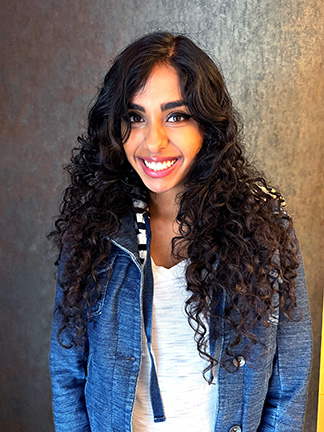 From the Editor: Rishika Kartik is a junior at Brown University, creating and pursuing Brown’s first bachelor’s degree in “Accessible Design.” She has been a volunteer with the National Federation of the Blind since 2019 and works to make art, technology, and healthcare more inclusive for people with disabilities. As the founder of “Touch and Create Studios” and the “Vision of the Artist’s Soul” project, Rishika works to create more artistic and educational opportunities for blind people nationwide. She is a TEDx speaker with over 1.1 million views and has received nearly a dozen academic awards, grants, and fellowships. At Brown, Rishika is the co-founder of a vision loss advocacy club called “Blind@Brown,” helps under-resourced patients access social services as part of the Connect for Health leadership team, and co-created a public art installation called “The Blind Urban Subject.” Passionate about education, she has created and co-taught two courses about accessibility at Brown: “Blindness, Arts, and Media,” and “Gerodesign,” the latter taught with the coauthor of this article. In her apparently elusive free time, Rishika loves writing, biking, and coffee-shop-hopping.
Chris is a 2025 Truman Scholar and 2024 Royce Fellow at Brown majoring in gerontology and cell & molecular biology. Currently, Chris serves as an elected committee co-chair within the Rhode Island Coalition for Elder Justice, a committee lead within the Rhode Island Elder Mental Health & Addiction Coalition, and an appointed member of the Rhode Island Elder Self Neglect MDT. He is an award winning advocate for LGBTQ+ seniors, serves on a committee that has raised $250k+ for research through the Arthritis Foundation, and works for Plans4Care, a company that develops programs for caregivers of people with dementia. He conducts research with teams at the Center for Gerontology Research and the Brown Health Cardiovascular Institute on topics ranging from Meals on Wheels to pharmacoepidemiology to cardiovascular health to climate change & aging. On campus, he is president of Brown’s Hospice Club, a geriatric patient advocate with Connect for Health, and an elected member of the Phi Beta Kappa honor society. In one sense, the contribution of these two outstanding scholars is highly academic, but in another it is deeply practical. It also demonstrates the positive outcomes that can occur when sighted researchers collaborate with blind people to learn from our training models and lived experiences. We therefore believe that readers of all backgrounds will appreciate and benefit from what the piece has to say about the intersection of blindness and healthy aging. Here is the article:
I. Conceptualizing Ourselves as Future Older Adults
The other month, Rishika and I were walking back to campus when we encountered a family of baby geese. We named them Duck, Turkey, and Chris Jr before hobbling back up College Hill—fighting the urge to stash one away in our backpacks. Temptation struck us once again the other day, when we spotted them swimming down the Providence River. They had grown adorably round—an army of flying bowling balls, an armada of feathered watermelons. We watched them swim underneath Pedestrian Bridge and pondered the glorious size they would become when they were fully grown—future older geese, as we imagined them, large enough to substitute for an advertising blimp.
That moment reminded me of a conversation I had with my dorm-mate. He had pointed to an equally round, large, and chubby baby and joked that, while to him it was just a baby, to me it was a future geriatric patient. And he wasn’t wrong: I’m too often quoted calling myself a “future older adult”—asking others to re-evaluate their positionality as well.
Oftentimes, when asked to think of older adults, we conceptualize an amorphic other—a population sequestered in nursing homes or senior centers and removed from the day-to-day lives of college students. However, what we fail to appreciate is that youth is ephemeral against the inevitability of aging: a process coded into our very DNA. Therefore, taking care of our bodies as though we are future older adults becomes a karmic endeavor, paying us back when we eventually become older adults ourselves. We call this framework “healthy aging,” which involves the maintenance of our physical, mental, and social well-being as we age. Envisioning ourselves, and each other, as future older adults leads to a world where aging and disability are met with dignity: where we can all age healthily through creativity, connection, and care.
II. The Ableist Framework of Healthy Aging
Over 46 percent of adults sixty and older have a disability (WHO, 2024). Yet disability justice is often excluded from conversations around healthy aging because of the stigma surrounding disability. A Harris Poll completed for Pfizer’s Get Old campaign found that 87 percent of Americans fear aging out of underlying fears of losing independence or acquiring a disability (Pfizer 2014). The core goals of healthy aging are often ableist, focusing on reducing years lived with disability, which makes little sense for people who already have a disability. When disability is discussed in the context of healthy aging, it’s often framed as something to cure or avoid. Consequently, those with disability prior to growing old are often excluded from conversations around aging in a healthy, dignified manner.
This theme emerges again through metrics used to quantify the impact or value of interventions that promote healthy aging. For example, metrics like QALYs (quality-adjusted life years) and DALYs (disability-adjusted life years) assign lower values to lives lived with disability, creating a misleading notion that disabled individuals have reduced quality of life compared to their able-bodied counterparts. These assumptions also affect research. For example, an article published in the Journal of Health Affairs found that, of the ninety-seven interventional protocols they examined, 34 percent of them excluded participants with visual disability, 10 percent of them excluded those with auditory disability, and 9 percent excluded based on mobility (Plosky 2022). This limits the extent to which our research is generalizable to populations of all abilities and backgrounds.
Finally, conversations surrounding healthy aging often involve a saviorism paradigm: where able-bodied individuals engage in a unidirectional, didactic flow of knowledge—imparting information rather than reciprocally sharing it. This method of engagement prevents mutual collaboration and learning. Thus, the very way we conceptualize healthy aging needs to be reassessed by aligning goals and dialogue within a disability justice framework.
III. Integrating Blindness into the Healthy Aging Framework
 In my first week of college, I met Rishika, a fellow student and disability advocate who was living in the room below me. Disability and aging, as we know, are inherently intertwined. However, it was over breakfast at a university dining hall we colloquially call The Ratty that Rishika introduced me to a new dimension to the aging-disability paradigm: blindness.
As I would come to learn, the blind community is especially excluded from healthy-aging dialogue, as blindness is believed to be rarer than other forms of disability. Public health efforts surrounding aging rarely include blind people, treating them as “edge cases.” However, treating blindness as an edge case ignores the fact that many people age into blindness. In fact, a 2023 Ophthalmology report found that 27.8 percent of Americans over seventy experienced significant blindness or low vision (Shaw, 2023). Even in cases where the prevalence of blindness isn’t as common, excluding blind individuals sends a troubling message: their needs—and by extension, their lives—matter less.
Our early conversations galvanized our interest in expanding healthy-aging initiatives to meaningfully include blind people. Specifically, we were interested in Structured Discovery Centers (SDCs)—which teach blindness skills through hands-on problem-solving and peer-to-peer support—and to understand how these programs support healthy aging, how they could be improved, and how healthy aging practices at SDCs might be applied to broader public health efforts.
To accomplish these goals, Rishika reached out to Maurice Peret—a cane travel instructor with decades of experience at SDCs—who was teaching at Ho’opono Services for the Blind in Oahu. Maurice identified a strong need for programming that more directly addressed healthy aging and invited us to construct a curriculum on healthy aging that was grounded in accessibility and positive blindness philosophy. Two months later, during our university’s winter break, Rishika and I traveled to Oahu to lead a two-week healthy aging program for blind Hawaiians.
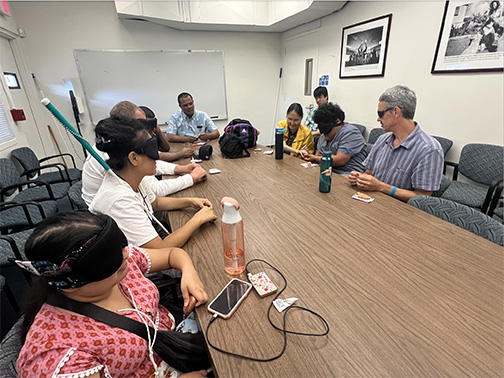
 That winter, we spent our days shadowing Braille and home management classes, exploring the streets of Honolulu during travel instruction sessions, and immersing ourselves in Ho’opono culture. Here, we had the pleasure of meeting students who had travelled from across the world to hone their blindness skills at Ho’opono—each of whom contributed unique perspectives, skills, and interests to the learning community. The highlight of Ho’opono’s program centered around the Business of Being Blind (BOBB) course, which Maurice has described as “an exploration [of] the emotional, intellectual, attitudinal, and philosophical aspects of blindness.” The programming centered on bidirectional and reciprocal dialogue, where students played active roles in shaping their experience and discovering new knowledge together—a philosophy we learned to embrace within our work as well.
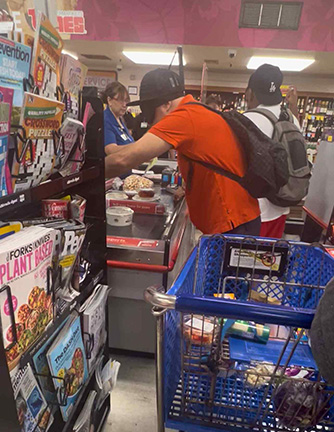
Central to this experience was embracing the creativity that facilitates healthy aging—a strength deeply embedded within the blind community. Effective healthy aging practices, just like effective accessibility practices, center around modifying our existing routines while problem-solving to work around constraints. By using the sun to orient cardinal directions, using AI to read grocery labels, or redesigning technology to be more accessible, to name just a few examples, blind people solve problems in ways that directly translate to healthy aging as well. Supporting healthy aging doesn’t mean starting from scratch—it means recognizing and building on the existing ingenuity that emerges from diverse, inclusive communities. Below, Rishika and I share five insights we gained from our time at Ho’opono.
IV. Key Takeaways
1) Don’t invent creativity, access it.
A primary goal of our program was to harness students’ already abundant creativity to collectively brainstorm ways to make healthy living more accessible. Creativity is often misconstrued as an elusive trait, reserved for the 1 percent of artists or geniuses. The truth, however, is that everyone, especially within the blind community, practices creativity every day. For example, when we strategize about traveling or cooking nonvisually, we create novel ways of engaging with the world. When we generate ideas with disability in mind, we develop new ways of connecting, learning, communicating, and problem-solving. Blindness, therefore, affords a unique way of viewing the world. Accessibility is a form of creativity.
Unfortunately, current approaches to disability inclusion send one message: conform. We stop generating ideas because we’re afraid we may be judged or shamed. We stop pursuing creativity to stay confined in comfortable, socially enforced boxes. To revitalize our creativity, we must consider an approach to disability inclusion that celebrates difference and gives people the freedom to challenge these norms.
2) Small changes, big impact
A common misconception with healthy aging was that it required dramatic changes to students’ routines. However, adopting lifestyles conducive to healthy aging doesn’t mean reinventing the wheel, nor does it have to be disruptive to your daily schedule. The cumulative effect of small, consistent changes can be larger effects that are more sustainable than big-bang modifications.
For example, many students said that they didn’t have time to hit the gym every week. To address this, we found YouTube videos that facilitated audio-guided chair yoga sessions and practiced cardio and stretching exercises that students could perform quickly at work or school. We also discussed the idea of engaging in “exercise snacks”, like having quick dance parties in between tasks and chores. These small healthy habits often compound over time, enhancing people’s quality of life far more than dramatic changes that are unsustainable and difficult to maintain.
3) We don’t resist change, we resist loss
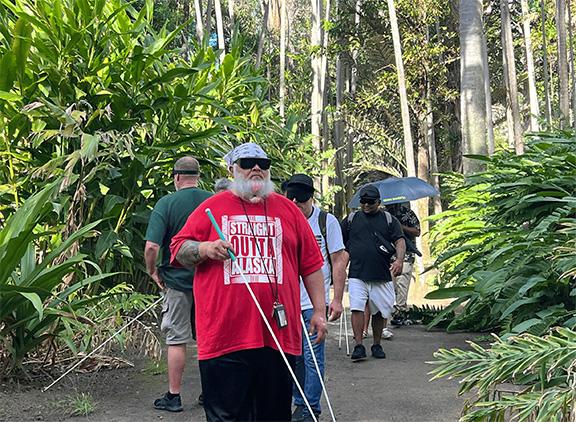
Another common concern we heard was that students didn’t want to give up their favorite meal. We wanted to reframe healthy eating as additive, not punitive: finding new favorite recipes or replacements rather than taking things away. As a group, we worked to find healthier or affordable replacements for ingredients: like using hummus or Tzatziki sauce instead of mayo, cooking with plant-based oils rather than animal fats, or reaching for heart-healthy seasoning like cayenne and garlic instead of extra salt. We were also inspired to find creative ways to add mental well-being exercises into our daily activities. For example, when accompanying students on daily walks, we practiced mindfulness meditation exercises. We also paired an orientation and mobility trip with an accessible botanical garden visit, an immersive exploration of flora native to the Hawaiian islands.
As we learned from students at Ho’opono, we noticed that the largest barrier to healthy aging was that students perceived healthy habits as imposing limitations, rather than creating new opportunities. This way of thinking parallels a common issue discussed in blindness philosophy classes in the National Federation of the Blind. When blindness is portrayed as a limitation rather than an alternative way of doing things, people become afraid of disability and underestimate their capabilities. The Ho’opono Center, however, treated accessibility as a chance to innovate. Students learned to approach challenges with flexibility and find nonvisual ways to meet their goals. Many students told us that blindness-skills training helped them uncover new hobbies, interests, and ways of experiencing the world once they opened their mind. In the same way, when we treat healthy aging as a chance to try new things, we open the door for more people to live not just longer, but better.
4) Define success on your own, together
After introducing students to a variety of healthy aging activities, we focused on developing sustainable, tailored goals to ensure that these healthy habits would stick. Here, we applied the SMART framework (which stands for Specific, Measurable, Achievable, Relevant, and Time-bound) to help students develop ambitious but achievable goals. One participant, for example, expressed a desire to eat healthier. Using this framework, we discussed the person’s habits, motivators, and constraints as a group to develop the following SMART goal: “I will eat hummus sandwiches at least three times a week for lunch this next month.” Unlike standardized metrics like QALYs and DALYs, SMART goals allow each participant to measure success on their own terms. This person-centered model allowed individual preferences and experiences to shape priorities, providing a more encouraging way to conceptualize health and aging.
We also introduced a framework for peer support called relational creativity through which students generated insights through collaborative dialogue. Peer support allowed us to transform activities into fun, social events: for example, organizing a communal potluck with healthy foods or finding exercise partners. Practicing creativity was essential for us to build motivation, giving us the initial momentum to get started. However, for these benefits to be realized, consistency is key, which is why community is an integral part of this process. Peer support holds us accountable to our goals and allows us to collaboratively develop creative ways to tackle obstacles. Making social opportunities more accessible is key to promoting healthy aging.
5) Ask more, assume less
Towards the beginning of this article, we described the dangers of a didactic, saviorism approach that reduces transparency, generates power imbalances, and impedes mutual understanding. To combat the “sighted savior myth,” we worked with the Ho’opono staff to align our work closely with the center’s central Socratic teaching philosophy, which is structured around helping others to help themselves and find their strengths. Students are encouraged to guide their own learning through questioning, discussion, and dialogue. By asking others “What’s been stopping you from doing this in the past?” or “What would success look like for you?” we created space for reflection and critical thinking. Throughout this process, each person was simultaneously a learner and a teacher. Our program’s true mission was to help people articulate, realize, and work towards what mattered most to them. Of course, the benefits of the Socratic method extend beyond blind communities and are just one example of how practices rooted in blind communities can lead to more effective, thoughtful ways of accomplishing goals.
V. Final Thoughts
To promote healthy aging, creativity and adaptability are essential. We all want to live full, healthy lives as we age. But too often, we conceptualize healthy aging as the absence of disability. Exercise programs frequently assume that all people have full range of motion. Nutrition labels often use visual information only, which makes them inaccessible to blind or low-vision populations. Public health messaging often frames disability as something to be feared or avoided, leaving people with disabilities excluded or stigmatized. In reality, disability is ubiquitous and intertwined with our life course, identity, and experiences. Most of us will experience a disability at some point: whether through chronic illness, injury, or sensory changes. Even if we don’t, someone we love surely will. Every form of disability affects how we age.
By envisioning ourselves, and each other, as future older adults, we motivate ourselves to cultivate habits that promote healthy aging. When we reframe the role of creativity in facilitating healthy aging, we can more sustainably achieve our goals. And finally, we should expand the dialogue surrounding disability in healthy aging beyond prevention or mitigation and celebrate the perspectives that disabled communities contribute towards a collective endeavor for a healthier life.