Twenty Years of Dr. Edward C. Bell and the Institute on Blindness
by Gary Wunder
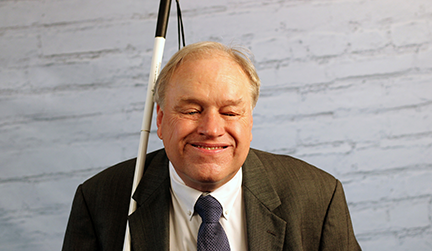 The Professional Development and Research Institute on Blindness (PDRIB) is marking the retirement of Dr. Edward C. Bell after twenty years of leadership—two decades that turned aspiration into program and program into a pipeline of professionals who expect competence from blind people and teach accordingly. Dr. Bell is the institute’s third director and, by far, its longest serving. During his tenure, approximately two hundred students have passed through PDRIB’s programs, many of them now shaping classrooms, centers, and agencies across the country.
What makes this institute singular is not just its location on a university campus. It is the first sustained, university-affiliated training center in blindness created by leaders in the organized blind movement and operated according to the philosophy of Structured Discovery pioneered by the National Federation of the Blind. Through its cane-travel track, it remains the only university-based degree program that explicitly prepares instructors to teach Structured Discovery Cane Travel.
A Collaboration That Changed the Center of Gravity
The institute grew out of a late-1990s partnership between Louisiana Tech University and the Louisiana Center for the Blind (LCB), a center run by blind professionals. That collaboration has now spanned more than twenty-five years and continues to anchor PDRIB’s immersion training and mentorship model.
When Dr. Bell assumed the directorship twenty years ago, the institute’s goals were more aspirational than specific. His first job was to refine the mission, then build the machinery to carry it out—curricula, clinical placements, faculty development, and a credentialing pathway that could certify new graduates and recertify working practitioners at regular intervals. Today PDRIB’s close work with the National Blindness Professional Certification Board (NBPCB) links preparation to standards, examinations, and ethics.
The Core: Structured Discovery
 Structured Discovery is not a bag of techniques but a philosophy for teaching and learning that puts the blind learner at the center. Where the traditional approach treats blindness as a deficit and casts the professional as the authority who prescribes narrow tasks to be copied, Structured Discovery treats blindness as a characteristic to be managed with alternative, nonvisual skills. The learner is active; the professional is a mentor who uses modeling, Socratic questioning, and well-planned experience so that students internalize problem-solving and self-monitoring.
Stated plainly, the goal is not to teach what to think but how to think. Teaching what to think confines a person to a script; teaching how to think equips a person to meet the unknown. For this reason, PDRIB requires deep practice rather than surface proficiency, blind role models rather than low expectations, and honest difficulty rather than overprotection. The national certification framework that grew up around Structured Discovery Cane Travel (SDCT) formalizes these expectations in exam domains and continuing-education requirements.
PDRIB offers three graduate pathways that embody this philosophy:
- Orientation and mobility—master of arts in counseling and guidance. The only university-based degree designed to prepare instructors to teach cane travel using the Structured Discovery methodology. The program requires an immersion quarter and extensive fieldwork.
- Rehabilitation teaching for the blind—master of arts in counseling and guidance. A cross-training program in Braille, daily living skills, access technology, and cane travel, founded to supply broadly competent teachers who can meet varied needs.
- Teaching blind students—master of arts in teaching. Preparation for K–12 classrooms with required Braille mastery, access-technology competence, and the expanded core content teachers actually deploy in schools.
Two of the three insist on immersion. Students complete 400 to 480 hours at an approved center such as LCB. During the training day they wear training shades—eight hours at a time—so that nonvisual techniques become reliable and efficient under real-world conditions. This is not denial of residual sight; it is a curriculum choice that ensures skills hold when lighting, fatigue, or disease makes vision unreliable and that people with progressive loss are not trained twice.
Opponents sometimes argue that shades ignore remaining vision or create unnecessary difficulty. PDRIB’s answer is that consistent nonvisual proficiency reduces anxiety, supports better generalization, and reframes identity: functioning is the point, not how much one sees. The result is steadier performance and, in time, higher expectations—by teachers, by families, and by blind students themselves.
Research, Publishing, and Building Our Own House
PDRIB’s job is not only to train but to ask better questions. As Dr. Bell often says, you can have rigorous methods and impeccable measurement, but if the underlying question assumes dependence and low confidence, your data cannot speak beyond those assumptions. The institute’s mission commits it to research that “broadens and deepens our understanding of blindness and the best ways to promote independence,” and to follow the data even when results complicate our hopes.
The reality of publishing that work has sometimes been rough. Early on, as Dr. Bell recounts, “We were, frankly, the ugly stepchild of the academic world, and we wrestled with gatekeeping that seemed to judge the byline more than the design.” The response was not withdrawal but construction: help launch and lead venues where rigorous, consumer-driven research could be judged on its merits. The Journal of Blindness Innovation and Research (JBIR)—the first scholarly journal created by blind people through the National Federation of the Blind to focus explicitly on independence and self-determination—stands at the center of that effort, and Dr. Bell has served as a part of its editorial leadership.
Beyond journals, the Critical Concerns in Blindness book series (which Dr. Bell has edited) translates expectations into practice for families and teachers. Volumes such as Getting Ready for College Begins in Third Grade and Independent Movement and Travel in Blind Children put practical, high-expectation counsel into the hands of the people who need it most.
Two Scholarships and a Path to the PhD
Along the way to his doctorate, Dr. Bell earned two National Federation of the Blind scholarships: one in 1995 and another in 1998, when he returned as a tenBroek Fellow—a designation reserved for prior winners who win again. Those dates show a through-line of scholarship, persistence, and increasing responsibility that would soon carry him into doctoral work and then into the directorship at Louisiana Tech.
Why Structured Discovery Matters
The scientific method is simple in outline—observe, hypothesize, test, replicate—but hard to live. Fields develop momentum; journals enshrine their assumptions; people are people. In blindness rehabilitation, those assumptions have too often divided the world into caregivers and the cared-for. Structured Discovery rejects that frame. It assumes capacity, teaches generalizable skills, and insists that independence is the default—not a miracle. This insistence has measurable consequences across reading media, mobility, and employment, and it is reflected in PDRIB’s research reports and national surveys that tie high expectations and comprehensive training to better outcomes.
The Human Part
Leadership is not a straight line. Dr. Bell has spoken plainly about his early years: “My first several years here were plagued with imposter syndrome. I felt way out of my depth: newly minted PhD, director of this program. I’m just a kid who finished college. It was very hard for me to adjust to this role.” That candor helps students and colleagues see the work for what it is: a demanding craft learned in public, with real consequences for the people we serve.
Twenty Years On
What remains after twenty years is a living system built on four pillars:
- Preparation joined to standards: A university program created by blind leaders, taught with high expectations and aligned to national certification.
- Immersion tied to philosophy: Hundreds of hours under shades, side by side with blind teachers and students, until nonvisual methods feel ordinary.
- Research that asks the right questions: A publishing and training ecosystem—JBIR, book series, reports—that keeps independence at the center.
- A collaboration with depth: The Louisiana Tech–Louisiana Center for the Blind partnership that has lasted more than a quarter century and still shapes how new professionals are made.
Dr. Bell set out to articulate a mission, build an infrastructure, and strengthen a credentialing system able to maintain standards over time. He did that. But the most important thing he did may be the least visible: he helped a generation of teachers, mentors, and scholars understand that our job is not to teach a script but to equip a mind. When you teach how to think, independence follows. May his next twenty years be as personally rewarding and helpful to blind people as his last two decades.