Collective Action through Financial Technology: Utilizing Disability Wisdom to Build Meaningful Innovations
by John Ciocca
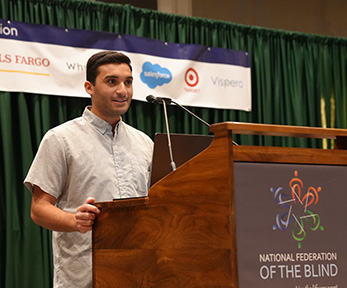 From the Editor: At some time in our lives, most blind people access federal cash and other benefits through programs such as Supplemental Security Income (SSI) and Social Security Disability Insurance (SSDI). These benefits are a blessing when we need them, but they can also become a burden and even a trap when we run afoul of the means tests and other rules that apply to them. John Ciocca, who addressed the 2025 National Convention on July 12 immediately following the national financial report and board elections, is co-founder and CEO of a company that seeks to help with this problem. Here is his presentation, including President Riccobono’s introduction:
President Riccobono: Okay, we have a couple more presentations this morning. We’re going to continue the financial discussion by inviting a gentleman to this stage for the first time. Access to financial services is really critical in living the lives that we want and competing in society, and oftentimes there are barriers in the financial services sector. We’ve talked about them in the past with some of our legal and advocacy work. Of course, if we’re going back through the decades, we’ve worked on accessible ATMs and websites and other aspects of banking. Our next presenter is really changing the landscape of how to think about accessibility in financial services by engineering a company that is looking at how to use financial tools and financial technology to better drive opportunities for people with disabilities. And the National Federation of the Blind was happy to provide a contribution to help this venture get off the ground. The company is called Purple. Maybe he'll tell us why Purple. And he’s already been talking to us about how we can find ways to use his platform to further the work of the organized blind movement. So I’d invite you, for his first time on our stage, to welcome the founder and chief executive officer of Purple. Here's John Ciocca. [Applause and music]
John Ciocca: Good morning. Thank you to President Riccobono for inviting me and to everyone at the NFB who helped bring this incredible convention to life and all of you for being here and being part of such an incredible movement. My name’s John Ciocca. I’m the co-founder and CEO of Purple. I’m honored to be here today and excited to share the Purple story with you, what we’ve built, what’s coming next, and most importantly, how we’re working together to build a financial system that truly serves this community.
At Purple, we build financial products for people with disabilities and their families to help them manage money, maximize benefits, and save for the future, all while protecting critical benefits.
My journey into tech started with my older brother Christian, who has Down’s Syndrome. He’s been the inspiration behind everything I’ve built. Growing up, I saw firsthand the barriers he faced not because of his disability, but because the systems and tools around him weren’t built for him. In middle school, I built my first app called MyVoice. MyVoice provided alternative augmentative communication or AAC to people with speech-impeding disabilities. The app was based on the Picture Exchange [Communications] System, also known as PECS. The traditional PECS book involved a student physically picking images and forming a sentence that a teacher would then read out loud. Obviously that's a time-consuming and frustrating process. My dad was a special educator, so I saw this over and over again with his students while sitting in his classroom after school. With MyVoice, instead of shuffling through a physical book, students could drag and drop images into sentences and the app would speak them aloud instantly. MyVoice was used in classrooms across the country, helping students and adults find their voice and speak their needs. [Cheers and applause]
Later on in high school, I built youBelong, a social network designed specifically for people with disabilities and their families to connect. I started it after our family moved from New Jersey to Florida. Shout-out to New Jersey and Florida! [Cheers and applause] My brother had to leave his closest friends behind, and I saw how difficult the move was for him, so I wanted to create a safe, welcoming place where he could stay connected and meet new friends.
Through these projects, I learned a powerful lesson. Technology can empower, but only when it's built with the community, not just for the community. [Light applause] As I listened to families and individuals using youBelong, one topic came up again and again: money. Families would share stories about how hard it was to manage their benefits, how afraid they were of going over asset limits, and how confusing the rules were when trying to save even a little for the future. And I saw these same struggles at home. As Christian became old enough to apply for benefits, my parents faced stacks of paperwork, hours on the phone, and constant fear of making a small mistake that could jeopardize his benefits. I realized that while there were tools to support communication and connection, there was a huge gap when it came to financial tools designed with and for people with disabilities.
When we talk about financial inclusion, we often think about simply opening a bank account, but for people with disabilities, true financial inclusion is about so much more. It’s about being able to save without fear of losing benefits. It’s about understanding complex rules in plain language. It’s about being able to navigate benefits, income, and expenses independently and accessibly. It’s about having the freedom to make financial choices and build security for the future. But today, the financial system isn’t designed with these needs in mind.
So let’s talk about the asset limit. If you receive SSI benefits, you’re limited to $2,000 in total assets across checking, savings, [and] investment accounts. This rule hasn’t changed in decades. For many, it creates an impossible choice: save money and risk losing benefits or spend everything each month and remain eligible. Last year alone, over 400,000 people lost their benefits because they crossed that $2,000 limit, often because of small things like working a few extra hours, a mistimed deposit, or a small gift from family. When that happens, families lose critical monthly income, sometimes for months at a time, and must spend countless hours trying to fix the situation.
In 2014, Congress introduced the Achieving a Better Life Experience Act, also known as ABLE, to provide a solution to this asset element. ABLE accounts allow people with disabilities to save up to a hundred thousand dollars in a tax-advantaged account without impacting their eligibility for benefits. You can contribute up to $19,000 per year, and funds can be used on a wide range of qualified disability expenses, and these include housing, transportation, assistive technology, education, and basic living expenses. And recent ABLE updates like the permanent extension of ABLE to Work allow working individuals to contribute even more beyond the standard annual limit, making it easier for people to build savings while maintaining employment. On paper, ABLE accounts are an incredible tool. They help people build real financial security. But in reality, they haven’t reached most of the people they were designed to help. Today, there are eight million people eligible to save with an ABLE account, yet fewer than 200,000 have opened one. Why? Because the user experience is confusing and fragmented, state-run ABLE programs have outdated dashboards, enrollment flows are long and complicated, investment choices are poorly explained, and most importantly, these accounts weren’t built with accessibility or lived experience at the center.
Starting next year, ABLE eligibility will expand dramatically from onset of disability before age twenty-six to onset before age forty-six. This change will add another six million people who can finally take advantage of these savings accounts, including one million disabled veterans. [Applause] This is going to be a huge opportunity to reach fourteen million people to save for a better life, but only if we build better, more accessible, more human-centered experiences.
At Purple, we’re working to reimagine the ABLE experience from the ground up. We’re building the first integrated ABLE banking experience so that people can easily manage everyday spending and long-term savings in one accessible platform. At the end of each month, Purple will automatically move leftover funds into your ABLE account to help you stay under the asset limit before your next deposit arrives. And when you spend, we’ll flag eligible expenses to make sure the money is coming from the most tax-advantaged account, giving you more control and confidence every step of the way.
With ABLE fully integrated, we wanted to make sure every part of daily money management felt just as seamless. That’s why we started with the Purple checking account and debit card, giving members a strong foundation for everyday spending while also making it easier to save for the future. The Purple checking account allows you to get your disability benefits earlier. You can set spending limits on your card, capture receipts and memos to stay compliant with SSA reporting requirements, and link your SNAP EBT card so you can manage all your balances in one place. Later this year, we’ll be making our debit card even more accessible. In partnership with MasterCard, we’ll be leveraging MasterCard’s Touch Card, a design that adds a distinctive notch to the card. This tactile feature makes it easier to identify the card in your wallet when paying at the point of sale, whether using the chip or a contactless tap. MasterCard has shown a commitment to accessibility, not just through the Touch Card, but also through features like the recognizable MasterCard Sound Mark at Checkout. This distinct sound lets people know their transaction has been successfully processed, an important cue for blind and low-vision users to feel confident and secure when paying. This shared focus on accessibility is exactly why we love working with the MasterCard team. Together, we're working every day to make spending even more inclusive for everyone.
Now, beyond the card itself, we built a suite of features designed to empower members in every part of their lives. Our income monitoring feature helps you track your progress towards the SSA’s substantial gainful activity limit, also known as the SGA limit. This is the amount of income you can earn while still remaining eligible for disability benefits. You can link any external account, and Purple will automatically watch for deposits and income, alerting you if you’re approaching your individual limit.
We also built document storage, a secure way to keep SSA notices, receipts, appointment notes, and other important disability-related paperwork all in one place. And we introduced Purple Companion, our AI assistant trained to help answer money management and benefits questions, helping users to make informed financial decisions without fear or guesswork. We're excited to keep improving Companion, building toward a future where AI and financial tools work hand in hand. [Applause]
But none of these features would exist without listening to the community. Early on, we spoke to hundreds of people with disabilities and their families. We heard about the fear of depositing a small check or working a few extra hours and accidentally losing benefits. We heard how overwhelming and confusing it can be to track income and expenses under strict benefit rules, and we heard the need for a simpler, clearer way to manage money without constant worry. And we’ve also had the pleasure of working with testers from the NFB BUILD program to put our software through real-world scenarios. Their feedback has helped us identify issues, improve navigation, and make meaningful progress toward a more accessible experience. [Applause] We know that accessibility is a journey and our software isn’t perfect today, but it isn’t an afterthought for us. It’s a foundational principle. We're always learning from our members and working every day to make our tools more accessible for everyone.
The idea of disability wisdom means designing with the community, not just for it. It means recognizing that lived experience, expertise, and every piece of feedback—whether it's about the language we use, the way information is grouped on the screen, or how a notification sounds—is treated as essential knowledge that shapes our product. We see our members not as users, but as co-designers and partners in this work. That’s how we make sure our tools truly support independence and that they reflect the real needs and goals of the community.
We also know that these financial barriers don’t exist in isolation. They’re deeply connected to other systemic challenges like housing insecurity, healthcare access, employment discrimination, and a long history of policies that have limited financial independence for people with disabilities. We understand that the debit card and a savings account alone isn’t enough to solve these issues, but we believe it’s a start, a foundation to give people more control, more choices, and more opportunity to build stability for the future. Our hope is that by making these tools more accessible and removing some of the fear and confusion around money, we can help open doors to greater independence and empower people to focus on what really matters in their lives.
As we look to the future, we’re exploring ways to support even more savings tools like Special Needs Trusts so members have options beyond traditional accounts and can choose what works best for them. We’re working to make Purple a true one-stop hub by servicing information about Medicaid waivers, other benefits programs, and resources that help families navigate complex systems with more confidence. And we’re even thinking about how we can help members build credit, connect with employment opportunities, and access the tools they need to strengthen their financial security and independence on their own terms.
Now, before I wrap, I’m excited to announce a special collaboration. Purple is partnering with the NFB to make it easier than ever for our members to support the organization. Later this year, Purple members will be able to set up recurring donations to the NFB by simply entering their Purple account email and phone number. Purple and NFB will handle the rest securely behind the scenes. No more hunting down and manually entering your routing and account number. This means more members can quickly support the advocacy and work that the NFB does every day. So stay tuned to your inbox for more information from the NFB team as we roll this out. [Cheers and applause]
At Purple, we believe that financial technology, when guided by disability wisdom, can be a tool for real collective action. It’s not just about checking balances or moving money around. It’s about independence, dignity, and having choices. It’s about freeing people from systems designed to keep them in poverty and empowering them to dream bigger. When we build together, we make sure no one is left behind and we move closer to a world where accessibility and financial equity aren’t special features, but simply the standard. [Applause] We’re honored to be on this journey with you, and we can’t wait for you to join the Purple community and help shape what comes next. You can learn more at withpurple.com. Purple is available in the Apple App Store, Google Play Store, and on the web. If you run into any accessibility issues or have ideas for improvement, email us at [email protected]. Myself and our team read every message. Your feedback is not just welcomed, but it's essential. Thank you for your time today. Thank you for your leadership and your wisdom. Let's keep building this future together. Thank you.