"Access On" through Collective Action: Mobilizing Leadership through Blind-Centered Technology Perspectives
by Jonathan Mosen
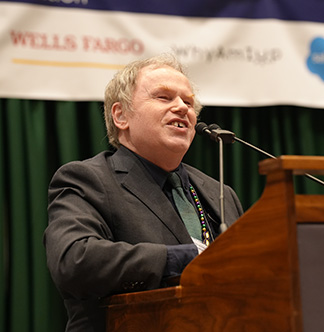 From the Editor: Jonathan Mosen is no newcomer to Federation conventions, but he addressed the 2025 Convention for the first time in his role as Executive Director for Accessibility Excellence at the NFB Jernigan Institute. As President Riccobono pointed out when introducing him, Jonathan picked up and moved his home and his life around the world to assume this role. Here are the updates and plans that Jonathan shared with the assembly:
Thank you Mr. President, and good afternoon fellow Federationists. It is an honor to be here as the Federation's Executive Director for Accessibility Excellence. And since I now live here in the United States, I want to assure you that I now feel honored without the letter U. [Laughter] I'd like to thank everyone who has made me feel so welcome to the Federation and to the United States. [Applause]
Technology affects us all. Some of us embrace it, some of us wish we could avoid it. [Laughter] Some of us find it intuitive, some of us find it inscrutable. Some of us rise to the challenge, some of us want to throw the darn thing out the window. While technology evokes varied responses and emotions, we all just want this stuff to work so we can get on with our lives. We demand access that is equal in functionality and reliability because we proudly and unashamedly assert our worth, and we deserve no less. When companies develop technology for our use, we, the blind, expect to have a seat at the table at a time when our voice can matter.
President Riccobono chose the title of this address, “Access On Through Collective Action.” I was delighted that he gave me this title, because “collective action” is the reason we have much of the technology we now take for granted. Sometimes, people say things to me like, “Oh, I’m really not much of a joiner. If I feel strongly about an issue, I can whip up a frenzy on social media, start an online petition, and make change that way.” It’s true, you might have some success if you have a big enough following, your issue gets sufficient traction, and all the noise reaches the right person who can implement the change you're asking for. I’ve seen it done, but it’s rare, and it takes time, skill, and a lot of luck.
Now, this organization has an unmatched track record of bringing about technological advancement because of the power of collective action. Social media is often an echo chamber, but history proudly chronicles that the voice of the organized blind has been echoing through the corridors of power, changing the world for eighty-five years. [Light applause] It is a voice that cannot be silenced and will not be ignored. While an individual complaint may be seen as a personal grievance, the organization representing the nation's blind transforms that complaint into a civil rights issue.
My fellow Federationists, the NFB is not fighting for us. Collective action means that the Federation is us, fighting for ourselves and for one another, stronger together, unstoppable in our momentum, gaining solace and strength from our solidarity. [Applause] To attendees in the room who have come to find out about the NFB, and to those listening online who are not part of our movement yet, I say this: If you want to see technology evolve and improve; if you believe that the blind have not just the right, but the duty to build on the work of those have gone before and worked hard to give us the technological victories we now enjoy; then our doors, our hearts, our arms are open. Come join us, there is a place for you in the National Federation of the Blind. [Applause]
At our Center of Excellence in Nonvisual Accessibility, which we call CENA for short, we inform, advise, educate, and advocate about technology. Of course, I have to start with artificial intelligence, AI for short, specifically generative AI. This is disruptive technology, and it has the ability to disrupt myths about blindness. The National Federation of the Blind knows that it isn't blindness that holds us back, but constraining attitudes certainly do. All the major AI players are well aware that without intervention, AI may perpetuate harmful stereotypes about blind people. The generative AI revolution has presented an opportunity to correct the record, and we intend to see that it is corrected. We’re making progress. Thankfully, it’s been a long time now since I’ve had an AI expressing sorrow that I'm blind. AI companies are actively rebalancing data, ensuring that we’re portrayed accurately. Many AI companies now have ethics boards that monitor AI for inaccurate portrayals. Blindness-specific data sets, where we ourselves demonstrate what it is to be blind, help to reduce bias and better inform the AI.
AI describes the world around us, and many of us find it helpful. Sometimes, it produces vivid, accurate descriptions. At other times it just makes things up. [Laughter] Although they continue to improve steadily, guided by member feedback, we in turn provide guidance to AI companies about the kind of information AI should convey in a range of settings. AI should never replace our own travel skills and awareness of our surroundings, nor do we wish for companies with the potential to provide us with useful information to be overly cautious and patronizing. We continue to talk with technology companies about the concept of AI as an alternative technique for access to visual information. Everyone else can identify people they already know in a crowded room, and AI in theory permits a blind person to do that too. We must make it happen. We must find ways of allowing a blind person to identify someone they know while respecting privacy concerns. This problem is no longer technological. It is ethical. We will work with the industry to figure it out.
You'll be hearing much more about agents in the world of AI in the year ahead. AI has the potential to create a new screen-reading paradigm that will be particularly beneficial for people who become blind in later life and may not have vocational goals. It can be conversational and easy to use for daily tasks like shopping and communication. We look forward to working with a range of companies, in the mainstream and access technology sectors, to see this new product category emerge in a way that makes technology more inclusive while preserving the efficiency so many experienced users need.
Speaking of efficiency, we continue to receive feedback from members about the need for companies to remember efficiency when designing for accessibility. There are some applications which are broadly accessible but which are unnecessarily verbose. Software developers mean well when they do this. But it is the equivalent of ordering a cup of coffee somewhere, and then when someone hands it to you they say, “Be careful, it’s hot.” [Laughter] We know it's hot, it’s what we ordered! [Laughter] When we press Enter in a browser to load a page, we don’t need to be told it's loading the page; it’s what we ordered. [Laughter] We’re in the undesirable situation of some applications speaking way too much, and third-party screen readers, with far fewer resources than big tech, having to invest some of those limited resources in making these apps bearable. That is wasteful, pure and simple. Some may think this is a finicky complaint. It is not. When you calculate over a work or school year the lost productivity due to suboptimal experiences, accessible but inefficient user interfaces hold us back. [Applause]
Now I’d like to talk about something we’ve received many phone calls and emails about: Facebook. Given how much concern people have expressed, I think it is important that I account in detail to the convention about our advocacy on this subject. Blind smartphone users who use Facebook have not had an easy time of it. Several severe bugs crept into the Facebook app which were left unresolved for a long time. Not everyone uses a smartphone. That is their choice, that is their right, and if a desktop site exists, we demand that it is fully accessible to everyone. [Applause] Late last year, just ahead of the Thanksgiving holiday, when people often use social media to connect with one another, Meta closed down its MBasic Facebook site. We know that change is the only constant when it comes to technology, and that the MBasic site was designed for older mobile phone browsers that no longer exist. But many blind people used it because it was clean, simple, and accessible. I don't think Meta appreciated the accessibility impact of deprecating the site. Nevertheless, the elimination of that workaround exposed how increasingly riddled with accessibility problems the primary Facebook site had become. Things were pretty bad. But the National Federation of the Blind and Meta have been in constructive, respectful, forthright dialog. We’ve gathered your feedback. We’ve found common threads and provided helpful steps for the Meta team to duplicate defects. Meta, in turn, has been responding. It has fixed some of the particularly egregious bugs that were frustrating smartphone users. We’re now starting to see improvements to the main Facebook website, with some of the keyboard shortcuts fixed and extraneous block quote characters removed. We’re not yet at our destination; the journey continues. But as long as we see changes in response to our feedback, we will keep the conversation going. I also acknowledge Meta’s presence here at our national convention; they have come so they can hear from their blind users. And we are pleased that they have responded to our feedback on improving the Meta smart glasses. [Applause] And I think you will be impressed with what is coming.
It was a significant moment in 1990 when Dr. Maurer unveiled the concept of the International Braille and Technology Center for the Blind. He said, and I quote, “When the blind buy technology, we deserve the same Consumer Reports-style independence that sighted people take for granted. The International Braille and Technology Center will exist only to answer one question—what really works for a blind person?” We launched the IBTC fifty years to the day that our Federation was founded. At a press briefing, Dr. Jernigan said this: “The IBTC is at least one of everything: every speech synthesizer, every Braille display, every scanner we can find. It is the tool we will use to keep industry honest and to keep blind people employed.”
Of course, the Federation delivered. There is no place on the planet like the IBTC. [Light applause] We have been so successful in our advocacy that many devices available for general purchase now offer accessibility features. The IBTC purchases a selection of such devices. But we have stayed true to the founding mission of the IBTC. When a device specifically for blind people comes on the market, we purchase it, we evaluate it without fear or favor, and we communicate our findings to you.
In 2017, in his banquet address, President Riccobono observed, “We live in a time in which technology is constantly a part of our human experience, but of course we’ve always lived with technology. However, the difference today is the speed with which technology is becoming increasingly important in our lives. The changes that occur as technology alters the pattern of our lives take place not in decades but in days. The increased velocity of change will soon demand altered patterns of thought and behavior from us hour by hour or minute by minute. Technology has changed the way we work, play, and even the way we think.” In response to the rapidity, impact, and nature of technological change, last year President Riccobono concluded that the time was right to create an executive director position with a technology focus. The Federation never stands still, and the time has come to write an exciting new chapter.
I have recently completed a thorough strategic review of CENA, which includes the IBTC and related functions, and there are ten key strategic objectives that will guide us moving forward:
- Be a timely, credible source of technology advice for our members.
- Make recommendations, provide technical advice, and perform detailed evaluations in service of the core programs of the Federation; for example, legal work, advocacy priorities, capacity-building projects, etc.
- Facilitate means by which members can share information about the increasingly complex area of technology, since no matter how talented our staff, they can no longer be expected to keep up with every option in minute detail.
- Conduct thorough, fair evaluations of products based on a published test methodology to ensure transparency and equity, reducing the prospect of personal bias creeping into evaluations.
- Raise awareness of accessibility in the wider community, ensuring the NFB is seen as the definitive, authoritative source of information on the accessibility of technology for blind people.
- Build strong relationships with companies producing technology that blind people use, both blindness-specific and not.
- Act as a conduit between members experiencing accessibility challenges and technology companies to promote speedy defect resolution, thus materially improving the lives of our members and adding value as an organization.
- When necessary, provide clear information and calls to action that allow the membership to campaign on accessibility issues of importance.
- Provide guidance to individuals and start-ups seeking to enter the access technology field, encouraging them to adopt a genuine interest in co-design and a respect for the self-determination of blind people.
- Seek international cooperation with individuals and organizations with whom we have mutual objectives.
In the years ahead, we’ll be making the operational changes that better equip us to deliver on those strategic objectives. As President Riccobono said in his report, in the coming year he will create a committee to more closely link the membership with CENA’s work. But there is much more. We’ll find innovative ways to bring the knowledge of the IBTC to you. Our new technology podcast, Access On, is just the beginning. Access On is an opportunity for us to tell you about some of the technology that we’ve been evaluating and let you hear the movers and shakers talking about the latest developments in technology. But we also love hearing listener contributions, and there are plenty of people in this room who can add immense value to the podcast, giving it a strong Federation flavor. So, if you have something to share, a concern, a demonstration others may benefit from, a tech tip to improve efficiency, remember Access On is the Federation’s podcast, which means it is your podcast.
Now as Steve Jobs used to say, I have one more thing. I’d like to share with you our bold dreams for the International Braille and Technology Center of the future. We’re reimagining the IBTC’s layout to reflect that technology is not an end in itself, but the means to living the life we want. In the IBTC of the future, when you look at equipment that can help you study, you’ll do so in a classroom. When you consider equipment to help you succeed on the job, you’ll do so in an office where you can sit down at your desk and try as many solutions as you need to. In the IBTC of the future, we’ll have extensive home automation set up so you can bring your own smartphone along, see what’s possible, and how effective it is to control the home yourself. These changes will take time and significant resourcing. But we know that when the National Federation of the Blind has a dream, we always turn the dream into reality through the grit, determination, and love that is the lifeblood of our movement. [Applause] This dream must come true, because technology affects us all. Accessible, functional, useful technology developed not only for us but with us means employment, education, entertainment, and empowerment. Let’s do what we must to preserve it and take further control of our technological future and make it happen. It will be so, because we are the National Federation of the Blind, and that is our right, that is our duty, that is our destiny. Thank you so much. [Applause]