When Cuts Become Catastrophe: Defending Braille and Deafblind Education
by Justin Young
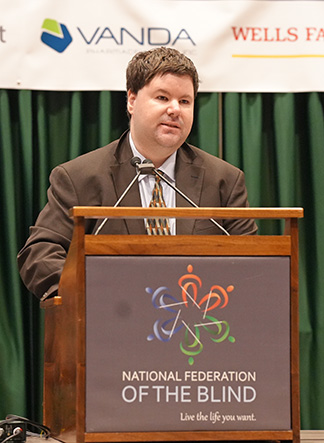 From the Editor: Justin Young is a member of the Advocacy and Policy team at the National Federation of the Blind Jernigan Institute, and education issues are part of his portfolio. Here is what he has to say about recent cuts in grants from the United States Department of Education:
The Department of Education has quietly taken an action that could devastate the future of blind, low-vision, and deafblind students across our nation. This fall, the Department abruptly eliminated more than thirty federal grants that fund Braille training, deafblind education, and teacher preparation. These are not obscure programs. They are the lifelines that ensure blind and deafblind children can learn, read, and communicate on equal terms with their sighted peers. That is why an urgent legislative alert went out from our national office. You can read it at https://nfb.org/programs-services/advocacy/legislative-priorities/legislative-alerts/reinstate-funding-critical .
As Education Week reporter Mark Lieberman documented in his October 2025 article, teachers and students learned of the cuts with shock and disbelief. April Wilson, one of only two teachers of blind students in her Illinois district, had been completing a federally supported Braille certification program when she received the news. “Some VI teachers can go years at a time and not teach Braille,” she told Education Week. “When we get that student who’s blind in our district, we’d better get ready.” Without those grants, she and hundreds of other educators will lose the opportunity to “get ready” at all.
According to the Education Week report, the Department has discontinued funding for Braille training programs at California State University and the University of South Carolina, as well as projects serving deafblind children under the Individuals with Disabilities Education Act. In his Positive Note, a publication for leaders and members of the National Federation of the Blind of South Carolina, affiliate president Marty McKenzie noted: “I was notified on Sunday, September 6, 2025, that [the] Project INSPIRE 2: Access and Equity in STEM Learning for Individuals Who Read Braille grant has been defunded effective September 30, 2025. Dr. Tina Herzberg, a Federationist, is the principal investigator on this grant. It is the third Braille grant she has obtained in her eighteen-year tenure at the University of South Carolina Upstate. Federationists such as First Vice President Lenora Robertson and others learned to read Braille under the first grant.”
Federal deafblind centers that help families and teachers across states are also facing elimination or consolidation. As Education Week notes, these students represent one of the lowest-incidence but highest-need populations in education. The federal deafblind centers that connect families and educators across states now face elimination or forced consolidation, meaning that the specialized expertise families rely on may simply vanish. “If our students don’t have the best quality of teachers,” one mother of a deafblind student asked, “what are we really giving them?”
These decisions are more than bureaucratic adjustments; they represent a betrayal of our nation’s commitment to equal opportunity in education. Braille literacy is not an elective skill—it is the foundation of learning for blind students. When teacher training programs are dismantled, students lose access not only to Braille but to literacy itself. For deafblind students, whose numbers are small but whose needs are complex, the loss of coordinated federal support could mean no meaningful instruction at all. This is not fiscal prudence; it is moral gross negligence.
The National Federation of the Blind knows what happens when society treats the education of blind and deafblind children as expendable. We fought for decades to secure the right to learn Braille, to receive materials on time, and to be taught by trained professionals. We know that when blind and deafblind children are denied those tools, the result is not merely academic failure, it is a lifetime of limited opportunity.
The Department of Education must reverse course and restore these essential programs. Our children’s literacy and future depend on it.