Equal Access to Live Theater: Opening New Worlds through Audio Description and Touch Tours
by Cindy Scott-Huisman
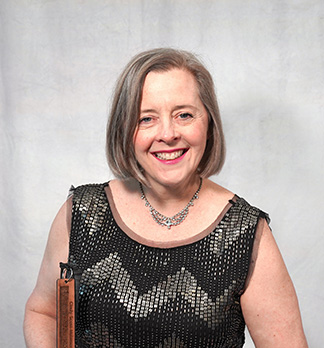 From the Editor: Cindy Scott-Huisman is a leader of the National Federation of the Blind of Arkansas. She lives in Little Rock, where she also owns an art gallery. Given her involvement in the arts, readers will likely not be surprised to learn that she is a theater enthusiast and has worked in that field. In this article, she describes innovations that are making theatrical performances more accessible to the blind and others. Here is what she says:
Audio description (AD) makes live and recorded performances come alive for blind and low-vision audiences. By narrating visual details—actions, settings, costumes, and more—it helps everyone fully experience theater, film, and other art forms. AD is now common in many movie theaters and on certain TV services, and it is gradually expanding into live theater.
Experiencing Broadway and Touring Shows
My earliest experiences with audio description were on Broadway in New York City. There, the description is often professionally produced and generally available for any performance once a show has been running for a while. These performances feature pre-recorded AD: individual sound clips carefully cued to match each moment, like any other sound cue, and synchronized with the performance through the miracles of modern technology. I also encountered prerecorded AD on a touring show in Memphis, Tennessee. At the Broadway performances, the description ran through a provided tablet and earpiece, and at the touring performance it ran through a free app on my phone called GalaPro. I have since been told that GalaPro is also an option on Broadway now as well, but that tablets are still provided for those who do not have or want to use their smartphone.
Building Local Access in Central Arkansas
Little Rock, Arkansas, where I live, offers more live theater than one might expect, and many local theaters provide live AD for at least one performance of each production. I became personally involved in 2019, helping the Arkansas Repertory Theater (Arkansas Rep), our local Equity house, implement AD. (An Equity theater is a professional theatrical production company that operates under a contract with the Actors’ Equity Association (AEA), the US labor union for stage actors and managers.) We lined up funding, equipment, and trained voice talent, even planning pre-performance touch tours of the set. Our first internal test in early 2020 was fantastic. I was thrilled beyond anything I had imagined. Then the pandemic abruptly halted the season.
A couple of years later, Sandee Pinkstaff took our initial work further. Sandee’s premier AD job came about because a former student was in town visiting family. This former student is now a parent. She wanted to take her young son to the Children’s Theater in the Arkansas Museum of Fine Arts, and having AD would help facilitate her understanding of the action on stage. Drawing on decades of experience as a music teacher at the Arkansas School for the Blind and as an orientation-and-mobility and Braille specialist, Sandee trained with Arts Access in Raleigh, North Carolina, and MindsEye in St. Louis. After retiring from full-time teaching in 2023, she launched Creative Descriptions, a business dedicated to organizing and promoting AD throughout central Arkansas. Sandee has gotten many of the theaters in central Arkansas interested in offering AD, and she is really good at organizing all of the aspects of this business. She puts together listings of upcoming theater performances and emails this information to potential attendees. Once she knows a person has tickets, she sends show notes and all of the other details, such as what time to show up and where to meet her for the equipment. Sandee’s approach therefore facilitates access not only to the performance itself, but to more of the printed information that is available to sighted patrons.
A Family Affair and Touch-Tour Highlights
My husband and I recently attended an Arkansas Rep performance where Sandee’s son Grant, a professional actor, delivered the live description. Before the show, stage manager Luisa Torres led a memorable touch tour, letting us handle key props and set pieces so we could visualize their use during the performance. Touch tours like this add a deeper layer to audio description. Luisa was so good, I asked where else she has done this. She told us that during the regular (fall through spring) season she works at Baltimore Center Stage (BCS) in Baltimore, Maryland. I enjoyed pointing out the connection that this city is where the National Federation of the Blind headquarters is located.
When I thought through this connection, I called Chris Danielsen, Editor of the Braille Monitor and Greater Baltimore Chapter president of the National Federation of the Blind of Maryland. He and I had a great conversation, comparing and visiting about each of our audio description experiences. He brought up the general show descriptions that are often given before the performance begins. If you don’t know this happens, you might miss a lot of informative details. This part of the AD usually contains information from the playbill and provides detailed descriptions of the set, characters, costumes, and other pertinent details that couldn’t be included in the AD during the performance because of the obvious time constraints. If this pre-show AD is a recording, it usually plays on a loop starting around twenty minutes before the show begins.
I contacted the Baltimore Center Stage Theatre and got to visit with Rachael Erichsen, the Director of Properties. Rachael is a member of the Allyship and Advocacy Committee of the Society of Props Managers. She is very tuned into accessibility and shared with me the following insights:
I was privileged to have close friends and mentors teach me early in my career that accessibility is at the core of a vibrant arts community. The Touch Tour program that we offer here at BCS exemplifies a core tenet of ‘universal design,’ that an accommodation for some is ultimately a benefit for all. While we created the Touch Tour specifically for our blind and low-vision patrons, it has become very popular with anyone who drops by. We have started offering additional Touch Tours at our student matinees, something that the Teaching Artist in me really enjoys. All our patrons benefit when we provide a tactile way to engage with the story, because theater at its core IS an embodied art form. For the actual tour, I aim to curate a tactile representation for every visual storytelling element on the stage. A typical spread includes pieces of the set like the floors, walls, and trim; entire costumes on dress forms; swatches of the fabrics used in costume builds; and [the] actual or replicas of the majority of props that are handled prominently by the actors. We arrange this all on several tables in the public lobby outside the performance space and always have an interpreter there who serves as a ‘tactile dramaturge.’ Their task is to guide our patrons through the offerings while relating them to their place and importance in the story. Because we always offer the tour at the same performance as our audio description service, the audio describer often comes through for a tour as well to gain further context for their script.
I was especially interested in learning more about Rachael’s innovative ideas for the future: “Something else I would like to include in tours is a topographical bird’s-eye view of the playing space with the current show’s set on it. I’ve seen these incredible tactile maps at places as varied as the Sagrada Familia [Church of the Sacred Family] in Barcelona and the Andy Warhol Museum in Pittsburgh. They instantly let you gather the layout of a space or image through touch alone, which is a welcomed anchor amid the flood of descriptive words!” Rachael is currently learning 3D computer modeling with the goal of using the theater’s 3D printer to build these “set maps” in the near future. She is very grateful that her role as Properties Director gives her access to these emergent technologies. The first line of Baltimore Center Stage’s vision statement is “We are building a theater for everyone,” and this deeply resonates with Rachael Erichsen.
Leadership Support for Access
Arkansas Rep Executive Artistic Director Will Trice, a multi-Tony-Award-winning producer, shares this commitment. “The touch tours certainly weren’t my original idea, but they made perfect sense once I learned about them,” Will told me. “Theater is a three-dimensional art form—well, actually four-dimensional,” he said. “Scenic and props designers create environments for the performances—sometimes literal, sometimes poetic. I’m not blind or low-vision myself, but it seems like being able to establish a tactile relationship with those environments would make all the difference in connecting with the performance. And under the guidance of a professional stage manager, touch tours are a relatively simple offering for most shows.”
Community, Culture, and Advocacy
The impact of accessible theater is tangible. Whenever I attend a described performance, I meet new friends from the blindness community—many of them students at World Services for the Blind. These events facilitate our active participation in the arts and invite the broader public to see us as full participants in cultural life.
The model is spreading, and those of us who feel called to do so can help that spread. Audio description is appearing in Arkansas State Park visitor centers and in museums and attractions nationwide. Sometimes all it takes is asking what accessible options exist. If you ask at an attraction and find out that accessible information has not been thought through yet, this could give you (and/or your chapter or affiliate) a chance to let them know what they can do to make your experience better.
Concluding Thoughts and a Personal Reflection
The arts have always been central to my life. I met my husband while working at the Arkansas Rep in the late 1980s (back when I was sighted), and our son—who is also blind—served as the Rep’s property manager in 2022–23. Watching AD and touch tours flourish today is deeply meaningful to me. They ensure that everyone, regardless of sight, can feel fully part of the living, breathing world of theater.