A National Home for Our Stories: Members of Maryland Congressional Delegation Introduce Legislation to Designate the National Museum of the Blind People's Movement
by Alison Tyler
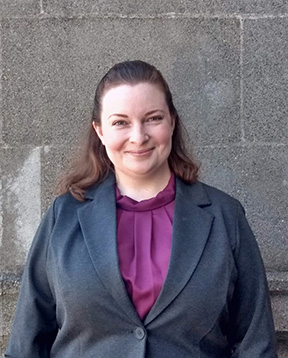 From the Editor: Alison Tyler is the member of our staff at the NFB Jernigan Institute who leads our effort to establish the Museum of the Blind People’s Movement. Here is her report on a development that could substantially enhance that effort:
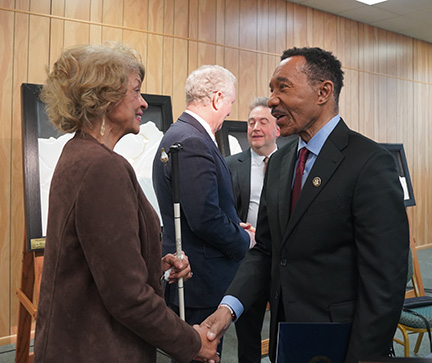
In a moment rich with symbolism and grounded in the power of collective action, members of Maryland’s congressional delegation; the boards of the National Federation of the Blind and the Jacobus tenBroek Memorial Fund; Baltimore City Councilman Zac Blanchard; and other dignitaries and Federation leaders gathered at the National Federation of the Blind Jernigan Institute on December 5, 2025, to announce the introduction of legislation that recognizes, at the national level, the central role blind people have played in advancing civil rights in the United States. The bill, introduced by Congressman Kweisi Mfume in the House of Representatives as H.R. 6467 and Senator Chris Van Hollen in the United States Senate as S. 3371, would designate the Museum of the Blind People’s Movement, to be housed inside the NFB Jernigan Institute, as the National Museum of the Blind People’s Movement.
As President Mark Riccobono noted in convening the press conference, “The history, lived experience, and contributions of blind people are essential parts of the American story that are undershared and often not understood at all.” The bill acknowledges that blind people have faced systemic discrimination, low expectations, and barriers to equal participation, while nevertheless making “significant contributions to society which have often gone underrecognized.” It further highlights the founding of the National Federation of the Blind in 1940 as the point at which blind Americans self-organized on a national basis to “raise expectations in society” and build a vehicle for collective action.
The bill also recognizes that, throughout its eighty-five year history, the Federation has amassed millions of artifacts, documents, and stories chronicling the individual and collective accomplishments of blind people. Those materials, along with future exhibitions and programming, will form the foundation of a museum unlike any other in the nation: a cultural institution that centers the experience of blind people themselves and is owned and operated by the blind of America.
This will not simply be a museum about blindness; it will be a museum about people—their agency, their resilience, and their insistence on equality.
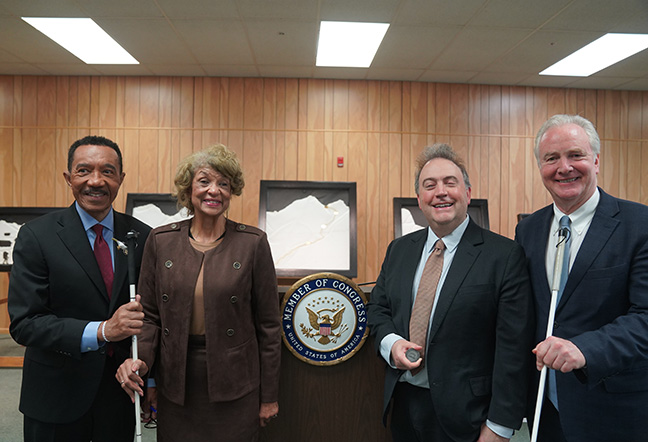
A Moment of Recognition and Resolve
At the press conference, President Riccobono situated the announcement within the Federation’s long commitment to preserving the movement’s history. When the organization nearly emptied its bank account to purchase the South Baltimore site of its national headquarters in 1978, he explained, one of its first acts was to bring into the formerly derelict building, constructed in the early twentieth century, the records and artifacts of its first four decades. “We began investing heavily in preserving the stories of blind people in this nation,” he said, adding that the Federation has been investing in Baltimore ever since. Today, the National Archives of the Blind People’s Movement occupy more than 20,000 square feet of the NFB Jernigan Institute.
Yet President Riccobono was unequivocal that preservation alone is insufficient; the stories currently “do not reach far enough.” He spoke of the planned museum as a catalyst for wider recognition and engagement: a place “to bring those stories to life in new, fully inclusive, and accessible ways; to teach all other cultural institutions about true accessibility; and to create new digital platforms so that these stories can be shared and used across the globe to change the understanding of blindness.”
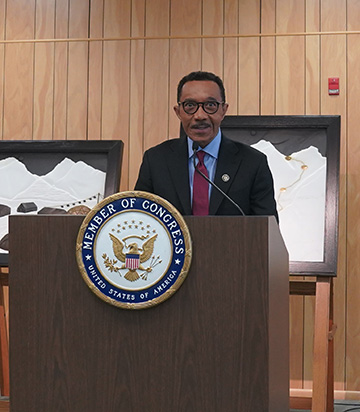 Congressman Mfume, whose district includes the NFB Jernigan Institute, delivered remarks that characterized this recognition as a marker of Baltimore’s civic progress and national profile. Drawing on the precedent of granting the National Aquarium its designation in 1980, he emphasized how congressional recognition elevates local institutions to national prominence. He also connected the museum to a broader civil rights narrative, highlighting the intellectual contributions of Dr. Jacobus tenBroek—the founder of the Federation and a noted legal scholar—to the architects of the Brown v. Board of Education decision. He read from a letter that Dr. tenBroek received from Thurgood Marshall, the civil rights icon who argued the case and later became a Supreme Court justice. This letter is one of the many gems in the archives and was featured in the October 2025 issue of the Braille Monitor.
The Congressman also underscored the museum’s significance as the first blind-owned, blind-led institution of its kind, one that will serve “students, researchers, veterans, workers, and families from every corner of the United States.” He declared firmly that he and Senator Van Hollen would “fight this tooth and nail” to ensure the bill’s passage.
Senator Van Hollen, in turn, celebrated the Federation’s decades-long leadership in advancing equal opportunity and reframing disability as an issue of civil rights. He placed the museum’s national designation in the context of the nation’s ongoing effort to fulfill the promises of the American Revolution as it approaches its 250th anniversary, the promises of “equal rights and equal justice and equal opportunity.” “What this museum will do,” he said, “is help tell a very important part of that story as we work to truly complete the work of building a more perfect union.”
Through Our Past We Can See Our Future
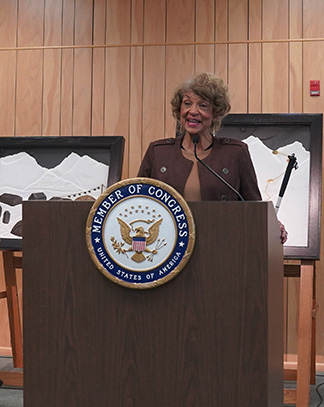 The press conference concluded with remarks from Ever Lee Hairston, a member of the board of directors of the Jacobus tenBroek Memorial Fund (which owns and operates the NFB Jernigan Institute facility) and a longtime civil rights advocate. She shared her own experiences with discrimination, including a college professor who dismissed her blindness as an excuse to get out of taking an exam. (She later took and passed it.) Later, inspired by the words of Dr. Martin Luther King Jr., she joined civil rights marches that ultimately contributed to the passage of landmark civil rights and voting rights legislation.
Her reflection connected the civil rights journey of African Americans to the ongoing struggle of blind people for equal opportunity. “Through our past we can see our future,” she said, urging all present to advocate vigorously for the passage of the museum designation legislation.
A Historic Moment in Our Movement’s Journey
The press conference was followed on December 8 by the release of an official statement from Senator Van Hollen, Congressman Mfume, Baltimore City Mayor Brandon M. Scott, and President Riccobono. Here is the text of the release in its entirety:
WASHINGTON, D.C. – Last week, U.S. Congressman Kweisi Mfume (MD-07) and Senator Chris Van Hollen (D-MD) announced their joint introduction of legislation to designate the new Museum of the Blind People’s Movement in Baltimore as the official National Museum of the Blind People’s Movement. Once established, this museum will be the first to be blind-owned, operated, and led.
“Blind Americans have long faced discrimination and low expectations, but that has never stopped them from making vital contributions to our society that are far too often under-recognized,” said Congressman Kweisi Mfume. “By acknowledging this institution as the National Museum of the Blind People’s Movement, Congress honors an important American story and supports a first-of-its-kind, blind-owned and blind-led cultural institution that will serve students, researchers, veterans, workers, families, and visitors from every corner of these United States of America.”
“We can all learn from stories of the pioneering blind Americans who have organized and led the movement that reshaped our nation in the direction of equality. With this legislation, we are working to honor eight decades of leadership and ensure this history is preserved, shared, and celebrated not just locally, but nationally as well. As a member of the Senate Appropriations Committee, I’ve been proud to support this mission with $301,000 in direct federal funding, and, now, to team up with Congressman Mfume on this legislation to designate it as the National Museum of the Blind People’s Movement,” said Senator Van Hollen.
“The introduction of this legislation marks a historic moment in our movement’s journey. The National Museum of the Blind People’s Movement will be the first blind-led and blind-centered museum that authentically preserves and shares our stories of advocating, innovating, and transforming society. This museum will be about the people who have demonstrated that with proper training and opportunity, we achieve equality and full participation in all aspects of American life,” said Mark A. Riccobono, President of the National Federation of the Blind. “We are grateful to Congressman Kweisi Mfume and Senator Chris Van Hollen for championing this recognition. This museum will serve as a national platform for dialogue, education, and inclusion—connecting our rich history with action that makes a difference.”
“We are proud to support this effort to uplift and honor the blind community with a museum here in Baltimore,” said Mayor Brandon M. Scott. “Our city prides itself on celebrating the history of those who shaped our nation, especially folks whose stories are not often told. We look forward to supporting the best federal delegation in the country as they work to advance this bill.”
The National Federation of the Blind (NFB), founded in 1940, has preserved a great number of artifacts, documents, and literature that chronicle both the struggle and progress of blind people across the United States. The NFB has committed to the collection, preservation, and curation of the history of the blind through the establishment of a museum to house these artifacts. The museum will serve as a national platform to explore these stories, foster understanding, and spark dialogue today.
Recognizing the Museum of the Blind People’s Movement as the National Museum of the Blind People’s Movement would be a significant step towards providing long-overdue national recognition to the many contributions to our nation and its collective history that have been made by blind Americans.
A National Museum for a National Movement
 The introduction of this legislation is not merely a ceremonial gesture. The designation of the “National Museum of the Blind People’s Movement” recognizes what we have long known: that blind people have shaped, and continue to shape, America’s pursuit of justice and equality. The history, lived experiences, and contributions of blind people are essential parts of the American story which deserve a permanent and prominent place in our national memory. The Museum of the Blind People’s Movement—soon, we hope, the National Museum of the Blind People’s Movement—will stand as a testament to the truth that the stories of blind people are worthy of preservation, study, and celebration at the highest level. It will affirm that our history matters. It will invite the nation to learn from our journey. And it will ensure that the stories of blind people—stories of determination, innovation, leadership, and love—are preserved and shared for generations to come.
Appendix: Complete Bill Text
A BILL
To designate the Museum of the Blind People’s Movement in Baltimore, Maryland, as the “National Museum of the Blind People’s Movement”.
Be it enacted by the Senate and House of Representatives of the United States of America in Congress assembled,
SECTION 1. SHORT TITLE.
This Act may be cited as the “National Museum of the Blind People’s Movement Act”.
SEC. 2. Designation of National Museum of the Blind People’s Movement.
(a) FINDINGS.—Congress finds the following:
(1) Equal treatment under the law and equal access to all the rights, privileges, and protections of the Constitution are core tenets of the philosophy of the United States of America.
(2) Those noble and lofty ideals have not always been met throughout the course of this country’s shared national history and its movement toward a more perfect Union.
(3) People with disabilities have faced unique challenges pertaining to accessibility and civil rights.
(4) Blind individuals have experienced systemic discrimination and low expectations but, despite these barriers, have historically made significant contributions to society which have often gone underrecognized.
(5) Blind people self-organized on a national basis in 1940 to establish the National Federation of the Blind which has served as a vehicle for collective action by the blind themselves to raise expectations in society.
(6) The National Federation of the Blind has served as the model and inspiration for the development of blind-led organizations the world over and sparked the creation of the International Federation of the Blind which later became part of the World Blind Union.
(7) Throughout the course of its eight-decade crusade to ensure the full integration of the blind into society on the basis of equality, the National Federation of the Blind has acquired innumerable artifacts, documents, and literature detailing the individual and collective accomplishments and struggles of blind people and how those individuals have contributed to the broader American society.
(8) The United States has no cultural institution that centers the experience of blind people and elevates the understanding of how those individuals have worked together to improve society and to change the negative misconceptions about the blind in the Nation and around the world.
(9) The National Federation of the Blind has chosen to commit to the collection, preservation, and curation of this history through the Museum of the Blind People’s Movement located inside the National Federation of the Blind Jernigan Institute in Baltimore, Maryland.
(10) This will be the first museum owned and operated by the blind of America.
(11) The museum, as well as the existing archive which is currently available to researchers, will serve as a national platform to explore the struggles and successes of the blind as individuals, as collectives, and as a movement, and to encourage understanding of the past, and facilitate awareness and evoke dialogue in the present, while inspiring respect, determination, and action for an equitable future.
(b) DESIGNATION.—The museum known as the Museum of the Blind People’s Movement, located at 200 East Wells Street in Baltimore, Maryland, is designated as the “National Museum of the Blind People’s Movement”.