The Myth of the SuperBlind
by Cricket X. Bidleman
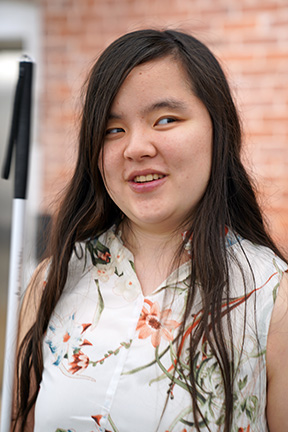 From the Editor: Cricket Bidleman has contributed to these pages before on the topics of fostering inclusion and helping blind people to understand our full potential. Here are her thoughts on how myths of what the Federation expects or is perceived to expect can present barriers to inclusion and how this can be avoided. Here is what she says:
When I entered the National Federation of the Blind about a decade ago, I noticed a tendency among some other members to hold up role models that I will call the SuperBlind—people (many of whom were in leadership) whom they perceived to be capable of anything and everything. At the time, I was a high school student, and I was awed by the concept of these people. Occasionally, I was accused of being one of them, but I am not, for reasons I will describe in this article. While mentors and role models are crucial to our movement and to our individual development as blind people who live the lives we want, I have come to believe that demonstrating our philosophy of blindness isn’t about being good at everything, and that when we emphasize the skills of our leaders too much, we can unintentionally create a barrier to entry or full participation in our organization.
When I was little, I often memorized directions for mom, who admitted to being “navigationally challenged.” I could tell from various context clues about how quickly she drove, and as a result, about where we were on a route. I would tell her things like, “When we get to [insert street] turn right, but be careful of the trolley tracks.” I am now navigationally challenged myself, since I take medication with the unfortunate side effect of making me dizzy almost constantly. Directional corners are now very much beyond my grasp. I am ashamed of how often I use a GPS when traveling independently, even to places I’ve been to dozens of times. I walk a lot because it’s good exercise and affordable, but I do often feel like I have something to prove, like if I work hard enough, I can be as good as (or better than) I used to be. I can reach that SuperBlind travel standard, whatever it is.
I used to be proud of how good my memory was. I didn’t brag about it because there was no reason to, but it certainly was a strength. If you gave me a phone number, or a story about you and your family, they would be in my head forever. Some thought I had a photographic memory, which I did not, but it was certainly above average. I did very well academically, and I wanted to go into physics because I had an aptitude for it. College math kicked my butt though, and then I started having medical issues. For various reasons, including brain surgery, that memory is no longer there. It might be what is called working memory… Or maybe it’s short-term memory. I forget which. I now have to work hard to remember those things I used to just know. Someone had to remind me of her shellfish allergy probably a dozen times before I remembered, and now I’ll never forget, but mostly out of embarrassment.
My parents refused to allow me to learn daily living skills, which my teachers and I often argued with them about. One day, one of them sent me home with a packet enumerating reasonable expectations for blind students of various ages, and though I found using a can opener fairly intuitive, I couldn’t do much else. As with many kids presented with a “forbidden fruit,” I desperately wanted to learn to cook, and I often read about food science. In college, I taught myself how to cook based on what I learned, and I am proud to say that I am especially an avid baker. There is always more to learn about cooking and housekeeping though, and if there is one thing I love, it is learning. Although I wouldn’t mind if I didn’t have to do laundry…
These examples illustrate how my skillset has changed, even over just the last decade. The navigational and memory issues are a matter of circumstance, and although I wish my parents had let me learn to cook, there’s a chance I wouldn’t enjoy it nearly as much as I do now. I was never one of those mythical SuperBlind, and I’m certainly now even further from this unreachable bar. I have more disabilities than I did back then, and my strengths and weaknesses have changed.
Unfortunately, some of the worst oppression has come from within my own community, and I know others have similar experiences. There’s a lot of literature supporting this for various minorities. We reasonably expect empathy to come from within the Federation because no one understands the blind experience like blind people do. But some, probably unintentionally, have made me feel like a burden because of my navigational, memory, and back issues, all of which I’m insecure about. I am not innocent either, though. I have made others feel similarly, the vast majority of which has been unintentional, and if I have done that to you, I unreservedly apologize. Being more intentional about avoiding micro-aggressions is essential if we want to help everyone feel welcome in our community, and it is something we should all work on. Including me. This is one way to foster inclusion, which is one pillar of what the Federation stands for.
When we hold up people as mentors or role models, we should remember that all of them are likely to have insecurities and things they are working on. Creating a community in which individuals feel comfortable being vulnerable is impossible when we think of and advertise others as the SuperBlind.
Externally, I strongly dislike when I meet someone who, upon finding out that I’m part of the National Federation of the Blind, says, “Oh, so you’re one of those Federation people,” with a tone clearly conveying their perception that we feel we’re somehow superior. We are not, and I haven’t met too many people who actually feel they are. Especially in a world seeking to divide us based on wealth, disability or lack thereof, or any number of characteristics, we really can’t afford to convey this attitude, either to others not yet part of the community or to those within.
The myth of the SuperBlind does not describe who we are; instead, it tempts us to measure ourselves against fantasies rather than realities. The philosophy of the National Federation of the Blind teaches something different: that blindness is not what holds us back. Low expectations are what limit us. Low expectations tell us that as blind people we cannot do anything. This is certainly toxic. But so is claiming that we can, or must, do everything perfectly. This is an unattainable standard. Our collective strength lies not in an image of perfection, but in the truth that blind people, like all people, grow and change. We learn skills over time; circumstances shift; new challenges emerge. None of this diminishes our capacity. Instead, it reminds us that we build competence through opportunity, community, and belief in one another.
The Federation builds a world where blind people can live the lives we want. This means building a community where no one feels the need to perform invincibility. It means supporting each other as we try, fail, learn, adapt, and succeed—often in ways that look different from one person to the next. When we embrace the full range of blind people’s experiences, we deepen our understanding and strengthen our movement. If we reject the myth of the SuperBlind, we make room for something better: a philosophy grounded in dignity, shared responsibility, and real expectation. We become a community celebrating both vulnerability and authentic success, where everyone belongs. This is the future the Federation is building—one where we recognize that none of us must be superhuman to be equal, capable, and free.