The Courage to Bloom
by Elizabeth Rouse
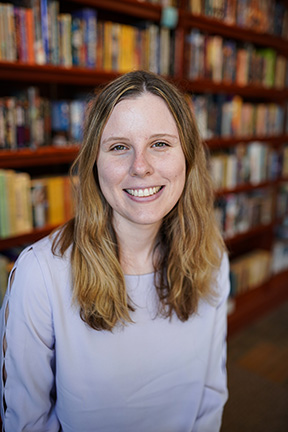 From the Editor: Elizabeth Rouse is a proud member of the 2025-2026 Kenneth Jernigan Leadership in Service Program cohort. While she has been blind since birth, she didn’t get heavily involved in the Federation until she began college in the fall of 2016. Now, almost ten years later, she wears lots of hats in our organization at both a state affiliate level and a national division level, and when asked, she shared that she “wouldn’t have it any other way!” Here are some reflections she shared that, among other things, are appropriate as we celebrate Mother’s Day:
Children begin asking one of life’s most pivotal questions at an early age—“Why?” While I can only imagine how quickly parents tire of being subjected to these curiosity-inspired lines of questioning, I will forever be grateful for my mother Monica’s willingness to tackle one of my life’s greatest inquiries: “Why do I have to be different?” While she didn’t know it in the moment, she planted a seed of positive blindness philosophy that parallels what we in the National Federation of the Blind know to be true. Blindness is not the characteristic that defines me or my future.
After being diagnosed with Leber’s Congenital Amaurosis (LCA) at around five months old, my parents worked hard to give me every opportunity childhood offered, including riding a bike, learning to swim, falling in love with books, and, with a slightly higher frequency, falling and getting hurt. When I began pre-school, an Orientation and Mobility Specialist placed a white cane in my hand for the first time, and I hated it on sight. I could not figure out for the life of me why I had to carry this obtrusive stick, a blatant indicator to anyone who looked that I wasn’t normal.
One day, out of frustration most likely, I asked my mom, “Why do I have to be different?” Instead of offering me some sort of placating remark, she painted me a visual image that still resonates to this day. “Different doesn’t have to be bad, Bethy. Think about it this way, you’re a flower just like everyone else, but in a field of daisies, you’re a violet.”
As I continued to progress through middle and high school, I tried to keep this guidance in mind, which is no easy task for young women. Anything that makes you stand out–height, weight, family make-up–is fodder for ridicule in the public eye. Thus, having the comfort of knowing my blindness didn’t have to be seen as a negative helped me navigate the treacherous waters of female adolescence.
Only after I found and embraced the Federation did I truly understand the wisdom of my mom’s explanation. The seed that was planted oh-so-long-ago was nurtured by mentors and friends who took the time to help me better understand that my blindness was simply a part of me. It didn’t have to be the biggest, best, or certainly not the worst part of me. My mother’s guidance made accepting the beliefs of our organization much simpler, and frankly, it laid a strong foundation for my willingness to accept others. Nowadays, I think it’s a bit more accurate to believe I’m a violet standing next to a rose, a chrysanthemum, and a tulip in that field full of unique flowers. Instead of fixating on our differences, though, I choose to celebrate the unity we share along with the attributes that make us our own blossoms.