Generational Federationism
by Latonya Phipps Cross
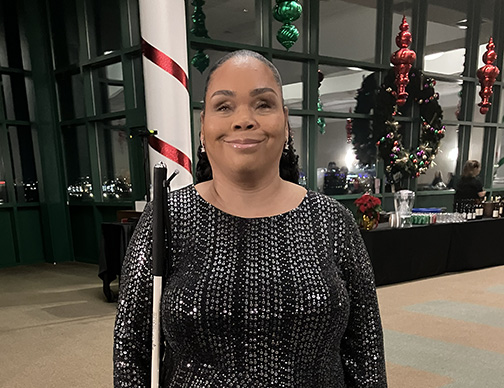 From the Editor: Latonya Phipps Cross is an attorney and serves as president of the Baltimore County Chapter of the National Federation of the Blind of Maryland. She is also part of the current Kenneth Jernigan Leadership in Service cohort.
Blindness was not a welcome characteristic in my household growing up. I remember my mother crying after doctor’s appointments and constantly being asked if I could see things. I internalized early that eyesight was better, and there must be something wrong with me if I could not see.
I grew up as a print reader using a small handheld magnifier. It doesn’t make much sense to me now, but the large-print books were actually too large for me to see. Over the years, the print would become more dim and harder to read. I remember sitting on top of my dresser at an angle so that the light reflected just right on the book for me to see it.
I did not know anyone who was blind until I lost all of my residual eyesight in my sophomore year of high school. Then, I attended the local school for the blind for a year, where I learned Braille and cane travel. I met other blind students, but in my mind there was still a hierarchy between the students who were totally blind and those who had some eyesight. I did not necessarily feel good about being blind.
At the end of my first year at the local school for the blind, I met with the guidance counselor, who suggested that I choose a vocation that did not require college. I explained to him that I planned to attend college. He dissuaded me from that goal, so I withdrew and went back to my public high school.
Once back at my high school, I used my Braille and technology skills. I read my books using cassettes and wrote my papers with a Braille-N-Speak. I thrived. I went from regular college preparatory classes to an honors slate of classes in my senior year. But although I was smart and thrived with the use of the alternative skills of blindness, I still felt different and somehow less-than as a blind person.
Winning a national scholarship totally changed my life. I heard for the first time that it was respectable to be blind. After decades in the National Federation of the Blind since winning that scholarship, I now know that sight is not better than blindness and no one is less of a person if they cannot see. Blindness is just what it is: the inability to perceive the environment visually. It does not change your value as a person.
In 2001, I became a parent. When I learned that my daughter had the same eye diagnosis as me, I initially was devastated. I knew the world would think of her as less-than because of the lack of eyesight. No one wants their child to grow up experiencing the same difficulties you experienced as a blind person. But, why not? If I learned to thrive as a blind person, why wasn’t that good enough for her as well?
So, I sought to give her every advantage that I did not have growing up. I pushed for her to learn Braille when she was just three years old and had significant usable vision. She was a part of the first-ever BELL® Academy program, which was pioneered in our home state of Maryland. Why? Because I knew that if she had the same diagnosis I had that she may one day be totally blind and I wanted her to be equipped with the necessary skills to live independently in the world.
When she was about four, we went to the Maryland Science Center for a Sunday afternoon trip. It was just the two of us. All of a sudden, she dropped to the floor and said that she could not walk. I had no idea what was going on, but I carried her out of the Science Center that day and went home. I let her rest and the next day sent her to preschool as usual. About mid-afternoon, I received a phone call from her teacher. Once again, my daughter was complaining of pain and could not walk. I went to pick her up and took her to the pediatrician, who said that he thought she had juvenile idiopathic arthritis. A subsequent visit to a pediatric rheumatologist confirmed this. My daughter had both uveitis and juvenile idiopathic arthritis. Great!
Now, as a totally blind single mother, I had to figure out how to rear a confident low-vision and arthritic child while being employed full-time at a job commuting from Baltimore to Washington, DC, daily. Easy, right?
I signed my daughter up for every program for which she was eligible. Independence 101 at Blind Industries and Services of Maryland was her first full-time emersion into life as a blind person. She continued to learn Braille there. She learned computer skills with a screen reader and rode public transportation. More importantly, she had low-vision and blind peers and mentors from whom to learn and grow. Her foundation was set as a middle schooler. As the Biblical book of Proverbs says, “Train up a child in the way he should go; even when he is old, he will not depart from it.”
We also got involved with the Arthritis Foundation. Like the National Federation of the Blind, the Arthritis Foundation encourages kids to live their best lives. Though your joints may hurt a little, that should not stop you from playing sports. My daughter signed up for soccer, volleyball, lacrosse, cross-country, and swimming. The highlight for her was practicing one summer to make the junior varsity volleyball team in high school.
Her school years would bring several surgeries and medication transitions. Even today, as a young adult, she is still managing these fluctuations in visual acuity and transitions in medications. She has lost significant visual acuity in the last three years. Earlier this year, it brought me joy to watch her share with her doctor that life goes on whether you are blind or not and you can have the same quality of life if you acquire the necessary skills. She often remarks that some people should attend the Louisiana Center for the Blind, as I did.
Last summer, my daughter invited me to meet her in Barcelona, Spain. Her job encouraged her team to travel internationally in August. She still had work responsibilities, so it was not a 100 percent vacation for her. I met her in Barcelona as any other mother would. I did not have special help, and I do not speak Spanish well at all. It was my first European trip, and I was traveling almost solo.
I am a big culture geek. Wherever I travel I want to learn about the people, the politics, the music, etc. I set up a guided tour. Prior to the tour, my daughter and I had walked for five hours through the shopping districts and parks and eaten lunch. When it came time for the tour, she said she would see me back at the hotel. She had to train the new analyst. Leaving your totally blind mom to fend for herself in the streets of Barcelona is the normal in our relationship.
Recently she met with a principal of a school where a blind child attends. She told the principal the expectations she should have for the blind student. As she spoke, I thought to myself, “Where did she get all of this information to not only live her best life, but to advocate for another blind child?” The National Federation of the Blind, of course.
In the Black community, we often speak of generational wealth. Through being a member of the National Federation of the Blind, I learned about generational Federationism. I learned that a single totally blind mom can rear a confident low-vision and arthritic child. I learned that I could be an example of working as a professional for a daughter who one day may be totally blind. My daughter learned that there are thousands of blind people all over the world who do not allow vision loss to stop their lives or their dreams. Together my daughter and I have learned the value of generational Federationism—that each generation can hand down wisdom to the next and achieve feats once thought unimaginable.