How I Came to the Federation
by Amy Porterfield
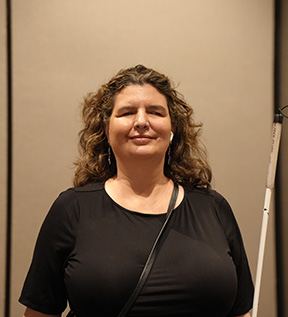 I was about six weeks old when my parents figured out I wasn’t tracking anything visually. The doctors confirmed I was totally blind. My mom and dad had never met a blind person before. When the doctor told them to place me in a sanatorium in Coolidge, Arizona, because raising a blind child would be too hard, they knew there had to be a better way.
My mother called what was then Arizona Services for the Blind. A young blind man named Ray Mungaray picked up the phone. He told my parents I could live a good life, and that it was their job to help me explore the world. They took him at his word. My childhood is full of memories that prove it. My father would distract the staff at a museum while my mother ducked me under the velvet ropes to touch the exhibits. My mother opened boxes on toy store shelves so I could feel what was inside. In our house, curiosity wasn’t just permitted. It was expected.
My father became a teacher and later an administrator at the Arizona School for the Blind, and my mother worked in the dorms. Both spent over thirty years at the school. My father used to tell me, “You are normal. You just can’t see.” That sentence was the interior compass I carried about what every blind person had the right to expect from their own life. But having a compass is not the same thing as trusting it when a credentialed voice tells you to put it down.
The Long Detour
I didn’t go straight into the field. I spent years in other human services work while earning my master’s in rehabilitation counseling and raising my preschool-aged son, Jordan, on my own. When a position opened teaching access technology at what was then the Southern Arizona Association for the Visually Impaired, I took it.
Once I was in the building, it didn’t take long to see how differently blind and low-vision students were treated. Students with residual vision were given opportunities to try things. Students with none were given excuses. I started meeting with the executive director about what more could be built, and together we wrote a grant so that I could complete my master’s internship at the agency, build a comprehensive program, and get paid for the work. As a single mother raising Jordan, an unpaid internship was not something I could afford. The grant was how I took care of my son and stayed in the field at the same time.
Even with the grant in place, the culture around me did not change. My supervisor told me to teach my students about good-guy drinking glasses and bad-guy glasses. Tall or thin glasses were the bad guys because they would be too hard to pour into. I was supposed to teach that in the name of safety. I refused. There were other things I also refused. My students were called my disciples. I was often ostracized by my sighted peers.
I eventually left to work at the Arizona Rehabilitation Services Administration, where I met people doing the work differently. I met Julie Deden from the Colorado Center for the Blind and saw what authentic blind training looked like, where students led and confidence was not a goal but an expectation.
A Class in a Living Room
Around the same time, I enrolled in a rehabilitation teaching methods class taught out of a living room. Bob Kresmer, now the board chair of Saavi Services for the Blind and then the president of the Tucson Chapter, and his wife, Lynn, taught it out of their home. It was the best class I ever took. They had made the environment so completely accessible that there was nothing to accommodate. Philosophy and technique were the same subject, braided together. Bob started inviting me to the National Convention, and every year I had a reason I couldn’t go. Eventually, when Mike Gordon became Saavi’s executive director and brought me back as associate director, he told me to go, and that the organization would support it. So I went.
The Convention Lobby
It was the day before convention, the evening when everyone reconnected after a year apart. I had come down to the hotel lobby to meet Bob and Lynn Kresmer. While I waited, I really listened to what was around me: canes tapping in every direction, conversations overlapping, and people greeting each other like family.
What captured me first was the young, confident blind women. They moved the way I moved. They talked the way I talked. They carried the confidence I had always carried. I realized, sitting there, that I had been missing these friendships in my own life. I had grown up around blind adults and blind friends, but I did not have a peer community of blind women who were mine. The second thing I realized, almost without a gap, was that my students back home were missing this too.
Then I saw a teenager I recognized. The year before, we had worked with him at our “Ready, Set, Go” summer camp, and my orientation and mobility teachers had told me, with the confidence of professionals, that he would never travel independently. I didn’t question it. I took them at their word. That same young man had gone to the Colorado Center for the Blind after our camp, and every time I turned around in that convention hotel, there he was: traveling on his own, crossing streets, and moving with his friends. He had been let loose.
The Shame
I want to tell the truth about what I felt in that lobby, because if I don’t tell it honestly, I can’t tell the rest of this story. I felt a profound shame. The shame wasn’t that I hadn’t known. That would have been easier. The shame was that I already knew. My father had handed me the compass when I was a child. Ray Mungaray had told my parents, before I was old enough to remember, that my life could be a full one. The Braille Monitor and the Kernel Books had come to our house my whole life. I still remember a piece I read years ago by a woman who had a mouse in her house and had to catch it and let it out. I used to turn it over in my mind, picturing how she had done it, running through how I would do it myself if I ever had to. I think about that piece to this day. So I knew that blind women lived ordinary lives, solved ordinary problems, and wrote about them in their own voices. Everything I needed to push back on what my orientation and mobility teachers had said about that young man, I already had. And I didn’t use it. I deferred to their credential over the student’s own potential.
That is the conditioning it would take me years to name. Low expectations are insidious. They live in the blind adult at the buffet line deciding whether to try to serve herself. They live in the habit of saying, “I can’t,” when what we mean is, “I was told I couldn’t.” Every one of us has done some version of this. I certainly have.
I came home from that convention and went straight to Mike. I told him we were hurting our students by not letting them find their own potential, that the Federation was offering something critically important we had been missing, and that we had to learn it together. Mike believed me. He caught my zeal and he backed me. The rebuilding of everything we thought we knew is a story for another article.
The Work Across Years
The first time I met Mark and Melissa Riccobono was at an Arizona state convention when, in 2011, Mark was serving as our national representative as the executive director of the NFB Jernigan Institute. He was kind and funny, and he was the first person to make me feel like a real Federationist rather than a professional visiting from the outside. What he offered me that day is what I have tried to offer every person I have met in the Federation since. A way to join, and to feel like they matter. That is the most important work I feel I can do in the Federation. Melissa was there with their toddlers, moving through the convention as an independent mother and a professional at the same time. I was still a single mom then, and watching Melissa was its own kind of affirmation.
Every convention I attended in those growing years surfaced another layer. One year the layer was what I had allowed at the center. The next it was catching myself still deferring to a sighted lead in small ways. Each year, Federationists beside me were working on the same layer. We didn’t finish the work. We shared it.
Pam and Rolland Allen and Joanne and Harold Wilson became mentors and friends. We would catch up at convention and keep the conversation going in between. Pam had a way of listening long enough and patiently enough for me to find the next step. Joanne had a way of pumping me back up when I was discouraged until I remembered why I had started.
The closest anchor through all of it has been my husband, Donald Porterfield. Donald came to Saavi as a student. After his training we began dating and we built a life together. He is a prosecuting attorney by profession and today serves as president of the National Federation of the Blind of Arizona. He believes it is our responsibility to use our gifts to advocate for those who haven’t yet found how to use theirs. That belief has been the steadying line through convention after convention where I found another layer of the shame to work through. Donald has walked me back into the work more times than I can count, and he has walked a great many other blind Arizonans into it beside him.
What the Federation Is For
Becoming a Federationist did not make me a different person. It reintroduced me to the person I had already been. What the Federation adds is the part no training center and no mentor can provide alone. It is the place where the work of pushing back against low expectations gets held across time, across members, and across generations so that no one of us carries it alone.
I know this in a particular way now, because I have watched it happen in the lives of our students. The young blind people I first started bringing to convention years ago meet each other there, year after year. They have become each other’s roommates, best friends, wedding party members, and babysitters. They are raising each other’s children beside their own. The friendships I spent my twenties looking for are the friendships they have now, and they have them early. That is why we show up at convention together, loud and proud. Not because we are trying to be noticed, but because we actually love each other, and a room full of people who love each other tends to make a certain amount of noise.
That is the life I wanted for that teenager the first time I saw him free in a hotel lobby. It is the life I want for every student who walks through the doors of Saavi Services for the Blind. And it is the reason that, whenever a student graduates from our program, I tell them the same thing: Training gives you skills. The Federation gives you a home.