Becoming Blind: Finding the Truth Beyond Vision
by Ahmad Shafi
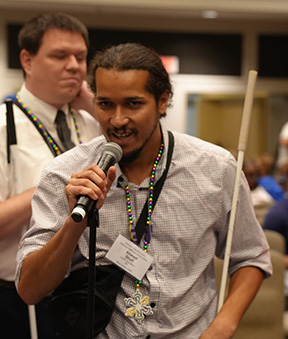 From the Editor: Ahmad Shafi is president of the National Federation of the Blind of West Virginia and participated in the 2025-26 cohort of the Kenneth Jernigan Leadership in Service Program.
Growing up, no one would have ever considered me blind. Most people assumed I was clumsy, and that probably made sense at the time since I bumped into things constantly. I’ve always worn prescription glasses, so to others I could “see.” What I didn’t realize was that my experience of the world wasn’t the same as everyone else’s. When night came, my vision disappeared almost entirely—but I assumed that was normal.
Blindness was not unfamiliar in my life. My mom taught us to offer help to blind people crossing the street. My first babysitter was blind. I didn’t think much of it—I even used to hide from her as a game. She took care of us, fed us, walked with us, and rode the bus. My uncle is also blind and has worked at the same hospital longer than I’ve been alive. Even with all of that exposure, I didn’t truly understand what it meant to be blind.
That changed when I was about the age of 13. I was admitted for a sleep study for unrelated reasons, and a doctor noticed something unusual in my eyes. After multiple appointments with retinal specialists, they diagnosed me “legally blind” with Retinitis Pigmentosa. It was a shock—but also an explanation. Suddenly, the things I struggled with made sense. For my mom, it was much harder to learn that her son had a rare genetic eye disease.
In seventh grade, I was given a choice: start learning Braille and Orientation and Mobility (O&M) right away, or wait until high school. I chose to start immediately, and I’m glad I did. At that point, I didn’t feel ashamed of being blind. In fact, I was excited. I told my friends when I got back to school. But their reaction changed everything. They told others, and soon they began avoiding me. That was the moment I learned that blindness, to others, meant something very different. From then on, I became more selective about who I told and when I used my cane.
That summer, I attended programs at the Romney School for the Blind. I earned my first leadership award there. I also visited places like Gallaudet University for the deaf and the headquarters of the National Federation of the Blind. There, I had my first real conversations about blindness. But even then, I didn’t fully understand what was possible. I remember saying I would never let a blind person cut my hair. I even saw the now President Riccobono driving a car and thought maybe I could still drive someday. I had hope—but not yet clarity. So I kept searching.
I attended NASA Space Camp for Visually Impaired Students throughout high school. I joined programs that took blind students skiing, whitewater rafting, and ziplining. At sixteen, I was selected to raft the Grand Canyon. I was surrounded by blind people doing incredible things. But despite all of these experiences, something was missing. None of these programs fully changed how I understood blindness.
That began to shift my junior year, when my O&M instructor told me about people with my condition—Retinitis Pigmentosa—who never fully accepted blindness or learned the skills they needed. He also told me about the Louisiana Center for the Blind. Around the same time, I realized how easily blind students can fall through the cracks. I had not been introduced to access technology early enough. I had to fight for what I needed. In college, that fight continued. I studied cybersecurity, but the systems we relied on—websites, course platforms, exams—weren’t accessible. When I raised concerns, I was asked to prove it. Even when I did, little changed. When COVID moved everything online, the barriers became overwhelming, and I had to withdraw.
That was the turning point. I made a decision: I was going to live as a blind person—fully and without apology. I committed to using my cane everywhere outside my home. I decided that if people had a problem with it, those weren’t the people I needed in my life. Shortly after, I reconnected with the National Federation of the Blind through members in West Virginia. Listening to their stories brought back the hope I had felt years before—but this time, it was different. When I shared my story, they didn’t measure me by how much vision I had. They accepted me completely. Through them, I learned about my rights, about advocacy, and about what was truly possible. They helped me access resources and supported my decision to attend the Louisiana Center for the Blind—even when others in my life doubted it.
That experience changed everything. At the center, I learned practical skills like cooking, cleaning, and technology while wearing learning shades, but more importantly, it changed how I saw myself. I stopped thinking of myself as “a person with some vision trying not to be blind.” I accepted that I am a blind person—and that blindness does not limit my ability to live a full life. I became adaptable. I gained confidence. I developed real independence.
Today, I serve as president of the National Federation of the Blind of West Virginia. I am working toward becoming a certified Orientation and Mobility instructor so I can help others navigate their own journeys.
Looking back, I’ve had many experiences as a blind person—some exciting, some difficult, some transformative. But no organization has had a greater impact on how I understand blindness than the National Federation of the Blind. They didn’t just teach me skills. They taught me to expect more from life.
And now, I want others to know what I didn’t know at the beginning: You have rights. You have options. And you are capable of far more than you may believe right now.
If you’re at the start of your journey, I encourage you to connect, to learn, and to share your story. You never know who it might reach—or how it might change their life.