BELLs Should Be Ringing Everywhere
by Eric Duffy
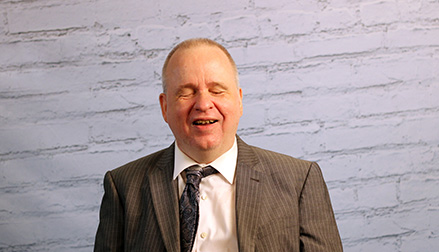 I joined the National Federation of the Blind in 1984. I have held various offices in my local chapter and state affiliate. I have served as president of the National Federation of the Blind of Ohio, and I was Director of Access Technology at the National Federation of the Blind Jernigan Institute. But one of my most rewarding roles has been that of BELL® Coordinator for the National Federation of the Blind of Ohio.
The BELL (Braille Enrichment for Literacy and Learning) program is for blind and low-vision children ages four to twelve. This innovative program was designed and built from the ground up by the National Federation of the Blind. We created the program because we recognized the need for blind children to receive more instruction in Braille than they get during the school year and certainly during the summer. I have coordinated four of the seven programs that the Ohio affiliate has conducted. I have consulted with affiliates that have started programs. For a number of reasons, we have not had a BELL program now in Ohio for a few years. Rather than coordinating a program, I have had time to reflect on the value of BELL. I know that we do far more than teach Braille in these programs, and I for one wonder what my life might have been like today had I been introduced to the National Federation of the Blind through the BELL program. But all of my contemplation on that subject will help no one, including me. Here is what I know for sure: We change lives through this program. Not only do we change children’s lives, we change the lives of blind and sighted adults as well. I plan to demonstrate this through this article and, in doing so, make the argument that BELLs should be ringing everywhere from here on out.
In 2013, Ohio conducted its first BELL program. It was a day program, and I believe we had six students. For most of these students, blindness was their only disability, but it was clear that they all needed the National Federation of the Blind. Not all of the blind adults knew it at the beginning of the program, but we needed them, too. Working this program took most of us out of our comfort zone at least a little, and that’s always a good thing. We challenged the students, and they challenged us. They challenged us to think of exactly how to teach a particular skill. Even at their young ages, they challenged us to explain the importance of wearing learning shades or using a cane. The program lasted two weeks, and most of our volunteers stayed at the Ohio State School for the Blind and commuted to the location of the program each day. The days were long for everyone, and long days turned into long weeks. But we did it. We were proud of our accomplishments and those of the kids. We were satisfied with our work. The students and their parents seem pleased as well.
But we knew that the real test of what we had accomplished was yet to come. What was going to happen in 2014? Could we fund the program? Could we get enough students again? Could we get some of the same students back? Could we get more students? Could we get enough volunteers again?
The answer to all of these questions was overwhelmingly yes from 2014 to 2018. In 2016, we made the decision to conduct a one-week residential program to be held at the school for the blind. Before we were too far along in the planning, I accepted a job at the New Jersey Commission for the Blind. But it will come as no surprise to anyone who knows the Federation that the show went on. Federation leaders in Ohio filled the void and ran successful programs in 2016 and 2017. There was no program in 2018, but in 2019 I had the privilege of coming back to Ohio to live and to coordinate another BELL Academy. Somewhere along the way (and I honestly can’t remember when) we began using the word “academy” rather than “program.” Academy is a much more appropriate word than program. Although I had to get used to this change, many of the students who participated in our first program were still with us. To me this spoke to our success more than anything else to that point. The students wanted to come back, and their parents were bringing them back. This wouldn’t have happened if the students hadn’t been learning and growing and if the learning and growing couldn’t be attributed directly to BELL.
But to me that still doesn’t pass the smell test. For me the question is: How do we know we changed lives? Do the families understand the importance of the National Federation of the Blind? Without a doubt, it is safe to say yes. How do I know? I stayed in contact with some of the families after they stopped coming to BELL. Some families attended state and national conventions. At least one of our first BELL students is now a member of the Capital Chapter of the National Federation of the Blind of Ohio. She is also involved in the National Association of Blind Students. She attended the Midwest Student Seminar this spring. One challenge in doing this was that she had to convince her family that she should and could do this on her own. She did, and, while there, she met Mark and Melissa Riccobono. She has just completed her freshman year at Miami University of Ohio. Here is a story that appeared in the student newspaper:
Miami University Student Honored for Winning National Braille Challenge
Miami University News
May 6, 2026
MaKenzie Love was honored by the Ohio legislature recently for being the first Ohioan to win the national Braille Challenge in 2025 as a high school senior.
Now a first-year student at Miami University, Love told lawmakers about the importance of Braille, a system of writing that uses characters made up of raised dots. She uses Braille every day at Miami and has even read the “Harry Potter” series in Braille.
“Braille literacy is absolutely crucial to the lives of blind and low-vision students. Over ninety percent of students that read Braille are employed, but the startling statistic is that only ten percent of blind people in the United States read Braille,” Love, of Commercial Point, told lawmakers on the floor of the Ohio House of Representatives in late March.
“We need to get out there as a nation and as a community, and as Ohioans especially, to encourage Braille literacy throughout the state and the nation.”
Love, who was born blind, is in Miami’s new Inclusive Education program. She wants to teach PK-5 students who are blind or have low vision.
Ashley Cartell Johnson, clinical professor of Educational Psychology and coordinator of the Inclusive Education program, said, “The Inclusive Education major prepares teacher candidates to teach all learners, including students with disabilities and multilingual learners, in today’s increasingly diverse classrooms. It is the first and only program in Ohio to offer a comprehensive and integrated major that leads to blended licensure in primary general education and K-12 special education (both mild/moderate and moderate/intensive licenses) and to an endorsement in Teaching English to Speakers of Other Languages (TESOL).”
Cartell Johnson said Love is a “dedicated and passionate inclusive education teacher candidate. We are confident that MaKenzie will shape, lead, and define the movement toward inclusive and accessible classrooms that support and honor all learners.”
Love said she plans to attend graduate school after earning her bachelor’s degree.
Love, who made President’s List her first semester, said she’s having a great experience at Miami. “I absolutely love it here. I love the friends that I’ve made, and I have met so many wonderful people.”
She chose Miami because of the education program in the College of Education, Health, and Society. “It really stuck out to me. I loved campus when I first came to visit,” she said, noting that she enjoys being in the Honors College and living in an honors residence hall on Western Campus.
Zeb Baker, dean of the Honors College, said Love is the embodiment of the ‘citizen scholars’ the Honors College has taken as its mission to produce those who use their education to advance the common good.
“MaKenzie is the kind of student who reminds all of us who are fortunate to work with her why we entered this profession in the first place,” he said. “Her inexhaustible love of learning and bottomless energy to do as much good as she possibly can through that learning are an inspiration.”
Love appreciates having the Center for Student Disability Services and the AccessMU Center on campus for assistance when students need them. For her, that ranges from getting materials in Braille and tactile graphics, using assistive technology, to meeting with her professors in advance “so they know how best to serve me in class.”
She demonstrated how she uses the BrailleNote device. She also uses Job Access with Speech (JAWS), a screen reader designed for blind and low-vision users to navigate computers via text-to-speech or refreshable Braille displays. It provides full access to applications, websites, and documents.
Love is able to get around campus without the aid of a guide dog. She walked from a class in Shideler Hall to the Armstrong Student Center’s Shade Room for this interview.
“I think the use of the white cane is absolutely crucial to mobility and to being able to get around,” she said. “It’s so important to have those cane skills before you could contemplate getting a guide dog.”
Love sang “The Star-Spangled Banner” at a Cleveland Guardians baseball game last July for Disability Awareness Celebration Night. Now she enjoys being a member of Miami’s Choraliers women’s vocal ensemble.
“It’s a lot of fun. We get to do a lot of interesting repertoires and a very diverse amount of music,” she said. “And it’s been great to establish relationships with other students that love to do the same thing as I do.”
Robyn Lana, director of the Choraliers, called Love a valuable addition to the choir.
“She works to learn movement and is open to the help of colleagues, who are eager to assist because of her ability and desire to do well.”
While Love uses a Braille reader to learn lyrics that aren’t available for the musical scores, Lana said Love catches on very quickly. Lana noted Love was a percussionist in high school and will be playing a cajon, a box-shaped Peruvian percussion instrument, during this Friday’s concert in Kumler Chapel.
“For this piece, she will ground the tempo for the entire choir,” Lana said.
Love also is involved with Navigators, a Christian ministry student organization on campus, and she is one of the co-founders of the Honors Spanish Tables for students who want to practice conversational Spanish in the Honors College.
She started Spanish Tables with Emma Grupe, resident director of Hillcrest Hall.
“MaKenzie and I were talking at the beginning of the year, and I had mentioned that I was a Spanish major here at Miami,” said Grupe, who graduated in 2024 with a bachelor’s in Anthropology, Spanish, and Linguistics and a master’s in Spanish through the combined BA/MA program in Spanish.
“She speaks Spanish as well, so we started chatting in Spanish that day,” Grupe said. “We discussed the possibility of doing something with Spanish for the residents of the Honors Residential College, and Honors Spanish Tables were born.”
Grupe said Love is a wonderful co-host for the program. “She is such a caring individual, and it shows in her commitment to her community and the ideas she brings to better it. I’m so glad to have the opportunity to work with her in this regard.”
Love said it was gratifying to win last year’s three-day academic challenge testing students on five fundamental Braille literacy skills: reading comprehension, spelling, speed and accuracy, proofreading, and interpreting charts and graphs.
“It was amazing to see how much my work had paid off because I had practiced really hard,” she said. She first won the Harley Fetterman Award for Excellence in Charts & Graphs, which she traditionally considered to be her weakest category. “I was very, very, very surprised and honored to win,” she said.
Love learned she won the varsity competition when her name was called.
“It was very surreal to hear it, but it was also very exciting to know that Ohio had been represented and that my wonderful teachers and instructors in high school were there watching online,” she said.
Her Teachers of Blind Students “got me to that point,” said Love, who at age five became one of the first students to join the Braille Enrichment for Literacy and Learning (BELL) Program through the National Federation of the Blind of Ohio. Love is still involved with the Federation, which she called “a major part of my journey as a student.”
She hopes to pay it forward by working with young blind students. “Braille exposure to individuals at a young age is very important,” she said, “and I think it’s so important and crucial to emphasize the learning of Braille and also to learn from blind adult role models as well.”
That was the student newspaper’s story about MaKenzie, and, yes, I know reporters can often generate a lot of fluff, especially those working for student papers, but MaKenzie is the real deal. I say without a doubt I am proud to know MaKenzie Love and proud to have her as a member of the National Federation of the Blind.
BELL is right for the sighted as well. I first met Caroline Karbowski at the 2018 National Convention. She was just getting to know the organization at the time, and we were just getting to know her. Since then, she has won a Dr. Jacob Bolotin Award for the work her company does with 3D printing. In 2019 She volunteered in our BELL Academy and taught our students how to dissect sharks among other things. On the afternoon the program began, Caroline and I went shopping for supplies. She wore learning shades and used her long white cane throughout the shopping trip. One might be tempted to say she probably used her vision too. From the length of that shopping experience, I can assure you she didn’t. I sat on a bench at the front of the store hoping we would make it back to the school before the families started arriving. Caroline told me that volunteering for BELL has been one of the best learning experiences she has had as she prepares to teach blind children. Caroline is one of those rare sighted people of whom we can truly say, “In her heart, she’s as blind as we are.”
In 2019, Emily Keihl also volunteered to help with our BELL Academy. With encouragement from Caroline, she came to Columbus as the ball of energy that she is. She was terrific with the kids, and she quickly picked up on the alternative techniques of blindness that week. Her growth as a blind person was tremendous. Although she has had a fair amount of useable vision all of her life, her skills and confidence really began to develop as a result of her involvement in the BELL Academy. She is now a leader in the National Federation of the Blind of Ohio. She is also a tenBroek Fellow, which means she has won two scholarships from the National Federation of the Blind.
Since my involvement with BELL, I have consistently said that this program benefits everyone who is a part of it, from the youngest child to the oldest adult. If anyone comes away from the program without learning to do something he or she has not done before, or without having learned to think about blindness in a more positive way than before, he or she didn’t leave it all on the field. I include myself in this as well. I have benefited greatly from working in our BELL academies, and I know you will too. The BELL Academies that are not already planned will not happen this summer, but I hope this article helps Federation leaders from across the nation consider the value of hosting a BELL Academy. I hope that affiliates that are not running a BELL Academy this year will do all they can to host one next year. I would be more than happy to assist in any way possible to help you have BELLs ringing in your affiliate next summer. That’s how much I believe that next summer BELLs should be ringing everywhere.