Eye Condition Twins: A Double-Edged Sword
by Justin Salisbury
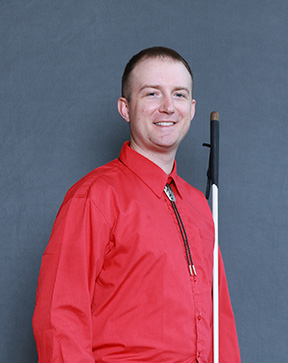 Sometimes blind people with the same eye condition will refer to themselves as “twins” in some way. The most common way that I seem to hear it is “eye condition twins.” In my experience, this is usually done in a positive, playful manner. I support the idea of blind people forming bonds with each other, but something about bonding over having the same eye condition has always seemed problematic to me, even when I could not quite put my finger on why. As I try to grapple with this concept, I hope that readers of the Braille Monitor will consider engaging in a conversation about the idea of eye condition twins and its drawbacks, as well as some of its benefits.
I remember being newly blind as a sophomore in high school and the process of looking for other people who shared the same medical conditions that caused my blindness. My top focus was figuring out how to succeed in the academic and social parts of school, and I was not interested in identifying with other blind people yet. I wanted to be remembered as the competitive student and athlete that I had been before that point, and grouping myself with other blind people seemed like an ineffective way to maintain that status. I would now discourage any other blind people from taking that attitude, but that was what I did at the time.
During the summer, I attended some residential high school youth programs at a training center for the blind. In my first program, which aimed to help youth transition to adulthood, we had a series of classes on a daily schedule, including Braille, orientation and mobility (which did not necessarily include using a cane), individual counseling, group counseling, and a few other things. We did not have classmates in the individual counseling class because that was where the counselor would walk us through the stages of grief and loss to deal with our blindness. In the classes where we had classmates, we were paired with other students who had similar levels of functional vision so that we could discuss similar techniques to accomplish tasks, maximizing the use of our residual vision. I do not recommend this clustering strategy, but it happened. Whether or not the program designers intended this, I found that I ended up bonding more with the students who had similar levels of residual vision, and I bonded less with the ones who did not. This was partly facilitated by the clustering of classmates, but I suspect that I would have taken this approach anyway, since I felt like my level of residual vision was such an important and defining feature of my own life. I wish that my training program had known better than to follow the same beliefs about blindness that I had as a newly blind teenager, but we cannot go back in time.
I noticed that some of the other students who shared the same eye conditions seemed to bond over that eye condition, and I think it was in that summer program that I first heard blind people referring to themselves as twins. At some level, I think this comes from the early conversations that we have with the eye doctors who tell us that we are blind or going blind. Eye doctors have a tendency to tell people that they have a rare eye condition, which is true when we are compared to the general population of the country or world. But once you get into the blind community, some of those eye conditions are quite common. For example, I have heard people start off by saying that they have this super-rare eye condition, eventually naming it as retinitis pigmentosa, only to find that about forty percent of the people in the room share that eye condition. I remember seeing those other blind kids finding their twins and feeling a bit left out when I didn’t have a twin myself.
Consider a conversation like this:
Person 1: Oh my gosh, you have Stargardt’s?
Person 2: Yes, I do.
Person 1: Wow, that’s so cool! I have Stargardt’s, too! We are twins! I’ve never met anyone else like me.
Person 2: Me neither! It’s so nice to finally find another person who understands me!
It took until I was in college to finally meet anyone with the same eye condition as me—and become aware that this was the case—but then that person still did not have a similar amount of functional vision as I did. That still did not seem to count as a twin. I think I was a graduate student at Louisiana Tech University, in my master’s degree program to become a cane travel instructor, before I finally met another person who could be my eye condition twin. By that point, I had stopped caring about the search. There were way too many other ways to bond with other blind people to worry about finding my eye condition twin. Here are a few of those other bonding strategies and examples of why I believe the “twin” approach can be problematic.
If we wait until we find someone with our exact same eye condition to trust that another blind person might share similar experiences with us, we might miss out on the opportunity to bond with a whole lot of blind people who could have much to offer us. One of the biggest ways that I started bonding with other blind people was through student division programming and scholarship programs at the state and national levels of the National Federation of the Blind. One of the biggest factors that helped us bond was shared academic or career interests. If I had waited to trust someone until I found someone with exactly my eye condition, I would have waited far too long.
The majority of the problems that we face as blind people are not automatic consequences of blindness; instead, they are consequences of living in a society that is designed based on sightedness. In our society, the dominant group whose needs and ways are prioritized are the sighted people. The people who fall outside that group share a common experience of our needs being treated as if they exist only in the margins. The margins have been set in ways that create a barrier that keeps blind people on the outside. As we work, collectively and individually, to get past those barriers, we learn things and make progress in ways that benefit everyone else who is kept in the margins like we are. Everyone who shares this common experience of marginalization can work together as one blind community to make the world more welcoming for us.
This is not to say that focusing on our medical conditions is never appropriate. I can easily imagine circumstances in which our medical conditions may lead to certain kinds of barriers that we may face that other blind people do not. For example, some eye conditions cause extreme sensitivity to bright lights, leading people to wear dark sunglasses or hats to minimize discomfort. Some people in our society look down upon those who wear hats or sunglasses. When they have influence over spaces, they may work to set rules, customs, or norms that make people wearing hats or sunglasses unwelcome. People who navigate this barrier may share kinship over shared experiences and be able to support each other in many ways. This is a way that specific ableist societal forces can corral together people with a specific medical condition.
While our level or quality of eyesight should not matter and does not make us any less of a blind person, it can relate to specific kinds of ableist microaggressions that we face. At the time of writing and for the past twenty-one years, I have had a significant amount of residual vision, with pretty good acuity but a narrow visual field. Some people call this “tunnel vision.” I often find that sighted people think that I am faking being blind because I am making good eye contact or reading the sign of a big-box store from across a parking lot. If they do not think I am faking blindness, they may assume that I can see more than I can and expect me to access visual information that I am not receiving. For example, they may try to hand me a printed form that I am supposed to complete visually with a pen, which I cannot do. A legislator may walk by me in the hallway and think that I am rude for not acknowledging them, when I never even knew that they were there, only to find me in their office moments later, looking them in the eye and asking for their support on a bill.
If they are less willing to support that bill because of what they assumed I saw in the hallway, we all suffer. People with no light perception do not experience these same microaggressions in the exact same way. Different groups within the blind community receive their own special casserole of microaggressions, but it is also essential that we work together to combat all forms of ableism against the blind, even if we personally are not part of that subgroup. Nonetheless, there is a way that these shared experiences with special forms of ableism can create some kinship among those smaller groups. Our eye condition twins may belong to the same smaller group as we do.
Overall, I believe that the idea of eye condition twins can be productive in some short-term ways, but I suspect that each blind person needs to progress to a point where we no longer feel emotionally invested in it. Dr. Jernigan gave us a model of three stages of independence: fear and insecurity (FI), rebellious independence (RI), and normal independence (NI). In the early stage of fear and insecurity, the idea of eye condition twins may lead us to feel comfort and acceptance at a time when we may find it difficult to feel comfort and acceptance from other sources. Finding a twin may create a bridge to help us to get connected with a broader blind community and perhaps a local chapter of the National Federation of the Blind. Our twin might get us in the door. If someone learns that I am their eye condition twin and feels a sense of safety, comfort, or understanding with me because of it, I would probably try to treat that as a good thing and help introduce them to additional blind friends and spaces that may help broaden their comfort zone. Eventually, when we get to normal independence, I suspect that we no longer feel the unique kind of emptiness that can only be filled by an eye condition twin. In the phase of normal independence, the eye condition twin is no longer so important to us, but we may be able to be a bridge for others who think of us that way.
Sometimes blind people became blind because of some other medical condition, where blindness was just one consequence. For example, diabetes causes many effects, and blindness can be one of them. In the National Federation of the Blind, we have a division for blind people who also have diabetes, and I think this is a good thing. For a blind person who has diabetes, connecting with other people who have diabetes can lead to sharing tips and strategies for how to manage diabetes as a blind person, such as by using talking glucometers and learning adaptive techniques as blind people with the complicating factor of diabetes. For example, I have heard blind diabetics share strategies for dealing with neuropathy in their hands while learning to read Braille or increasing their reading speed. These are great things, and these other intersecting medical conditions are not the type of twins that I am proposing that we should perhaps consider problematic.
When I think about the ways that I intentionally bond with other blind people, I think it should not be centered around my eye condition. I am much more complex than my eye condition, and my eye condition is a relatively insignificant part of who I am. My identity as a blind person is, by contrast, a significant part of who I am. My eye condition and my identity as a blind person are two very different things. If we think that we can fit in or belong once we find someone who shares our eye condition, then we also reinforce an idea for ourselves that, when we are in places where nobody shares our eye condition, we do not belong. This means that, in most spaces in this world, we will not belong. That can be a dangerous downside to settling into a sense of comfort based on shared eye conditions. In the National Federation of the Blind, we consistently reject the notion that the most important part of blindness is a medical condition; instead, the marginalization of blind people in society and how we deal with that marginalization are much more important. If a newly blind person is willing to connect with me because I share their eye condition, I am happy to connect with them. I simply never make my eye condition the pitch for why anyone should trust me or bond with me. I do not want to reinforce the common ableist idea that a person’s eye condition is a central part of who they are.