Future Reflections Summer 2000, Vol. 19 No. 2
Reflections on My Childhood Mobility Experiences
Editor�s Note: Dr. Gabias is a Professor of Psychology at Okanagan University in British Columbia, Canada.
From my earliest days as a blind child, I believed that I could do pretty much anything my sighted peers could do. But how do we measure the difference between what we believe sighted and blind people can achieve when we use the expression �pretty much�? As you will see from my reflections on my early life, my expectations of what I could achieve as a blind person drastically changed over the years, but especially between the ages of fifteen and twenty.
The ability to walk around the
environment safely is one of the most basic human skills a person can have. I
have always believed in my ability to keep myself out of harm�s way, even
though people have questioned my ability to do so from as far back as I can
remember.
I remember as a young boy
resisting the attempts of adults to help me when I saw no need for their intervention.
I remember wondering why people always thought that I didn�t know where I was
going, or that when I approached steps I would either trip or fall. They always
seemed to think that, for me, exploration of the environment was a hazardous
affair, rather than an exciting and stimulating adventure! Gradually, I
discovered that people were continuously frightened about my safety because, as
they said, I couldn�t see. This not being able to see was a very troublesome
problem for people. Of course, I had no problem with it, not until people told
me that I should. And then, of course, my biggest problem was that people told
me that I should have a problem with it, when I didn�t!
If I was anything like my
daughter was when she was three years old, I can see why, when I wanted to do
something, my parents quickly learned to stay out of my way as much as they
could! At three years of age, my daughter was fiercely independent. She wanted
to do everything herself, whether she was able to succeed or not. It was only
after she�d tried to do something and came to the realization that she
couldn�t, that she allowed her parents to help her. We always got the feeling
that she knew that it was only a matter of time before she would master a
particular skill. Once she mastered a skill, we were told in no uncertain terms
that we should not try to help her anymore. Our help was considered unwelcome
and inappropriate. She would say to us �I no want you do dat! I do it myself!�
This is, of course, the way it
should be. My parents, for the most part, had the good sense to realize that. I
believe that this intense drive to achieve is an important component of
physical and psychological maturation. The level of this drive probably varies
from child to child, but it is there in every child, and can be suppressed if
not properly understood. Of course, it can also be accentuated. That�s one of
the roles of good parents and teachers.
With this strong need to
achieve and be like others, I did not wait for permission to take my first walk
outside. I grew up in east Montreal in an area called Rosemount. Our
neighborhood was a mixture of busy and quiet streets, all with sidewalks.
Certainly before the age of six I was visiting neighbors on my own. I also
insisted on going to the drugstore by myself. After all, my older sister was
allowed to do so.
I remember, at six or seven
years old, walking to the drug store by myself with a dime tightly clutched in
my fist. At that time, I had never even heard of white canes. On the way to the
store I continuously rehearsed to myself what I was going to ask for at the
store. My father told me that the kind of chocolate bar I liked was a Cadbury�s
Dairymilk chocolate bar. The store was not close. To get there I had to cross
de Biloxi, walk south along de Biloxi, cross de Mobile, turn east on de Mobile,
cross 35th Avenue, and turn south on 35th. I then had to walk east through a
lane in the middle of the block. At the end of the lane I crossed to the east
side of 36th Avenue and turned south on 36th Avenue. At the corner I had to
turn east on Rosemount Boulevard. The drugstore was located just before the
grocery store, Soucis, which was on the corner of Viau and Rosemount Boulevard.
Of course, at that time, I
knew nothing about north, south, east, and west. I just followed the route that
my mother and I customarily took. It was about a ten-minute walk. The crossings
were not busy, but you didn�t want to be in the street at the wrong time. You
had to listen for cars because cars did pass every two or three minutes. The
probability of a car coming when you wanted to cross the street changed from
street to street, and you had to be aware of this. Rosemount Boulevard and Viau
were busy streets, but I didn�t have to cross them.
I used to love to be asked to
go to the store by myself to get things. Every time I went to the grocery store
Mr. Soucis, the owner, used to give me a chocolate bar. I knew he didn�t do
that for other children in the store. I knew that it had to do with the fact
that I couldn�t see. Even at this young age, I felt singled out, I felt pitied,
and I resented the gifts. My mother told me that I had to be polite and accept
them. So, when my sighted cousins came to visit me, and we went to the store, I
asked Mr. Soucis if they could have chocolate bars too!
Now Mr. Soucis did not want to
be thought of as an unfair man. He told us that because I was his special
friend, he would give my cousins and me chocolate bars. But, of course, I knew
that I had done nothing to deserve his special friendship. I also knew that my
cousins were as nice as I was. The only difference between other children and
me was that I was blind and they were not.
I learned at a very young age that there are, as we say today, no free lunches. There is always a price to be paid for undeserved handouts.
When I was about nine I
decided I wanted a bicycle. My sister, who was fourteen, had had a two-wheeler
for quite some time. Then my six-year-old brother was given a two-wheeler. I
wondered when I was going to get my bicycle too! I had a tricycle, which I rode
up and down our quiet street, but I wanted a bicycle. I could not convince my
parents to buy me a bicycle, so I borrowed my brother�s and sister�s.
Nobody taught me how to ride a
bicycle. I don�t remember how I learned it, and I don�t remember any particular
trauma in learning it. I think I used the training wheels provided with my
brother�s bicycle for a few days, and that was it!
I rode up and down our street,
avoiding the parked cars through the use of echolocation. Whenever I heard a
moving car coming, I headed for the nearest curb. Echolocation, by the way, is
simply the ability to use echoes to determine the position of an object. A cane
tip striking a surface will make sounds which bounce off nearby objects�such as
a pole or building. The cane user can use these echoes to gain information
about objects around him.
Just as a point of information here, the echo from the tip of a steel tip cane is far superior to the echo of a plastic tip cane.
I didn�t have a cane during my
early years, so I had developed the habit of making a particular clicking sound
with my tongue against the roof of my mouth, which I used with great accuracy.
I didn�t always need it, but it was at my disposal when I did.
The professionals later told
me that this sound was a blindism, and I should not do it. Of course, the use
of a white cane or a guide dog makes such a practice rarely necessary. But in
those days I used it to advantage and it enabled me to have a lot of fun which
I otherwise wouldn�t have had.
When I was about eleven or
twelve, I learned to water ski. Our family rented a cottage every summer in
South Hero, Vermont. Through an ex-boyfriend of my sister�s, my father got a
good deal on a fourteen-and-a-half foot wooden boat with a thirty-five-horse
power Johnson outboard motor. The boat was a bit of a wreck, and it didn�t seem
to mind reckless treatment, either. It had to be coated with fiberglass on
several occasions to prevent it from leaking. About twice every summer
neighbors would come to our door early in the morning with an announcement that
went something like this: �Your boat is sinking again. You better hurry up
before it gets to the bottom of Lake Champlain. The motor is completely covered
with water!� It would have to be bailed out or towed to shore for emptying and
drying. The boat and motor seemed to survive these ordeals every summer. Our
motor boat gave us a great deal of pleasure for at least seven summers.
I learned to slalom ski
(starting off on one ski) and I loved the exhilaration of the speed. I loved
crossing the wake back and forth. I loved leaning into the crossings,
maximizing the acceleration, and making sure to catch the outside of turns for
extra speed and excitement.
But I look back on those days
now and wonder why I was never asked to participate in the emergency bail-outs
of the boat. Was it because I was too young? Surely not at fourteen or fifteen!
Perhaps they thought that because I was blind I would get in the way, and
perhaps I believed it too. �The blind cannot be trusted to be helpful in
emergencies.� All of us, through subtle means and not so subtle means, have
been taught this lesson since early childhood. The blind require help, so how
can they be expected to provide help! This is a lesson most blind people have
learned well. It is difficult for us as a culture to unlearn it. But we are in
the process of unlearning it, and many of us have now come to believe that,
with the right training, we are not safety hazards, and we can be depended upon
to know how to do the right thing at the right time at the right speed. You can
bet that today I would be helping bail out that boat!
 |
|
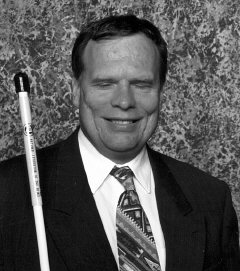
Dr.
Paul Gabias
|
I was introduced to the white
cane at age fifteen in grade ten. In the Quebec system of education, that
was third year high. I had never liked the notion of using a cane because
canes reminded me of old people, feebleness, and helplessness. Yet students
older than I were taking buses and going places by themselves. They had learned
to accept the cane, and so I supposed that I would have to do so as well.
The English teacher, who was partially sighted, was one of our mobility instructors.
The other instructor was totally blind.
My mobility teacher first
taught me cane technique inside the school building. Then he taught me how to
work with cardinal directions. As far as I knew, north was straight ahead,
south was behind me, and east and west were on each side. That was the extent
to which I had thought about cardinal directions. He introduced possibilities
that had never occurred to me. For example, he would say: �Suppose you�re
facing west. Where�s north? Where�s south? Where�s east?� Then he would turn me
around and say: �Now you�re facing south. Where�s west? Where�s east?� I�d
never done these sorts of exercises before,�
and I practiced them. I had no idea, in those days, how useful this
skill would become. I can use it now to direct drivers even in fairly
unfamiliar cities. I learned this was possible by listening to other blind
people directing cab drivers to desired destinations.
After inside mobility lessons
we graduated to outside mobility lessons. It was sheer delight to walk around
the streets of the neighborhood. In the three-and-a-half years that I had been
at that boarding school, I had never once walked around the neighborhood. It
was pure joy to be walking on my own outside the confines of the schoolyard.
The schoolyard was bordered on
three sides by a high chain-linked fence with spikes at the top. Above the
spikes there were several layers of barbed wire. No one was going to get in and
no one was going to get out.
Our yard was adjacent to
another schoolyard that was associated with the local public school. As I think
of it now, it is amazing that we never had anything to do with our sighted
counterparts on the other side of that fence. They never talked to us, and we
never talked to them. We acted as if we completely didn�t exist with respect to
one another. I never even thought of them as a significant factor, just as a
noisy bunch playing ball on the other side of the fence. As I think about it
today, to them we must have been the blind kids, the inmates, a pitiable lot,
not even worth teasing. Consider all the friendships that might have been and
never were.
The Clerics of Saint Viateur,
the Brothers who ran our school for the blind, told us that these high school
kids were ruffians. They told us that there were a lot of unwed pregnant girls
at that school. They made it seem to us as if those kids were the sort of
people we wouldn�t want to have anything to do with. And so, we had nothing to
do with them. But what if we had been given the opportunity to judge these kids
for ourselves? What if we had been encouraged to speak to them and to educate
them about blindness? What if we had been given accurate information about what
they wore and how they looked? What if they had begun to think of us as normal
students their age, with the same aspirations and desires? Would the fence have
kept us apart? Certainly not to the degree that it did, and there might have
developed a healthy competition between the two schools. But, as it was, there
was no contact because the Brothers who ran our school believed that we
couldn�t compete with the students on the other side of the fence: not in
wrestling, not in academics, not in anything except singing.
Our choir competed with other
choirs around the city. We never met with anyone in those other choirs, we only
sang. We did meet with other youth groups in my fourth year of high school. But
that was strictly for purposes of discussions that were supposed to prepare us
for life. These discussions were led by Brothers and priests from other
schools. We never met for dances or anything like that!
But I digress. Returning to my
cane travel lessons. As I think about walking around the neighborhood near the
school for the blind I can still remember the warm sunshine on my face and
body, the fresh air, and the sense of freedom I felt. I remember the sounds of
lawnmowers and people on their stoops, front lawns, or balconies. But as I recall
now, nobody talked to us. And later, when I was alone, the only question anyone
ever asked me was whether I needed help. Even though it was meant to be kind,
those questions made me feel the same anger I experienced as a child, when
people wanted to stop me from falling down the stairs, from going (what they
thought was) the wrong way, or from bumping into something I already knew was
there. People believed I had no sense of the world around me.
Of course, in some ways I
didn�t. I had never taken a bus by myself. I had never taken a girl on a date.
I had never bought shoes or clothes by myself in a store. My cousins had paper
routes. I had never had the opportunity. I did sell chocolate bars from door to
door for my brother�s school. Our school never organized such an endeavor
because they didn�t believe that the blind could do it.
There came a weekend after
only about four cane travel lessons, when I had an unexpected choice: I could
either spend the weekend at the school for the blind or take the bus by myself
and go home. I had never taken a bus by myself before. My parents were away
that weekend for some reason and could not pick me up. After talking it over
with my sister, I decided to take the bus home. I got directions from some
friends at school who had already traveled around the city, a staff person in
charge of us that afternoon, and my sister. Putting all of those directions
together, I took three buses and got home safely. At the time I was very proud
of myself, but in retrospect, I am reminded that my sister took buses around
the city at a much younger age than I did.
When I got home that night, I
asked my sister to explain to me why it is that when you are walking along the
same street, you have to cross streets. How can you step off a curb, walk a
little, step up a curb again, and still be on the same street? Why do the
sidewalks have to end and begin again?
With knives to represent
sidewalks and the spaces between the knives to represent streets, my sister
showed me the shape of a four-corner pattern and a T-crossing. It was amazing!
Here I was, fifteen years old, and I still did not know the basic layout of
streets and sidewalks! Why had I never asked? It was probably because I didn�t
understand what there was to be understood. But, of course, my parents
understood! Maybe they never realized that I didn�t understand, or maybe they
never realized that a blind person could understand this pattern. My parents
were not terribly introspective or communicative on these matters. Since they
are now both dead, I will never know the answer.
The professionals in the field of blindness often say that people totally blind from birth have trouble with concept formation. We don�t have trouble with concepts; we just need to be given sufficient information.
If I had been provided with a
raised map of streets and sidewalks when I was six years old or even earlier, I
could have perceived the layout on the map and understood its correspondence to
the streets and sidewalks in my neighborhood. As it was, I did not get this
information until necessity dictated that I seek it out at the age of fifteen.
After I received cane travel
lessons, I used to walk to my sister�s apartment from our family home. It
involved walking north one block on our street to a busy street called
Bellechasse, walking east along Bellechasse, crossing 35th and 36th Avenues,
and then walking east some more until I got to Viau. Having arrived at Viau, I
then had to cross both Viau and Bellechasse, two major busy streets. From there
I had to walk up the east side of Viau and cross three more busy streets. I had
not been taught to use the pattern of the traffic flow to judge the state of
the traffic lights properly. I know this now, but I didn�t know it then. I
would simply run across whenever I thought it was quiet. I later learned to
judge traffic properly from a few chance walks with Dr. Lambert, a blind
college professor who became my mentor.
I felt so happy with myself
every time I made the trip by myself to my sister�s apartment. But, of course,
in comparison to the extent to which I can travel today, that trip was nothing.
In comparison to the travels of my sighted peers, it was nothing. As I learned
in Vermont, many teen-agers my age were already driving cars. Oh yes! I crossed
those streets, but I was afraid of the traffic. Some of my sighted peers were
driving in traffic at sixteen! By then, I was also walking through downtown
Montreal and taking subways. But I always got help crossing the busy streets
whenever I could.
When I first entered college,
my sister showed me the layout of the campus. Routes were planned and learned
carefully. I was shown where to look for entrances and exits, where to find
turns in pathways, and how far the distance was from landmark to landmark. I
remember thinking that I was very lucky to have a sister who could take the
time to show me all these things. I wondered what I would do when this was no
longer the case. I had no idea then that in the next twenty-five years I was
going to be required to move to seven different campuses, either for study or
for employment purposes. I could not understand then that twenty-five years
later I would come to consider learning to move about new campuses and new
neighborhoods as routine parts of daily living. These novelties now are neither
challenging nor intimidating. They are simply part of the business of living,
much as they would be for most sighted people in my situation.
I know how to strategize my approach to these new travel situations so that the planning is routine and second nature.
In my first year of college I
met Dr. Robert Lambert. Dr. Lambert had a profound influence on my life. To me,
at that time, he embodied the very core of what independence was all about. His
guide dog was superbly behaved. They walked quickly and efficiently together. I
remember that, for some reason, he, a professor, and I, a student, were part of
a group of people going to a restaurant bar. I remember how, without breaking
the flow of conversation, he got out of the car, walked into the restaurant and
sat down. When it was time to leave, he and his dog walked to the door, out of
the restaurant, and back to the car with as much ease as a sighted person might
do. His functioning with the dog was smooth and unobtrusive. This was what I
wanted.
When I found out that he and
his wife had trained their own guide dogs, I was very impressed and very
curious as to how they had done it. I can tell you truthfully that, at that
time, I had not been impressed by the guide dogs I had encountered that had graduated
from the schools. Nor was I impressed by how they were handled.
Because the Lamberts had done
so well with their guide dogs, and because, from early childhood, I always
believed that my mobility was my responsibility, I decided to take the plunge
and train myself a guide dog. By that time I certainly loved dogs well enough.
I thought I knew a good deal about learning from the chapter in introductory
psychology. So why shouldn�t I give it a try, I thought? What a coup it would
be to succeed! So, in early July of 1970, I purchased a six-week-old male
Labrador puppy. That endeavor changed my life significantly.
At the age of twenty, one year
after I had trained myself and a guide dog to work successfully together, I
went to Germany for a six-week stay. I left in the summer of 1972 after one
course in German, with no supervision, no itinerary, and a minimum of planning.
In Germany, I walked all over the different towns I stayed in: Wilhelmzhaven,
Wetzlar, and Bad Driburg. It was a wonderful time, and it was on that trip that
I realized fully the extent of independence which could be achieved by highly
skilled interactions between a blind person and a guide dog. For the next
twenty-five years my guide dogs were my primary means of mobility, although I used
the white cane for periods up to a year between working dogs.
As I now recall, it was only
five years before my liberating trip to Germany that I was in a restrictive
mobility situation that could have been avoided.With my strong love of walking,
my intense satisfaction at exploring new environments, why is it that I did not
do more walking between the ages of fifteen and twenty? It is because I did not
even dream that it was possible.
In those days, there was time
to explore the highways and byways of the surrounding areas in South Hero.
There were all the country roads to walk along and explore, and yet I didn�t do
it. I didn�t think I could do it! I was afraid I�d get lost! I had not been
taught! It never even occurred to me to dream of these things! Had I had
sufficient experience and cane travel skills instilled in me early, I might
have taken all of those wonderful long walks. But I hadn�t had the training,
and the walks were never taken. That time has forever slipped away.
Today, I no longer use a guide
dog. I travel successfully with a white cane for reasons of personal
convenience. Cane travel, I believe, must be the absolute bedrock of
mobility for every blind person. Guide dogs can
be used as valuable additions in some cases, but to have more and more blind
people utterly dependent on animals for their primary means of walking through
the environment is restrictive. Dogs die, dogs get older, and some dogs don�t
work out. These factors cause a perpetual reliance on agencies, for something
even as basic as putting one foot in front of the other.
Once you feel that you can go anywhere with the white cane
comfortably, under any circumstances, nothing and nobody can take that away
from you, and
you don�t have to re-learn it.
The feeling is there for as
long as you live. It is a great basic comfort that every blind person has a
right to enjoy. Independent travel is taken for granted by the sighted, and we
ought to take it for granted for ourselves.
From my involvement in the
National Federation of the Blind I have expanded my horizons with respect to
the expectations I have about myself and independent travel with the white
cane. If role models are important for blind children, they are equally
important for blind adults. Dr. Jernigan certainly became a role model for me,
in terms of his ability to force us to face issues that are sometimes
uncomfortable. Yet, at the same time, he had an uncanny knack for keeping
people�s loyalty, even when he confronted people with disturbing ideas.
I want to end by asking
parents of blind children to have confidence in their children�s ability to
keep themselves safe from harm and to know what is around them and what is
happening around them. Urge your children to explore their environment with the
white cane. Expect of your blind children what you would expect of other
sighted children at the same age. Don�t wait for professionals to tell you what
to expect. Take part in activities of the National Federation of the Blind. Let
your blind children see for themselves how blind adults can live normal lives.
As you spend more time in the Federation, you and your children will gain an
inner strength that will give you great peace of mind.