Future Reflections Convention Issue 2014 NOPBC CONFERENCE
Kid Talk
by Dr. Marc Maurer
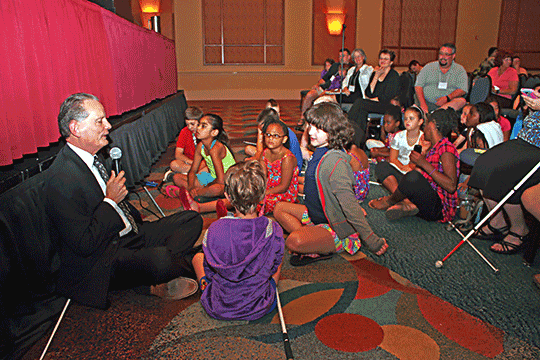 From the Editor: At the opening session of the NOPBC conference, NFB president Dr. Marc Maurer spoke to a group of blind children and answered their questions. By long-standing tradition, he sat on the floor at the front of the conference room, and the children circled around him to talk.
Dr. Maurer: I'm going to sit here on the floor and talk to anyone who wants to come up here. I think some kids may want to come up. Grownups are welcome to come up, too.
I've been a blind person for a long time. I came to be a blind person when I was six. I went to have an eye operation, and it didn't work. I had a little bit of vision before I went, and when I got out of that operation, I didn't have any vision at all. It was gone. That bothered me a lot. I didn't like it, and I was sad.
I sat on the couch for several days. My mother would give me some breakfast, and then I would go sit on the couch and do nothing. After a few days, my mother got mad about this. She said, "You're going outside, and you're going to play."
I said, "I'm not going."
She said, "You are going out. You're going out now!"
I tried not to go outside, but she took me anyway. She dragged me out. She said, "You're going to climb up this ladder to the slide, and you're going to slide down."
I said, "I won't!"
She said, "You will!" So I did.
I slid down the slide, and I said, "All right, I've done it. I'm going back in."
She said, "No, you're going to do it again!"
So I did it again. I thought, I'll run away from home! But I didn't run away. I stayed outside. I didn't want to go in where my mother was--she was mean to me! But I found it was fun to be out there, whether I was a blind kid or not. I've been having fun outside ever since. I still like to go outside very much. I like to wander around in the woods. Sometimes I chop wood, sometimes I have picnics.
Now I didn't have a cane when I was six, because I didn't know about canes. My mother didn't know about canes, either. We learned later. It would have been nice to have one, but I didn't. So I would bump into things. Do you ever bump into things? You can hurt your nose! I know, because I ran into stuff.
When I got bigger, around twelve or thirteen, I used to deliver newspapers. I don't think kids do that anymore. I would get a bunch of newspapers and take them around to the neighbors' houses and put them in their mailboxes. I would collect money from my neighbors for doing this.
When I was doing these deliveries, I didn't have a cane. I asked my brother, who was a sighted kid, to help me figure it out. He walked with me the first few times, and after a while he didn't want to do that anymore, so I walked by myself. I still ran into things, and I didn't like that. To keep from hurting myself too much, I wore a cap. The bill on the cap would run into things before I did. I wore a pair of sunglasses, too. When I was delivering newspapers, if I wasn't careful, sometimes I'd get where the sticks from trees would poke me in the eye, and I didn't like that. The sunglasses helped protect my eyes.
Then I came across this National Federation of the Blind group, and they said, "You better get a cane." I have mine here. It's a big tall cane, probably taller than you. I go all over the place with it. It helps me find steps so I don't fall down them. It helps me find other things, too. My cane runs into them before I do. It's very helpful for getting around. Going places is fun. Just because you're a blind person doesn't mean you can't just go places. With my cane in my hand I've been to lots of places all over the world. You can go lots of places, too.
Now, do you have any questions for me? Here's the deal. I'm a blind person, you know. In your classes when you want to ask a question, you stick your hand up in the air. What you do here is you say your name. I already remember mine, so you don't have to say it. If you want to ask me a question, say your name, and I'll call on you.
Abby: What was the hardest part about being a blind kid?
Dr. Maurer: There were two hard things. One of them was learning that it's fun being a blind kid. I told you about that already. My mother made me learn it. I was mad at her then, but I've been glad about it ever since. She didn't know how to manage a blind kid since she'd never met a blind kid before, but she got thinking that it wasn't good for me to sit around doing nothing. She wanted me to do something, and she didn't care very much what it was, as long as I was doing something and finding out that it's fun to do things. So that was the first hard thing.
Then I had to find out how to read. I read Braille. Reading Braille is great! I used to get Braille books from the library at my school, and--I wasn't supposed to do this, so don't tell anybody--I used to sneak them under the bed. Then I would slide them out at night to read, and you know, you don't have to have a light for this, so lots of times they didn't find out. If it was a little cold in the winter, which it sometimes was, I would put the books under the covers, because you can still read them in Braille that way.
Anna: What's the percentage of blind kids that read Braille and use a cane?
Dr. Maurer: I don't know the answer, so I'll start with that. I think about ten percent of blind kids learn to read Braille, which is way too few. We need for more blind kids to learn Braille. And I don't know how many blind kids use canes. I could ask over at the rehabilitation group, because they teach people to use canes.
Anna: Did you go to the Iowa Training Center?
Dr. Maurer: Yes, I went to the Iowa Training Center when Dr. Jernigan was running it. How do you know about the Iowa Training Center, Anna?
Anna: I got the Library Stick [a thumb drive containing a collection of NFB documents, available through the NFB of Utah].
Dr. Maurer: Oh, you got the Library Stick! Yes, I was there. I used to get up in the morning and go to gym class from five-thirty to six-thirty. By eight o'clock I was supposed to be in class to learn how to use a cane; I didn't know how to do that before I got there. I'd do cane travel for a couple of hours, and then go to shop class after that. We'd do wood cutting and metal cutting and build stuff. Then we'd study home economics for a couple of hours, then we'd do Braille for an hour, and then we'd do typing. We didn't have computers; this was before computers. Then we'd have philosophy class. We would talk about the philosophy of the NFB, the way we think about blindness. We had this schedule every day. It went from about five-thirty in the morning to five-thirty in the evening, with a few breaks along the way. It was a long day.
After I learned to use all the tools, the shop teacher asked me what I wanted to build. I said I didn't want to build anything. I wanted to overhaul an automobile. So we got a bunch of tools, and we overhauled an automobile. I learned to be a mechanic. It was fun. If you want to be a mechanic, go and be that. If you want to be something else, be that instead.
Here's what I want to tell you before I go to my next meeting. I'm a blind person. You're a blind person. There are lots of things you can do that are very exciting. You can build things. You can do a lot of stuff, but you have to learn how. You have to learn how to read, you have to learn how to have faith in yourself, you have to learn how to get people to have faith in you. I know it's a big job, and when you're a kid, it's hard to approach it. You have to know that you're important. Some of your teachers, if they're anything like the ones I had, will be glad you're doing good work. But some of them will think of you as just another blind kid who can't really do much. That's a big mistake! Your teachers are largely in charge of you, and it's too bad if some of them think of you that way. You and your parents together can help them learn that you're an important person, because you are.
It's been great to be with you. Thank you!
Media Share
