Future Reflections Convention Issue 2014 NOPBC CONFERENCE
Taking the Next Step
by Mark Riccobono
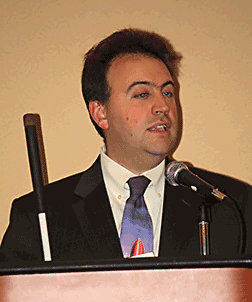 From the Editor: Mark Riccobono became director of the NFB Jernigan Institute in 2004. At the 2014 convention, he was elected to serve as the next president of the National Federation of the Blind. He gave the following address at the NOPBC conference.
I come to you this morning to talk to you about taking the next step. Let's pause right now and absorb this moment that we're experiencing. You have taken a very important step by being here this morning. You should pat yourselves on the back for being here with the National Federation of the Blind. It's important to remind ourselves that we consciously take this step because it's meaningful to us. During this week some of you, especially our first timers, are going to get frustrated. You'll feel you messed everything up before. But your kids aren't broken, they're not damaged forever, it's not too late. You've taken the most important first step by being here with our National Organization of Parents of Blind Children. Congratulations! You're working to get your kids on the right path.
I'm speaking to you today as a blind person and as a father. The youngest of our three children is now two. As a parent, you spend a lot of time urging your children to take the first steps. (Then you end up spending a lot of time figuring out how to stop them! It can get pretty hectic!) We're on a journey to put our children on a path to success. I want to talk to you today about my experience and about some of the things we might do together in the National Federation of the Blind. We need for our kids to learn how to take the next steps, and we can teach them to do it on their own.
Becoming a Driver
I like to say we need to teach our blind kids to be drivers in their lives rather than passengers. That's because so often as blind kids we're taught to be passengers in our own lives. We're taught to sit and wait. We're taught that someone else will take care of things. But that's not what we learn in the National Federation of the Blind. We know that our kids need the chance to be drivers. That means that our kids need to have the chance to fail. We need to give them opportunities where they might actually fail.
When I think about journeys, I think about a book called The Alchemist. In The Alchemist, we're presented with a journey. One of the things we learn in this book is that when you want something, all the universe conspires to help you achieve your goal. That's really what happens in the National Federation of the Blind. When you dream of something as a blind person, all of the Federation conspires to help you achieve your dream.
Here's an example from my life. When I grew up, I was the only blind person I knew. I didn't know I was a blind person; I just knew I couldn't see too well. I have glaucoma, so I've lost vision all my life. I learned to fake it. I like to say I learned to fake it to make it. In case any of you might be fooled, your kids can get really good at faking it, too. They can fake you out in an instant! I created all sorts of skills, tools, and techniques to help me fake it. I could pretend I saw things in such a convincing way that no one could guess.
There was never a mention of Braille for me, because I was so good at faking it. I hid out in the back of the room. They weren't the sharpest folks in the back of the room, but I could fake it back there. I blended in, and once in a while I'd get somebody to fill in a worksheet for me, but I faked it. In eighth grade science class I sat in back and played a lot of table football. You fold a piece of paper into a triangle and flick it back and forth, and you can do that for hours. I did that in science class because the first thing you were supposed to do in that class was go up to the front and copy stuff off the board. There was no way I was going to go up to the board and copy stuff, no way I was going to out myself like that! So I hid in the back--and I was permitted to fake it.
When I was a senior in high school, I was offered the opportunity to learn Braille, if I wanted to learn it. I was a senior in high school--now why would I want to learn Braille? Why would I give up a study hall to learn it? No one ever told me that there was something more to want.
Then, in 1996, I met the National Federation of the Blind. I was at a loss about what my next step was. When I met the Federation, I learned that it was really the next step. I needed to be guided in that next step by having people around me who had faith in my capacity as a blind person. I needed them to trust me and to help me begin planning my journey. It has always been about the next step. The next step, the next action, is the most important one.
Faith in Our Capacity
What are some of those steps, and how can we help our kids get there? The first and most important step, I think, is believing in our capacity as blind people. For you parents who aren't blind, it's your internalization of the belief that your blind children are not broken sighted children, that they have capacity to offer. You need to gain the deep belief that they can achieve anything that they put their minds to. We often present blind kids with the opposite, and it starts pretty early. "We're sorry you have to learn Braille. It'll be hard, but you can do it." When the five-year-old blind boy says, "I want to be a fighter pilot some day," he hears, "I'm sorry, Johnny, but a blind person can't do that." People say that, even though they know that tomorrow Johnny's going to want to be a doctor or an astronaut. We need to cultivate those dreams. I can tell you from personal experience that we don't know what the limit is for us. That's why we come to the National Federation of the Blind to share our experiences. Here is where we learn from each other that there are no limits. We do it through faith in each other.
Martin Luther King had a great quote about faith that I believe speaks to the Federation. He said, "Faith is taking the first step, even when you don't see the whole staircase." I never thought that driving was a possibility for me. I had totally erased it from the bank of things that would be possible for a blind person to do. Then my mentor, Marc Maurer, said, "Why is it we say that blind people can't drive? Don't we have capacity? Don't we have the ability to think and react? Can't we build technology that would give us information that would allow us to drive?"
I thought, okay, that's a good gimmick. It'll get some people interested in us. Then some guys from Virginia Tech called and said, "We want to work on this idea you have about a blind person driving a car." They said, "We can build cars that blind people can drive. We can put you in the back seat and you push a button and be done."
I said, "But that's not what blind people want! We want to be able to drive the car! We want to sit in the driver's seat. We even want to be able to crash that car!"
They said, "What?"
I said, "We don't want to crash it, but we want the experience to be so real that if we crashed it, it would be because we made the wrong decision. We hope to learn enough not to do that, but if we don't have the opportunity to fail, what good is it?"
That's when I began to learn to be a driver in my own life. It happened because of the belief that the Federation has in blind people. As parents we need to internalize that faith that we have in each other. We need to get to know our blind brothers and sisters. Talk to them. Find out how they do things. Dream with them. Not all the answers are obvious. Sometimes we're talking about doing something that no blind person has thought about doing.
What really turned me around on our Blind Driver Challenge was when we put a prototype in front of blind kids at our 2009 Youth Slam program. They hadn't been told for decades that they couldn't drive. They said, "Hey, why don't we have this today?" They said, "Can't we do it this way?" and "Wouldn't it be great if the technology did this?" They hadn't gotten the idea I had that driving was off the list. They hadn't been told that for years on end.
Faith in the capacity of blind people is our next step. It's always our next step. We need to challenge our current assumptions about what the possibilities are. That's how we push each other forward in this organization.
Developing Skills
Okay, next steps. Skills! There are skills we need, and we need for our kids to learn those skills. We need for our kids to have the opportunity to practice those skills. They don't have to be perfect cane travelers, whatever that means. They need to practice their skills. My two-year-old is learning to use a spoon by making a big mess. She's learning to use a spoon by doing it. As parents, it's important that we give our kids opportunities to learn and practice their skills. They need the chance to get lost, to fail. It's important that we don't get in the way of their building those skills for our own convenience. "We're really in a hurry--why don't you just leave your cane here today?" I can tell you--my two daughters, ages four and two, have their little canes--and it is really tempting sometimes to say, "We'll just go without the cane this time," especially when they've hidden the cane who knows where! Don't do it! We need to be intentional about letting our kids practice their skills.
As parents we need to learn some of those skills ourselves so we can help our kids understand. We need to start thinking about how to do things in nonvisual ways. We need to think consciously about how to talk about things in terms of description, not just "Look over there." We need to point out things to our kids. That means some of you need to make a conscious decision to do that, because you don't think nonvisually most of the time.
I was sitting next to my four-year-old on the airplane on the way here. Of course, when you get on a plane in hot weather like this, they tell you to pull the shades down to keep the plane cool. Partly because she's four and partly because she couldn't see out the window, my daughter kept saying, "Are we flying yet?" I'd tell her no. We talked about some of the ways she could tell if we were flying. Maybe they're not obvious to some of you. The first thing is, you can feel the bumps in the runway as you're taxiing. The sound of the engines is different when they start to accelerate for takeoff. Of course you can feel the tilt of the plane. We had the opportunity to talk about all that. It had never occurred to me to be intentional about it. I fly all the time, so it's obvious to me. I had to make a conscious decision to think about what it is about flying that helps me know when I'm in the air.
As parents there are other skills we need to develop, and some of them are very hard. We need to develop advocacy skills for our children. It's very difficult, because when it's our kid, we're emotionally involved. This brings me to the third step, which is networking. My wife and I are both blind, and we've been advocating for ourselves for a long time. But our daughter is now in pre-K in the Baltimore City public schools. A lot of people say, "Can you imagine being at an IEP meeting with Mark and Melissa Riccobono?" [Laughter] But I want to tell you--when it's your own kid, it's very different! It is hard to operate as an advocate, because your first reaction when they say something you don't like is to strangle them! It's your kid they're talking about! One of the steps, one of the reasons you're here, is to develop a social network. You may be a great advocate, but you still need other advocates with you. Sometimes it's too emotional for you, and you need to bring in someone who can keep it calm and on track. The National Federation of the Blind is the greatest network that we have in this country.
When you go on any journey, what's the first thing you do? You start planning your trip. You go on Trip Advisor or some other site and find out what other people have said about the Rosen Centre Hotel or about Orlando. The Federation is just like that. If you want to find a blind person who has done something, if you want to find a parent who has dealt with a particular situation, if you need to find someone who is willing to go knock your school district upside the head, you can find that person here in the Federation. Just ask. They will help you. That's what we do for each other. This network will create opportunities for you, and it starts here today.
Giving Back
A thing I want you to do that's very important to the next step is to contribute. Mark down what you did and whether it worked or not. Don't beat yourself up if it didn't work. You want to gather a little wisdom so you can share it with other people in the network. That's what we call giving back. It is a very important step in what we do in the National Federation of the Blind. We take next steps, and we share our knowledge freely with other people. We're going to encounter barriers in many of our next steps, and we need to tell people behind us what we did right and what we did wrong. That's how we've gotten to where we are today. That's how blind people in this country have made such tremendous progress. We've shared with faith and love on our journey together.
What are some of the things we've done together? We got the law changed to make Braille the default in IDEA, the Individuals with Disabilities Education Act. Great move, right? [Applause] It hasn't exactly worked as we wanted it to, so we put a marker down. One of the things that hasn't worked is the way the kids are assessed. The assessment is the key. So we created the only research-based assessment for reading media. [Applause]
What else do we need to change, from our experience? We know that a lot of kids still aren't getting Braille, so there's a lot of work to do to change the service delivery system in this country and create innovation. We got into the law that electronic files be provided for textbooks in the K-12 system. This is the National Instructional Materials Access Standard. We would throw it out today if we were going to create it. We know today that what we want is the same book, at the same time, at the same price as everybody else. [Applause] Now we're trying to figure out how we can get mainstream access for our kids. We've created the TEACH Act, which will create standards in higher education. Those standards will eventually be enforced for K-12 to create better standards to facilitate our kids getting books. It's not that the steps we took before were wrong. They were right at the time. But we know there is a next step that we need to take together.
A wonderful thing about the National Federation of the Blind is that we get to decide what we do. This is our organization. It's yours and it's mine. We need to take very seriously the responsibility of moving it forward. It will make a difference in the lives of blind people. Over the past almost seventy-five years, that is the thing that has made a difference. If we're not moving forward, we're not living the lives we want to live.
Next steps. Our president has said he's not going to run for office again. I'm going to seek the office of president of the National Federation of the Blind. [Applause] I appreciate your support! Why am I doing it? I can't think of anything more meaningful to do in this world than to create opportunities for our blind kids. These kids are going to teach us. They're going to fly airplanes and become astronauts. They're going to do things that we'll look at and say, "We never imagined that was possible!" But that will only be true if we put our imagination, our faith, and our energy into the effort. That is our next step. That's what we need to do. I'm going to need your help to do it.
I want you to know today that you are not alone in your journey. The National Federation of the Blind is with you, and I am with you. I make a personal commitment that if I can do something to help you on your journey, I will do it. I will also challenge you to contribute to what we can do together.
That brings to mind a poem that expresses the faith that we have in each other and the challenge that we put to each other to take the next step. This poem is called "Come to the Edge" by Christopher Logue. I think you should think about it in terms of yourself and your kids and where we want to go with the Federation.
Come to the edge.
We might fall.
Come to the edge.
It's too high!
COME TO THE EDGE!
And they came
And we pushed
And they flew.
Together with love, hope, and determination, we will transform dreams into reality. Take that next step!
Media Share
