Future Reflections Convention Issue 2014 AWARDS
Empowered: Choosing to Come to the Edge
by Theresa Postello, MA, TVI, COMS
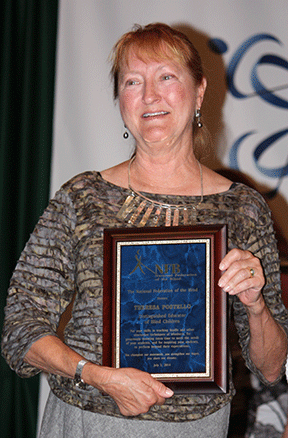 From the Editor: Theresa Postello, a teacher of the visually impaired and orientation and mobility instructor in California's San Mateo County, was honored by the NFB and NOPBC as the 2014 Distinguished Educator of Blind Children. On Thursday, July 3, she delivered the following address at the annual division meeting of the NOPBC.
I always wanted to be a teacher! As a youngster, I had an insatiable love of reading and of sharing knowledge. My mother reports that while most children were playing house, I was gathering the neighborhood kids to my little school. I had a chalkboard, and I provided paper, pencils, and books. Even as a nine-year-old, I was bossy and committed to teaching useful things, such as raising your hand, taking turns, and completing little assignments.
Let me share a poem by the English poet Christopher Logue that Dr. Sally Mangold recited to me when I was transitioning to a new teaching experience:
Come to the edge.
We might fall.
Come to the edge.
It's too high.
COME TO THE EDGE!
And they came
And we pushed
And they flew.
The very best part of being in this highly specialized field is the challenge of working with such a variety of students--students of different ages, visual conditions, demographics, and skill levels. As educators and parents, how do we empower and entice students to come to the edge? Over twenty-eight years of teaching students who are blind or visually impaired, I have compiled my Top Ten Guiding Teaching Philosophies. I hope everyone here can glean something to foster that "nudge toward the edge."
My Top Ten Guiding Teaching Philosophies
10. We are life-long learners!
Learning is dynamic. No one, parents included, can be a Renaissance person or an expert in every facet and nuance of our profession. Knowing how to access resources or reach out to others for consultation is vital! In 1989, Dr. Sally Mangold offered the following pearl of wisdom: "Tradition is no excuse for best practices." In other words, Braille is no excuse for being a slow reader.
Make transcribers your best friends. They are essential to an education team. My motto to classroom teachers is, "Stay ahead of the game." Provide print materials that need to be transcribed in a timely way. To date for the 2013-2014 school year, I have transcribed language arts materials and embossed about two thousand pages (outside of my contract working hours). I save the precious math and science for our fabulous, erudite transcriber, who hails from the Stanford University Transcription Department.
Hang out with the vendors and exhibitors at conferences. Learn about the newest and greatest technologies that might meet our students' and children's needs.
Support parents by helping them gain a more in-depth understanding of their child. Make an effort to learn more about the culture, home dynamics, and environment; encourage inclusion and high expectations for full participation in family activities. Create opportunities for parents to talk to other parents.
All children can learn! As a teacher who promotes life-long learners, nurture curiosity, promote critical thinking, and encourage problem-solving skills. I believe sensitivity and sensibility are right up there.
9. Paraprofessionals are vital team members.
A good paraprofessional is a special kind of human being who can support the curriculum in just the right way. To develop skills in giving accurate visual information and adapting materials, the paraprofessional most often requires training by the teacher of the visually impaired (TVI). It is vital for the paraprofessional to give enough information while still fostering the student's independent learning. Being "velcro-ed" to the student does not benefit the child. My dear friend and colleague, Dr. Laurel Hudson, urges teachers and parents to practice "The Nineteen Ways to STEP BACK" (Classroom Collaboration, Perkins School for the Blind, 1997).
8. Transition is continuous.
My favorite area in my work is the transition of high school students toward adulthood. Another one of my mottoes is, "I love a good challenge."
In 2008, I entered the realm of teaching preschoolers; now I love teaching those little ones. It's totally different from supporting Advanced Placement, chemistry, and world history curricula. As always, I'm molding minds, no matter the age level--preschool to adults.
7. Put your best foot forward.
There are many aspects of putting one foot in front of the other and efficiently, safely, and gracefully traveling independently. Toddlers begin to gain confidence with push devices and kiddie canes. They learn about movement by running, climbing, tumbling, dancing, and exploring the world around them. Students evolve as they gain increased mobility and spatial awareness. To beckon students toward the edge, I support the provision of every mobility tool that is deemed developmentally appropriate: canes, canines, tactile maps, optics, and GPS.
6. Embrace technology.
The younger the better to introduce information technology to students. Keyboarding is becoming a high priority skill. Computer and keyboarding skills are required in order for students to access new state and federal tests. Moreover, the use of adaptive devices greatly facilitates access to electronic texts and enhances the education process.
Again, be a co-learner. It can be as simple as taking a product out of the box with your student beside you. Look together at the packaging, contents, and connections, labeling the cables, hooking up the device, charging it, and turning it on.
A technology toolbox could include PDAs such as a Braille notetaking system, a computer with an enlarged screen display or screen reader, a Braille display, or one of the iOS devices.
Allow students to explore access technology tools without fear that they will touch the wrong key and cause a problem. Let them figure out how to get unstuck when there is an operator error; we've all been there!
5. "You can do it! You WILL do it!"
This is my battle cry. Instill your students with a sense of empowerment. Have the same expectations for our students who are blind or visually impaired that teachers have for their students who are sighted. When you level the playing field with the appropriate tools, adaptations, and technology, your students will acknowledge that the EDGE exists.
4. Make literacy your passion!
I have a background as a high school English literature teacher. I hail from the University of Iowa's prestigious Writer's Workshop. I have always loved reading and writing. For me, teaching is not about Braille and the code. It's about teaching students to read and write. It's very exciting to be transitioning to the UEB (United English Braille) code right now. I've begun to use UEB with my students, and they have barely blinked with the new formatting. I noticed that the NFB convention program is in UEB. Way to go! Bottom line, Braille is more than dots; it's empowerment, enrichment, and opportunity.
My greatest bliss was getting a thirty-year-old Braille embosser from my darling spouse. Who needs Tiffany jewelry when you have your own personal Braille embosser?
One of my favorite professional conferences is "Getting in Touch with Literacy." Literacy comes in many forms besides reading and writing. Here are some examples:
- Math Literacy--the language of numbers and lines;
- Tactile Literacy--pictures, diagrams, charts, graphs, real-life objects, models, and 3D printed objects;
- Social Literacy--eye contact, handshakes, waving, initiating and following conversations, and making friends;
- Technology Literacy--access and mainstream devices;
- Vocational Literacy--job applications, interviews, and work experience;
- Listening Literacy--information from audiobooks, screen readers, and human readers. Please don't overlook or undervalue the importance of listening skills! Check out the AFB Press publication Learning to Listen, Listening to Learn;
- Location and Wayfinding Literacy--cardinal directions, sense of time and distance, awareness of street layouts, and understanding of the built environment.
I can't make a wholesale statement about when to begin literacy instruction in every form and at each particular age. Over the years, I have acquired a good sense of how to get it going with just the right amount of push, not stressing out the learner. It's very individual.
I am an advocate for teaching both Braille and print to students, based on their visual capacity and prognosis. There are many aspects to factor in, including age, cognitive abilities, and support from the education team.
With good literacy skills, the edge is looking safer.
3. Communication is the key to effective parent-teacher partnerships.
Education and parenting are a collaborative endeavor. It takes real teamwork. We have joint responsibilities and mutual commitments to the positive and appropriate education of children.
Build a relationship outside of formal IEP meetings. IEPs should be collaborative rather than adversarial.
Be sensitive to family dynamics. For constructive dialog, explore not only what the teacher sees, but also what the parent sees. As equal partners, each may see needs and challenges from different perspectives. Be attentive, be a good listener, and be a thoughtful observer.
2. Continue to learn about visual impairment, human capacity, and personal achievement by engaging in firsthand experiences with people who live with vision loss.
Volunteer with local social service agencies (such as the local Lighthouse), schools (such as schools for the blind and special day classes), or Talking Book libraries; or become a personal assistant or reader. Make an effort to bring students to professional and consumer conferences.
In 1993 I became an associate member of NFB. Dr. Fred Schroeder signed me up when he was the director of the New Mexico Commission for the Blind. That same year I participated on my first NFB/NCAER (Northern California Association for Education and Rehabilitation) parent-teacher panel, which took place in San Jose, California. In 1995 I attended the national convention in Chicago, where Sally Mangold gave a stirring keynote address on the importance of Braille literacy.
Engender and internalize true wonderment and excitement about the edge!
1. Teach to the potential adult!
The goal is full participation as an adult in our society. It is paramount that we help facilitate the development of taxpayers whenever that is feasible. The driving force is to channel the student toward control of her/his life.
I'm a compassionate yet tough professional. I do NOT subscribe to the "Aw Shucks Shuffle." In other words, when complimented for what I do, I never say "Oh, it's nothing." It IS a big deal! I'm very proud of my profession and the work I do with students and their families. It's a fascinating journey, learning how to customize solutions to meet students' needs. Each student is unique. There's something out there for everyone to embrace.
It is imperative to provide opportunities and resources in order for students to participate in nonacademic activities such as camp; music and/or dance lessons; athletic events such as tandem bicycling, goalball, swimming, and kayaking.
Be resourceful in reaching out to the community for funding and financial support. Provide a toolbox filled with many resources that our students can pick and choose from, depending on the task and application.
Overprotection may lead to dependency, social isolation, and learned helplessness. I realize this is a blanket statement. It truly could be another whole presentation!
Many life skills are needed to build responsibility and good citizenship. My all-time favorite life skill is achieving one's "personal best." I urge students to do their best given their circumstances and available resources. I'm a long-time proponent of NFB's Braille Readers are Leaders Contest. I encourage students to compete against themselves, even by as little as reading one more page than last time. The Braille Challenge, sponsored by the Los Angeles-based Braille Institute of America, is a wonderful event. I am usually a proctor at our Northern California regional contest. I faithfully accompany any of my students who placed in the regional to the National Competition in Hollywood. (As we were dancing around the living room, one of my regional winners exclaimed, "By the way, what is Hollywood?") Once those students have recovered from not placing in the Nationals, they rally and vow to come back with a stronger Personal Best!
These high-achieving Braille Challenge competitors remind me of one of my favorite quotes: "Nothing worthwhile comes easy. Turn mistakes into learning experiences." I always encourage students to set goals and dreams just out of their reach.
Conclusion
I've learned an incredible amount from my students and their parents. I've learned small and large lessons from my spouse, colleagues, and friends who are blind and visually impaired. By working together as a team, we can increase our effectiveness in reaching the common goal of providing an appropriate, quality education for each student. Thus we provide each student with the skills, abilities, and attitudes to become an effective self advocate and independent adult.
I am passionate about quality education for our students who are blind and visually impaired. I'm humbled, proud, and honored to receive NFB's 2014 Distinguished Educator of Blind Children Award! I will always be an advocate and will work to bring awareness of some of the significant issues in the education of our students.
Think how long some of our students have stood at the edge, waiting for a push to independence and empowerment. I'm proud to say that many of my students have taken the leap and have flown; some even brag that they have their own pretend jet planes!
Before his death in 2011, the author of the poem "Come to the Edge" invited a group of teachers to play with his lines and make them our own. Here is my version of the poem.
"Come to the edge," she said.
"We're comfortable back here," they said.
"Come to the edge," she said.
"We're too busy," they said.
"Come to the edge," she said.
"It's too high," they said.
"Come to the edge," she said.
"We're afraid," they said.
"Come to the edge," she said.
"We'll fall," they said.
"Come to the edge," she said.
And they did.
I pushed them.
And, they flew.
Media Share
