Future Reflections Convention Issue 2014 AWARDS
The 2014 Dr. Jacob Bolotin Awards
Presented by James Gashel
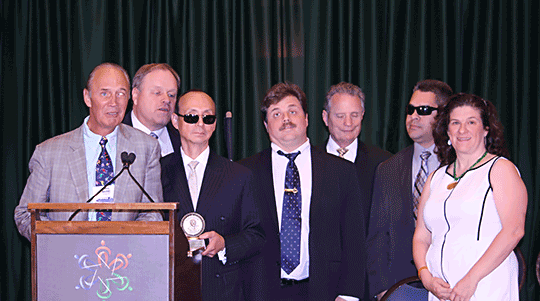
From the Editor: Every year the National Federation of the Blind bestows the Dr. Jacob Bolotin Awards upon individuals and organizations that have found innovative ways to improve the lives of blind people. The 2014 Jacob Bolotin Awards were presented by James Gashel.
James Gashel: Thank you, Mr. President, thank you, fellow Federationists! It is my high honor to come before you to present the Dr. Jacob Bolotin Awards for 2014. A biography entitled The Blind Doctor: The Jacob Bolotin Story, written by Rosalind Perlman and published by Blue Point Books, is available from the National Federation of the Blind Independence Market.
 Like our award winners this year, Jacob Bolotin was a person of dogged determination in spite of incredible odds. He was born in 1888, and he died in 1924 at age thirty-six; he actually worked himself to death. Although his years were few, his accomplishments were many. And you know what? He didn't have it nearly as easy as we do today. He didn't have the KNFB Reader running on the iPhone. Lacking financial resources after attending the Illinois School for the Blind, Jacob Bolotin worked to support his family members and himself. He worked in Chicago selling kitchen matches, brushes, and even typewriters door-to-door. Although the hours were long and the work was hard, he made a success out of these businesses. He even made enough money to put himself through medical school to become a licensed doctor. He was the only blind person to do so at that time. He had no Rehabilitation Act, no ADA, no Section 504, and no NFB to back him up. But in the spirit of Newel Perry, Jacobus tenBroek, Kenneth Jernigan, Marc Maurer, and Mark Riccobono, Dr. Bolotin blazed a trail for all of us to follow, and we are walking in his footsteps. [Applause]
In every way that counts, Jacob Bolotin was a Federationist. He was a Federationist before the Federation existed. These qualities--a standard of excellence, a pioneering spirit, and a pioneering vision--are foremost on our minds as we review the people and projects that you nominate each year.
The funding support for this program comes from a bequest from the Alfred and Rosalind Perlman Trust that was left to the Santa Barbara Foundation and the National Federation of the Blind. Rosalind Perlman was Dr. Bolotin's niece. This year we have $50,000 to award to four recipients. In a moment I'll specify the amount of the awards for each winner, but first I'll talk about the plaque that they will receive. Here are the words on the plaque:
Presented to
(name of the recipient)
by the National Federation of the Blind
and the Santa Barbara Foundation
July 2014.
The medallion that is suspended over the plaque has print on both sides. The text on the obverse side reads: "The Dr. Jacob Bolotin Award," with the logo of the National Federation of the Blind, and immediately below the logo these words: "CELEBRATING ACHIEVEMENT, CREATING OPPORTUNITY." And on the reverse side are these words: "Dr. Jacob Bolotin" with a depiction of his bust, then the dates of his birth and his death below that, then finally these words: "CELEBRATING HIS LIFE/THE ALFRED AND ROSALIND PERLMAN TRUST."
Now for the 2014 Jacob Bolotin Awards. As our first recipient, representing exemplary individual achievement and outstanding service on behalf of the blind of the United States, we recognize Scott LaBarre. We recognize Scott with an award of $10,000.
Scott LaBarre is a lawyer. He's not just any lawyer. Scott's achievements and efforts to represent the blind in civil rights cases throughout the country are known very well. The Iowa Supreme Court knows Scott LaBarre, and the Palmer Chiropractic Institute knows Scott LaBarre. Five years ago we asked Scott to go off and get an international treaty adopted so blind people around the world could get greater access to books. Nothing is too big for Scott to wrap his arms around. Advocates for the blind, led primarily by the World Blind Union and the National Federation of the Blind, were in favor of having a treaty, but there were others that weren't. That included book publishers, motion picture studios, and the like. Scott took them on, and he's nothing if he isn't tenacious. Throughout a series of biannual international meetings and with a lot of work in between, during 2009, 2010, 2011, 2012, and part of 2013, Scott never failed to represent the blind of the United States, and he never faltered in his belief that this work would be done and could be done. Even though there was only a glimmer of hope of succeeding in the end, Scott kept at it.
Finally, in June of 2013, just days before the National Federation of the Blind Convention, Scott's persistent persuasion prevailed in snatching victory from the jaws of defeat. The treaty, which has been mentioned this week, was adopted.
There's more to come. Scott has to get it through the US Senate. That's a tall order. When you think of the right to read, the right to learn, and the right to be literate, when you think of successful advocacy by leaders of the blind who stand tall on behalf of protecting rights and winning new rights for blind people, you should think of Scott LaBarre. Here to accept the award is Scott LaBarre.
Scott LaBarre: Dr. Maurer, President-elect Riccobono, members of the board, Jim Gashel (who was my first boss and first tremendous mentor), and my Federation family, this is indeed an honor. I could not have done it without all of you. When I think of Dr. Bolotin, I think of a pioneer, an early torchbearer whom we could later follow. His work stood for the principle of equal opportunity, and I have no doubt that the work we did in Marrakesh will create that opportunity because it opens up the information flow.
I also want to tell you that recently I've been thinking of Dr. Bolotin for another reason. I've been thinking of Dr. Bolotin because of Aaron Cannon. If Jacob Bolotin could be a practicing, successful medical doctor in the 1920s, there's no reason in the world why the Palmer Chiropractic Institute should deny Aaron Cannon from being a chiropractor in the twenty-first century.
Let me end really quickly with what I told the Iowa Supreme Court. I quoted from Dr. Bolotin himself when he was becoming a licensed physician. He said about that fact, "Well, is there anything so remarkable about it? Because a man has no eyes, is it any sign that he hasn't any brains? That is the trouble with the world and the blind man. All the blind man asks is fair play. Give him an equal chance without prejudice, and he generally manages to hold his own with his more fortunate colleagues." That's what Dr. Bolotin said, and that's what we believe. I thank you, Federation family; I thank my family--Anahit, Alexander, and Emily. Thank you very much, Mr. Gashel.
Jim Gashel: For our second recipient, representing exemplary organizational achievement, we recognize the National Federation of the Blind of Missouri and its parent advocacy program for blind parents. This is with an award of $10,000.
When Erica Johnson and Blake Sennet arrived at Centerpoint Medical Center in Kansas City, Missouri, they were just two parents getting ready to give birth to their first child, and they were in every way normal parents. They were going to have a girl, and they had already named her. She was going to be called Mikaela, and that means "somebody who resembles God."
In every sense imaginable, Erica and Blake were and are a normal couple, but not so as that is understood by the state of Missouri. Upon receiving a report that a baby had been born to a blind couple in Kansas City, a protective services agent (they'd probably say a social worker) swooped into the hospital, snatched up the baby, and took her to foster care. To the National Federation of the Blind of Missouri, this is what you might call a teachable moment. Armed with an attorney and witnesses, the NFB of Missouri did its own swooping in to teach officials of the state a lesson that they should have learned. Two months after the baby was snatched away from Erica and Blake, a social worker from the state showed up at their home and brought Mikaela back. Two hours later our attorney got a fax saying the Department of Social Services was dropping the case. The department gave no explanation of why the baby was taken in the first place and no explanation of its high-handed conduct in the whole sordid affair. In the face of our NFB affiliate, the state of Missouri stood down, gave up.
That wasn't enough. The NFB of Missouri, at the next sitting of the legislature in Jefferson City, got a bill passed to strengthen the rights of blind parents in that state to raise their own children. [Applause] They've even made a video to teach the social workers how to behave. When you think of blind people raising their children to become competent, contributing, successful adults, when you think of facing down the power of the state and teaching the officials lessons about blindness they should have learned in school, then you should think of the NFB of Missouri and its Blind Parent Advocacy Program. Here to accept the award is Gary Wunder, president of the NFB of Missouri.
Gary Wunder: Thank you very much, Mr. Chairman, Mr. President, board of directors, and all of the people who made this possible. It's a great thing to come before you today and receive this award. We decided that we would do this video when we went to Children's Protective Services and they said, "You know, we don't want to be treated this way anymore, and we don't want to treat people this way anymore. How do we change it?"
We said, "Well, we'd like to come and talk to you."
They said, "Okay, there are 114 counties, and you'll probably have to come talk to us every year or year and a half because of the turnover."
We said, "Oh my goodness, how do we do that?" So we decided we would make a video, and they would incorporate it into their training. The main person responsible for this was Carol Coulter, and this represents another Federation victory. You'll remember that in 1986 Carol was denied the right to be licensed by the state of Missouri as a childcare worker, and now she runs her own business. You guys made that happen.
We made the video, we're going to distribute the video, and we're going to make it such that blind people in the state of Missouri and the nation can parent without fear. Thank you.
Jim Gashel: Now for our third recipient. Demonstrating exemplary leadership on behalf of the blind, this year we recognize the Parent Leadership Training Program conducted by the National Organization of Parents of Blind Children with an award of $10,000. The challenge of becoming a parent to an impressionable and precious little child is part of the normal human experience as children are born, advance through school, become adults, have babies of their own, and pass the torch along to the next generation. We've been passing the torch all week here. You know there are books written on this topic, but I've always wondered, why doesn't each kid come with a help file or an owner's manual, so we know exactly what to do when things don't go right?
Now imagine that the parents of the child are sighted, and the child is blind or becomes blind. Where is the help file for that? Well, it's the Parent Leadership Training Program and the NOPBC, that's where it is. Launched eight years ago, the Parent Leadership Program is a two-year training program providing parents of blind children with the skills they need to become effective advocates for their children. They also develop the skills to become leaders within their localities and within a national network to make sure that no blind child is left behind. When you think of believing in blind children as ordinary children who just can't see, when you think of reaching out and lifting up sighted parents so they are empowered to raise their blind children as normal human beings, when you think of selfless service to help others in need to know how to solve a problem, you should think of the NOPBC Parent Leadership Training Program. Here to accept the award on behalf of the NOPBC Parent Leadership Training Program is Carlton Walker.
Carlton Walker: [Ms. Walker speaks with a voice that has obviously been over-stressed by convention and her allergies.] As a parent you know we give it all. I thank the Bolotin committee as chaired by Mr. Gashel. I thank President Maurer, President-elect Mark Riccobono, and the entire Federation family. We all know a child needs a loving, supportive environment in order to thrive. Members of the NOPBC, a proud division of the National Federation of the Blind [cheers, applause], we know our children receive just such an environment here in our NFB family. We are committed to sharing this truth with every parent of every blind child. We are grateful to the Bolotin Committee for this award, which will enable us to continue nurturing parent leaders across our nation. Thank you all.
Jim Gashel: And now for our fourth and final recipient this year. You can count as well as I can--you've got three $10,000 awards going out so far, right? We've got $50,000 to give out, right? To represent exemplary performance on behalf of blind people we recognize the National Blindness Professional Certification Board [cheers] with our highest award this year, an award of $20,000.
Now you know one of the shameful truths in the blindness services profession is the propensity of professionally trained sighted workers to believe that they, and not the blind, know what's good for the blind. But blind people have not been silent bystanders in the face of these kinds of lofty pronouncements from these learned professionals, especially when they write them up in the journals they control. In 1981 the only organization that was then available to certify professionals in work with the blind refused to certify Fredric K. Schroeder, even though he had completed all of the academic and practical experience requirements necessary to be certified as an orientation and mobility instructor. In the intervening years, laws were passed that encouraged personnel standards that required certification. But the same laws also required nondiscrimination on the basis of disability, which you've heard about this week.
Enter the National Blindness Professional Certification Board (NBPCB). Responding to a growing body of legal requirements, both related to personnel standards and nondiscrimination, the NBPCB is a voluntary organization of educators and rehabilitation specialists serving the blind. Its mission is to develop standards for certification of professional personnel who provide services to blind persons throughout the country and to administer tests designed to assess their professional competence. Critical areas include orientation and mobility, Braille literacy, and certification of adjustment-to-blindness programs. Most important of all, the NBPCB's standards give full respect to the competencies and capabilities of blind people working in these programs. In becoming widely recognized and accepted as a reliable certification authority, the NBPCB has brought equality to the blind and put an end to second-class treatment of the blind in the profession of serving the blind. When you think of exploding myths by more enlightened understanding, when you think of courage to believe in blind people in the face of others who do not, and when you think of shaking the blindness profession to its core and changing that profession forever, think of the National Blindness Professional Certification Board. It is a high honor to recognize the president of the NBPCB to accept this award, Dr. Fredric K. Schroeder.
Fredric Schroeder: Thank you very much, my Federation family. The board has really done some amazing things, and really its formulation is pretty straightforward: we work based on the philosophy of the National Federation of the Blind. We start with the assumption that blind people can live the lives they want to live. We believe in blind people. When the established profession wouldn't certify blind people to teach orientation and mobility, we created a certification standard that, in my opinion, is the gold standard in certifying orientation and mobility specialists. We have taken affirmative steps to address the crisis in Braille literacy, and we have now certified many people as competent in literary Braille. The same is true with our training centers using the Federation philosophy as their foundation. We look at training programs in terms of whether they really fulfill the promise of providing the encouragement and the skills that blind people need. Thank you very much for this recognition.
Jim Gashel: Thank you, Dr. Schroeder. Dr. Maurer, Mark Riccobono, and fellow Federationists, these are the distinguished and very deserving members of the Dr. Jacob Bolotin Award class of 2014. Thank you to Ron Brown and Mary Ellen Jernigan for their enlightened experience and intelligent review of all of the applications that various ones of you submitted this year. Their help in doing this work is invaluable. Mr. President, this concludes my report and the presentation of the Dr. Jacob Bolotin awards for 2014.
Media Share
