American Action Fund for Blind Children and Adults
Future Reflections Special Issue on Tactile Fluency PICTURES
Lessons from the Tactile Art Kit
Compiled by the American Action Fund for Blind Children and Adults
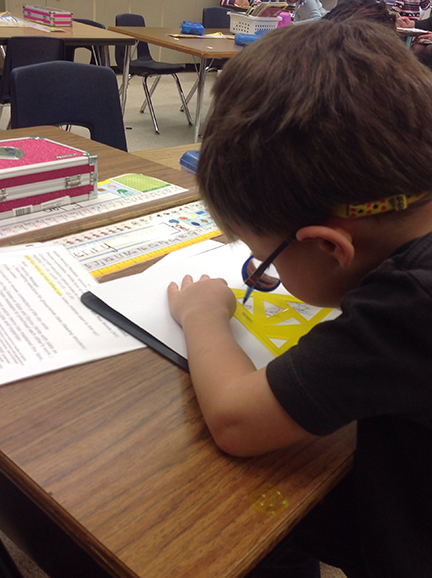 In July 2017, artist and teacher Ann Cunningham addressed the general session of the National Federation of the Blind Convention. Her talk was entitled "Touching Imagination: Unlocking the Creativity of Blind Artists." "Just as verbal literacy is broken into two parts, reading and writing, I see picture interpretation as one part of art literacy and picture creation as the other," she explained. "There is no reason that blind people should not be the creators of tactile images as well as the consumers. It takes skill and education to create tactile images, but it does not take sight. Tactile images need to be formatted differently from visual images, but who knows that better than a tactile picture consumer? We need to discover the best way to tactile literacy, and the American Action Fund's initiative is taking an amazing step by distributing tactile art kits."
Later that year the American Action Fund for Blind Children and Adults launched its pilot project on tactile art. It distributed one hundred tactile art kits, free of charge, to families of blind children between the ages of two and eight. "Blind people are often told that they cannot participate in art," the Action Fund explained in its welcome packet. "The American Action Fund for Blind Children and Adults works to dispel this and other misconceptions and encourages blind people to live independent lives. Comprehending tactile representations is a learned process for blind children, as it is for all children and adults. We believe starting that learning process as early as possible will significantly help develop a child's creativity and imagination. This learning process gives [blind children] the skills to begin interpretation of tactile drawings, printings, 3D renderings, and maps. Tactile comprehension can help blind children in learning subjects beyond art. It can be critical to geography, chemistry, physics, architecture, gardening, and dozens of other topics."
Each tactile art kit contained a variety of materials. As listed in the welcome packet, the kit included:
Substrate materials: sandpaper, animal skin rubbing plates, embossed grid paper, plastic canvas, and a Sensational Blackboard [a rubberized board for creating raised-line drawings]
Drawing materials: ink pen, jumbo crayons, tracing wheel, chopsticks, and a slate and stylus
Tools: print/Braille ruler, rounded scissors, basic shapes templates, French curve templates, and a glue stick
Papers: Braille paper, parchment paper, copy paper, tracing paper, thermoform paper, tactile drawing film, and tactile pictures
Sculpture material: Model Magic
Parents were encouraged to visit the tactile art page on the American Action Fund website. The page contained links to a series of videos that showed parents ways for their children to use and enjoy the tools and materials in the art kit. Although the pilot program has ended, you can still see these videos by visiting https://actionfund.org/tactile-art-program.
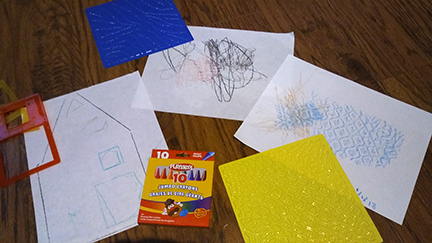 Parents who participated in the pilot program were encouraged to complete questionnaires every two months for six months. The questionnaires sought information about how often blind children used the art kits, which materials and tools they most enjoyed, and whether they seemed to be more interested in exploring and creating pictures since using the kit. Open-ended questions invited parents to share personal experiences and reflections.
According to the questionnaires, families used the art kit two or three times a week on average. The Model Magic, the Sensational Blackboard, and the textured rubbing plates ranked as the most popular items in the kit.
Many of the parents took the time to add comments about their children's responses to the tactile art kit. "It's extremely exciting to think that our blind daughter will be creating art," one parent wrote. "It's even more exciting to see it actually happening! She's holding the big crayons and coloring over the shapes and sandpaper. The videos were very helpful to show us how to introduce these new experiences to her. Her cousin also loves to watch her and be able to color with her." Another parent wrote that she sent some of the materials from the kit to school with her son so that he could participate in art class with his classmates.
"Christina has started to hold crayons and scribble," one parent wrote when asked whether the child was taking part in art activities in new ways. "Before, she would just throw or drop the pens and crayons." Another parent wrote, "[My son] is transferring what he learns through creating art to other objects. He is taking his time exploring the shape of things and is interested in recreating them in his artwork."
Some parents shared that the art kit helped their children feel more fully included in family activities. "We are a creative family," one parent wrote, "and this has made her feel like she can join in!" Other parents explained that the art kit showed them possibilities they had not imagined. "Items in the box are things I didn't think of giving him," one parent wrote. Another stated, "It's given me a good starting point. I felt kind of lost before, and now I have better ideas of what to use."
In her convention presentation Ann Cunningham spoke of the untapped potential of blind artists and the possibility that new forms of art might be created, art that is meant to be enjoyed through touch. "I am a sighted artist, but I know there is something powerful here," she declared. "There is so much more to our experience of the world than visual input. I know far more is attributed to vision than it actually deserves credit for. . . We know that we can feel 360 degrees at once; no one can see that. What else is possible? I am sighted, but by spending time exploring my world through my other senses, I realize that when I close my eyes, I suddenly expand my world in whole new ways that are unexpected, enlightening, and exciting." She concluded, "Thanks to creative initiatives like the tactile art box by the American Action Fund, I look forward to the day—and I hope it's soon—when I hear a young blind child saying, 'What do you mean that in the old days we didn't have pictures?'"
Media Share
