American Action Fund for Blind Children and Adults
Future Reflections Special Issue on Tactile Fluency PICTURES
Teaching Blind Kids to Draw: What Have We Learned So Far?
by Al Maneki
 From the Editor: Al Maneki is a blind mathematician who serves as STEM adviser to the NFB Jernigan Institute. He is passionate about opening opportunities in the STEM fields for blind youth.
Most blind adults will tell you that even though they are excellent Braille readers, they are incompetent at tactile drawing. They feel that they cannot draw a picture or diagram, nor can they interpret one. Such people may be successfully employed, and they have gotten along very well in their lives without cultivating the ability to draw.
The inability to draw that is so widespread among blind people differs radically from the experience of most people who are sighted. When sighted people are asked to describe a particular event or concept, they may choose to describe it verbally or pictorially, depending on which mode of description seems most appropriate. In many situations a combination of both will be used. On the other hand, blind people are forced to rely on verbal or written description because the graphical mode is not at their command. Even a crude drawing may be more convincing and easier to comprehend than a verbal description. If we believe that the average blind person, possibly using alternative techniques, can perform as competently as the average sighted person, then it stands to reason that every blind adult should have acquired basic drawing skills, using tactile methods.
Opportunities through the NFB BELL Academies
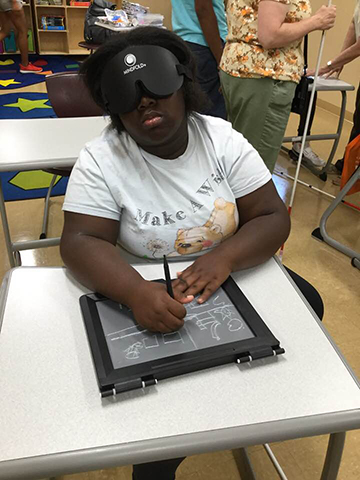
The summer NFB BELL Academies, held in states throughout the country, provide an excellent opportunity for teaching the skills of blindness, including tactile graphics, to blind students. In Maryland, NFB BELL Academies have included units on tactile graphics for the past six summers. We have used the E.A.S.Y. inTACT Sketchpad exclusively, but other tactile drawing devices can also be used. We have focused entirely on using the Sketchpad to trace templates cut out from foam sheets that fit snugly over the drawing surface. The inTACT Sketchpad is designed with a raised border that nicely accommodates the use of foam sheet templates. Of the many choices of available materials, we have found foam sheets to be the easiest from which to construct templates. We have not yet attempted to introduce our students to freehand drawing. Given the enthusiastic responses from our students, it's reasonable to believe that lessons on freehand drawing would go over quite well.
In our early programs we only attempted to teach drawings of simple geometric shapes such as squares, triangles, diamonds, and stars. Circles have posed more of a problem, because it is harder to cut out a smooth circle in a foam template.
As our confidence grew in teaching the drawing of simple shapes, we began to offer more challenging exercises, such as drawing houses, Christmas trees, menorahs, and various animals. We further developed the idea of using multiple templates on the same drawing. For example, after drawing the outline of a house, students inserted a second template over the outline to add the windows and doors. Our drawing of Santa Claus requires four templates. I have written an article providing details about constructing and using templates from foam sheets to be used with the inTACT sketchpad. To request a copy of my unpublished article, "Constructing Foam Sheet Templates for the E.A.S.Y. inTACT Sketchpads," please contact me, [email protected].
By using multiple template overlays, NFB BELL students have learned to draw complex figures without initially learning to draw simple geometric shapes. In Maryland's 2018 NFB BELL programs we went a step further by combining our tactile drawing activities with the activities of constructing 3-dimensional models of the things the students had drawn. Our aim was to teach students that every 3-dimensional object has a 2-dimensional representation. We prepared templates of an airplane and a sandcastle which students were first asked to draw. Next we had the students assemble models of airplanes with balsa wood and models of kinetic sandcastles that were poured into molds. These items, as well as the foam sheets themselves, may be purchased inexpensively from several sources, including Amazon.com and Michaels.com.
The comparison of the 3-dimensional objects and their 2-dimensional counterparts left students with a profound sense of amazement. They were thrilled that they actually had constructed airplanes that flew for a short distance. As an added bonus, students were permitted to take home their drawings, their planes, and their sandcastles. The possibilities are endless for BELL activities relating to constructing 3-dimensional models and their 2-dimensional counterparts. Since many of our students attend our NFB BELL programs for consecutive years, we must plan for new activities each summer. We are very confident from our experiences that we can expose our students to a wide range of new activities.
Additional Projects
 One new idea is the use of directional shadings or crosshatches to represent colors in our diagrams. For example, the color white may be represented by no shading, black by horizontal shading, red by vertical shading, blue by diagonal shading (bottom left to top right), and green by opposite diagonal shading (top left to bottom right). The shading used to represent a particular color will depend on the color that is required in each diagram. For example, an outdoor scene may require blue, green, brown and yellow.
What lessons have we learned so far? Ideally, blind students should have tactile drawing tools and lots of drawing sheets available to them at all times. They should be encouraged to draw whenever they are inspired to do so. They should be taught from the very beginning that they are not dependent on templates to help them with their drawing; rather, the templates they used during BELL were just the means to an end.
Two additional activities come to mind to encourage students to think beyond foam sheet templates:
First, give students a 3-dimensional object, not necessarily the same one, and ask them to draw it freehand. Encourage them to draw what they consider to be the most important features of the object. They should be challenged to attempt something that they have not done before. Remind them that many aspects of artistic work are not accurate representations, but only are suggestive of what is being represented.
Second, present students with an idea or concept. You may present several possibilities and have each student choose one of them. The assignment is to represent their selected topic only in words (Braille), only pictorially (tactile graphics), or in a combination of the two. For example, students might be asked to describe the layout of a baseball field, directional compass points, the face of a clock, types of triangles (acute, right, isosceles, obtuse), etc.
Early Exposure
At a more fundamental level, even before NFB BELL Academy, how do we teach graphics, drawing, and the representation of objects? My early education in these matters was next to nil. My parents did not know what to do, and the National Organization of Parents of Blind Children (NOPBC), the parents' division of the NFB, did not yet exist. Most disappointing, my teachers of the blind were of no help.
I realize now that blind kids should experiment with tactile drawing tools at the same age when sighted kids are given crayons and pencils. It doesn't matter what they draw. They can scribble just as sighted children do.
As they get older, blind kids can produce images of objects that they encounter frequently. For sighted kids this process occurs naturally. Their minds are filled with visual stimuli. For blind kids, the equivalent stimuli come through the sense of touch.
Blind kids should be encouraged to explore the objects around them tactually, and they should learn to distinguish the finest details of the things they touch. For blind children the admonition "Don't touch!" is psychologically destructive.
As blind kids explore objects in their surroundings, they should be encouraged to draw what they have encountered. Blind kids who come to NFB BELL with this type of background will derive the greatest benefits from their BELL experiences.
Learning Curves
Blind adults who have had minimal experience with tactile drawings often complain that lines and curves are too close together. They find it difficult to separate the component parts of a diagram. They may struggle to recognize a square or rectangle within a complex pattern of shapes and contend that the entire diagram needs to be enlarged.
Newly blind adults who are learning Braille make similar requests. They find standard Braille dots too small and closely packed. However, those of us who learned Braille as children find the standard size and spacing of Braille dots to be ideal. Perhaps if blind children were exposed to tactile diagrams at an early age, the size of tactile drawings might not be a significant problem.
We cannot overemphasize the importance of graphics in the vast majority of academic endeavors today. Textbooks and journal articles include heavy doses of graphical content in all fields of study, ranging from the social sciences to chemistry, physics, biology, mathematics, and engineering. Braille materials in these subjects, if they exist at all, almost uniformly exclude the graphical content that is included in the print originals. In part this omission is due to the present shortcomings of technology to render print graphics readily into tactile form. In addition, I think that the producers of Braille content are unwilling to create tactile graphics because they are convinced that blind readers are unable to interpret graphic materials.
I know that graphics are a great aid to improving one's comprehension of many technical matters. Even with the Nemeth Braille Code to represent mathematical notation accurately, drawings and pictures contribute immensely to improving comprehension of many esoteric subjects. We must train blind students as rigorously in graphics as we train them in Braille. The challenge remains to develop inexpensive methods to produce Braille content, including Nemeth and graphics, to meet the needs of today's students and professionals.
Every NFB affiliate should make BELL Academy programs a priority, and all BELL Academies should include units on tactile graphics. Our NFB BELL programs will have a profound influence on today's blind kids. Not only will their skills of blindness be strengthened, but their interactions with successful blind adult role models will enhance their future opportunities. Most importantly, by sharpening their skills in tactile graphics, blind kids of today will be better prepared for tomorrow's career opportunities, opportunities in careers that have yet to be conceived. Although I missed out on becoming competent in tactile graphics, I take pleasure in helping the next generation to acquire a skill that I do not possess.
If you have questions or wish to share ideas about this article, please contact me at [email protected].
Media Share
