American Action Fund for Blind Children and Adults
Future Reflections Special Issue on Tactile Fluency INNOVATIONS
Touch Graphics Turns Twenty
by Steve Landau
 From the Editor: Steve Landau runs Touch Graphics, a five-person firm focused on the design and fabrication of tactile graphics and 3D touchable models. He studied design in the late 1980s and worked as an architect in New York City before he started Touch Graphics twenty years ago.
In 1998 I was working on a historical restoration project in a New York City architecture office. Karen Gourgey, a blind educator at nearby Baruch College, called me based on the recommendation of a mutual acquaintance. She needed my help on a project to create raised-line and Braille maps of New York City's labyrinthine subway system, to be made available to visually impaired New York transit riders. The maps would help blind riders plan efficient travel routes through a better understanding of the relationship between the city's physical layout and the subway system.
Intrigued, I wanted to know more, so I walked over to Karen's office. That meeting, and our subsequent collaboration, eventually led me to change my career path. As we worked on this project, I became more and more engrossed in solving the technical and design challenges Karen had posed. I quit being an architect and founded Touch Graphics, a company devoted to everything tactile.
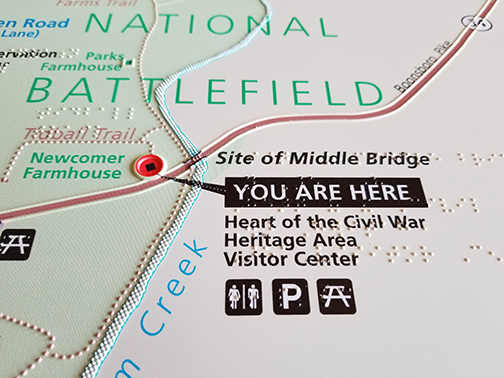
Now, twenty years later, Touch Graphics, Inc. designs and fabricates all manner of maps, signs, and building directories, as well as tactile graphics and models that are used as classroom learning aids and museum exhibits. Our main focus is on the development of new methods for producing precise, consistent, and information-rich graphics that communicate through multiple senses for universal access.
A Short History of Tactile Graphics
Tactile graphics have been around since the formal inception of education for the blind in the early 1800s. Today, museums at Perkins School for the Blind in Watertown, Massachusetts, and Overbrook School for the Blind in Philadelphia display examples of early tactile teaching aids, often handcrafted by the teachers themselves. These teaching tools helped explain concepts in math, geography, chemistry, physics, and more, all through the sense of touch. Though producing these creative and often beautiful objects must have been time-consuming, these early educators understood that blind students need hands-on experiences to understand concepts that defy description through words alone. Tactile experiences provide crucial pathways to understanding for learners who can't access print graphics.
Methods for Tactile Graphic Production
 In the late 1990s, Karen Gourgey's group at Baruch developed a new, multistep process for creating tactile graphics that was a big step forward. To make the subway maps, we started with a computer drawing. We used the drawing to drive a robotic router that carved each tactile element we wanted to produce into a thick plastic sheet. The carving created a reverse-reading (negative) image of the eventual raised-line map. Then we poured a thick liquid plastic onto the surface of the carved plate. When the liquid hardened, we ended up with a right-reading (positive) flexible rubber mat. We perforated this map with tiny air holes to create a mold for vacuum thermoforming the form of the subway map onto a sheet of clear vinyl plastic. The transparent tactile maps were bound into books, interleaved with sheets of paper printed with the visual map that could be seen through the clear plastic map pages. While the results were visually crude, the tactile lines and textures were consistent and legible. We had achieved a new level of clarity and reproducibility, important characteristics of good tactile graphics.
The Need for a Better Way
The New York Subway maps were a big step forward compared with what had been possible until that time. However, we knew that our process involved too many steps and potential failure points. It was too expensive and way too slow. To succeed commercially we needed a better tactile printing process, and since one didn't yet exist, we needed to invent it.
The solution was UV (ultraviolet) printing, a recent technology that has led to dramatic improvement in the quality of our products. UV printing uses bright UV light to cure liquid inks instantaneously as they are jetted onto any substrate, or printing surface. The process allows us to control the relief (height above the substrate) of each tactile line or texture.
UV printing is superior to vacuum thermoforming. We now can produce tactile graphics on many rigid surfaces including plastic, stone, and glass. Materials printed in this way are very durable, with improved tactile sharpness, precision, and consistency. UV-printed signs are durable enough to survive outdoors without fading or deteriorating.
UV printing makes it easy to achieve a perfect alignment of visual and tactile images. This was always a big challenge in thermo vacuum forming, since visual printing and tactile forming were done on two different pieces of equipment.
The Next Twenty Years: A Golden Age for Tactile Graphics?
 UV printing could lead to a proliferation of tactile products. At Touch Graphics, Inc., we are ready to show the world how to build a more inclusive, universally accessible environment through the thoughtful deployment of multisensory design.
Twenty years from now I hope that tactile graphic signs will be everywhere. We have to work hard in the present to introduce this simple but powerful idea. Only when tactile information is ubiquitous will it reach its maximum impact. I am grateful to Karen Gourgey for introducing me to this fascinating field, and to all of my past, present, and future collaborators, who share my enthusiasm for this work.
Projects now underway include:
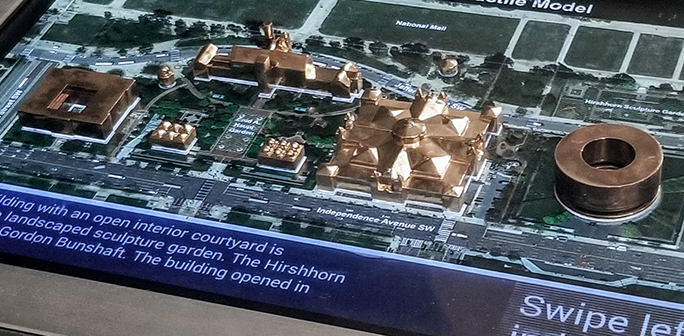
- National Mall Talking Touch Model. This large tabletop model shows the heart of the nation's capital. The 3D printed building models are mounted to an aerial photograph that has been UV printed onto the surface of a 55-inch diagonal touch screen. As visitors touch the buildings, gardens, roads, and other features, they hear each place name spoken aloud. Additional taps reveal more information, such as current exhibits at each of the Smithsonian museums. The model will be installed at the Smithsonian Castle Visitor Center in the summer of 2019.
- Cosmic Buddha Talking Touch Model. This interactive exhibit presents the Smithsonian's world-famous Cosmic Buddha (Chinese, circa 600 CE). Three stone panels are UV printed to create tactile versions of some of the intricate carvings that cover the original sculpture. When visitors touch the printed stones or the scale replica of the original sculpture, they will hear the voice of Keith Wilson, Smithsonian's curator of Asian art. Mr. Wilson identifies and explains this important and fascinating work, ensuring that this world-class treasure is available to all visitors, including those with visual impairments.
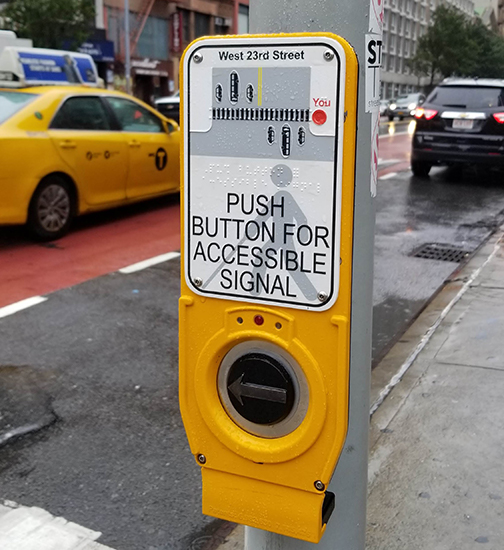
- New York City Subway tactile signs for navigation. The New York City MTA (Mass Transit Authority) has asked Touch Graphics for help in developing a new navigation aid for the subways. New tactile signs will work in tandem with special tactile floor tiles to create pathways through stations to assist independent blind cane travelers catch their trains. While these navigation tiles have been used previously in Japan and elsewhere, this will be the first time that tactile floor markings are paired with tactile signs mounted at decision points along a route. The project also calls for mounting tactile strip maps on platforms to help transit riders plan their journeys, figure out where to transfer to another line, or to count the number of stations between their current location and their destination.
Media Share
