American Action Fund for Blind Children and Adults
Future Reflections Special Issue on Ethnic and Cultural Diversity BUILDING UNDERSTANDING AND FORGING CONNECTIONS
Reflections from Turtle Island: The Intersection of Blindness and Indigenous North American Identity
by Justin Salisbury
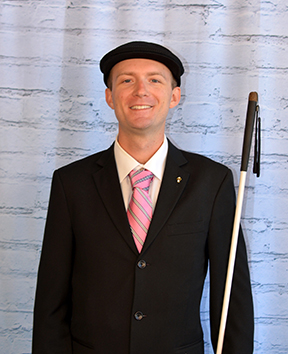 From the Editor: Justin Mark Hideaki Salisbury (Mi'kmaq-Nova Scotia) is a board member of the National Association of Blind Students. Recently he left a position in Honolulu to begin a new job as coordinator of educational programs at Associated Services for the Blind in Philadelphia.
Before I discuss indigenous North American identity and blindness, I will start by choosing some words. We sometimes hear that it is correct to use the term Native American to describe indigenous people. I often just say Indian, and I have learned to do so from other Indian people. I like the term Indian because it has fewer syllables. In this article I include all indigenous people from the landmass that is known to most of its present inhabitants as North America. To my people, the Mi'kmaq and Passamaquoddy, it is known as Turtle Island. There are some differences in traditions from one Indian nation to another, but I will attempt to address common themes.
In Indian circles we often are very comfortable having frank conversations about oppression, privilege, and Indian identity. These discussions have helped me talk about these issues very directly. Many of us who are blind may not be used to talking in these terms about blindness issues. I hope the readers of Future Reflections will be open to my perspective.
To discuss Indian identity, it is vital to start by explaining settler colonialism. Throughout history, settler colonialism has sought to replace the original population of a territory with a new society of settlers. Like all forms of colonialism, it is based on domination, typically organized or supported by an imperial authority. It involves replacing the customs and culture of the original people with those of the colonizing culture, which are believed to be innately superior. Once the culture of settler colonialism becomes established, members of the dominant group take it for granted. Settler cultures include those established by British, German, French, Spanish, Belgian, Chinese, Japanese, Dutch, Portuguese, and Danish colonists around the world.
Settler colonialism and the notion of manifest destiny have heavily influenced the popular concept of what it means to be an American. Americans are often taught that the desire for conquest is an innate human tendency, inherently disregarding the worldviews of indigenous peoples. To most indigenous people, life simply is not about conquest.
Traditional Indians want to be connected with the purpose behind the things we do. We seek a connection with the web of life we participate in and benefit from, a world that sometimes suffers from the things we do. We are often taught to look at the purpose behind things before we act. By tradition we are more reflective than settler groups. However, many of our traditions have been stripped away from our members. This loss of identity is something that many of us ponder.
Attempts to Invalidate Our Identity
Indians face a constant barrage of attempts to invalidate our identity. If the settlers can demonstrate that we do not exist anymore, they can release our claims and argue their full rights to the land. Just as the government attempts to determine who is blind and who is not through its definition of "legal blindness," the federal government "recognizes" Indian tribes or nations. Some nations, such as the Lumbee, are not federally recognized, so they are excluded from some benefits and programs.
I do not belong to a federally recognized US tribe because my people are from Canada. Belonging to Canada First Nations gives a person no status for benefits in the US. Both Indians and blind people are often asked to show a card that proves that we are Indian or that we are blind. Sometimes I feel the urge to ask to see the card that others carry to prove their race or visual acuity.
Nearly all Indians today are people of mixed ancestry, and this interracial background helps form our identity. In some places people regard me as Indian, in others as Latinx, and in others as White or as Ashkenazi Jewish. The truth is that I am all of these things. Many settlers try to invalidate a person's entire identity by saying, "Oh, we're all a mix of everything," as if belonging to multiple groups somehow eclipses indigenous people's social standing or challenges their claim to the land.
Indians have the highest suicide rate of any ethnic group in North America. A sense of belonging helps protect people from suicidal ideation. When we are separated from our people by blood quantum requirements, we are told that we do not belong. For blind Indians, the Federation can help provide that sense of belonging that we might otherwise lack.
The question of belonging is most painful when Indians ourselves attempt to shed our Indian identity, perhaps to escape the discrimination that comes with it. In my family I have often heard mixed-race Indians take conversations on deliberate tangents to declare their white identity. White people who feel secure in their identity don't need to make such claims. In the same vein, some blind people pretend to belong to the sighted majority. I have heard blind people with residual vision talk proudly about how much they can see, as though trying to validate their sighted identity. Sighted people don't need that validation.
Much of the invalidation of Indian identity comes from a practice known to us as paper genocide. Governments document us in ways that strip us of our identity. This practice involves blood quantum requirements that must be met for a person to be officially considered Indian. As we mixed with other groups, we quickly were recorded as everything but Indian. Often we are told, "You don't look Indian," much as blind people often hear, "You don't look blind."
Loss of Culture
Eradicating indigenous cultures is part of the erasure of identity that strengthens the settlers' claim to the land. Through forced assimilation, many of our people have lost our tribal languages. I know a little bit of the Mi'kmaq language but none of the Passamaquoddy language. For our communities, being able to speak the language is a major source of pride and value.
Our languages had no written form before writing was introduced by European missionaries. We have been discouraged from writing in our languages by those who want to eradicate them. Most Indian languages have no Braille code. Braille helps us access language, and language is culture. Thus Braille could help us access our culture more fully.
Many Indian young adults share a sense of shame and embarrassment about not knowing our traditions. Perhaps we don't know how some powwow regalia should look or how to perform a particular ritual. Often we are expected to learn by watching and following wordlessly. For blind people this form of teaching creates a familiar problem; we are at a disadvantage when actions are not communicated to us in ways that we can access nonvisually.
Similarly, blind people may feel shame and embarrassment if they have not mastered Braille, cane travel, and the other skills of blindness. My training at the Louisiana Center for the Blind helped me overcome that embarrassment. By learning to ask questions I have become a better consumer of cultural learning. My ongoing work in the blindness field calls on me to be a role model, and I must push myself beyond shame and embarrassment.
Stereotypes and Misperceptions
Indians and blind people are both subject to many stereotypes and misperceptions. The public has a vast misperception that all blind people receive money from the government simply because we are blind. There is a similar misperception that Indians all receive money for being Indian. Supposedly we receive a resource that we have done nothing to deserve, a resource that makes it easier for us to get ahead.
Blind people and Indians have both been the subjects of comic or stereotypic representation. The cartoon character Mister Magoo is depicted as a figure of fun when he makes bumbling errors due to his poor vision. Indians are often represented with Halloween or Mardi Gras costumes. We often point out, "My culture is not a costume."
Racial sports mascots reinforce the notion that Indian men are threatening. These stereotypes hurt our employability, especially in careers where being hostile and threatening is not particularly desirable. Racial stereotype may seem to fit us for work as a bouncer at a bar or a career in the military, but many Indian men gravitate toward careers such as counseling, teaching, and nursing. For Indian men who are blind, blindness- and race-related stereotypes may exclude us from a broad range of jobs.
While Indian men are stereotypically thought to be fierce and dangerous, Indian women have been seen as passive. Historically there has been a widespread attitude that male settlers could do whatever they wanted to an indigenous woman. Similarly, blind women are often expected to be passive recipients of whatever treatment they receive. Often these attitudes fly in the face of reality. Countless blind women have shown themselves to be capable, powerful, and self-directed. In many Indian traditions, families and communities have strong matriarchal structures. It is very natural for us to have a woman in charge. Non-Indians seem to grasp this concept less instinctively. American Indian women are excellent leaders and organizers. A group of Indian men will often struggle to make a decision without a woman's input.
How were people with disabilities regarded in traditional Indian societies? I have heard stories that we would abandon people with disabilities to die, but this may be settler propaganda. In the tribal village everyone had to do something useful to help the community. A person with a disability who could build canoes, stitch clothing, or brew medicinal teas could play a vital role.
Jealousy and Resentment
As Indians we often face barriers accessing services we need, such as healthcare, government benefits, or vocational rehabilitation. We are often told, "Go get it from your tribe—don't take it from us." I even have been denied critical healthcare in the emergency room and told directly that it was because of my race. No civil rights organization seemed to care. I should not be forced to go to the Indian Health Services clinics, where I am not eligible anyway without membership in a federally recognized tribe!
In another scenario, I was denied vocational rehabilitation services with the claim that "American Indians aren't eligible for VR." I was told to pay for my own rehabilitation with my casino money. Some tribes have plenty of resources, including tribal VR programs, but most do not. I don't get casino money, and very few Indians actually do. The myth that all of us get a check for being Indian sometimes fuels jealousy and hostility in other ethnic groups.
Many of our treaties involved giving up our land and our livelihoods in exchange for education, healthcare, food, housing, and other benefits from the US government. These benefits would continue for seven generations, until our people could adapt to the new society. The US government has yet to deliver on most of those promises. Although in some cases the government partially delivered, those promises never really took effect.
The blind community deals with a similar phenomenon. As blind people we sometimes face jealousy from other disability groups over benefits we receive that are not available to them. Blind people get an extra standard deduction when we pay our income taxes. We have a higher substantial gainful activity threshold for Social Security benefits than people with other disabilities. This benefit is due in part to our need for out-of-pocket work-related expenses such as readers, drivers, and assistive technology. Some states have separate rehabilitation agencies for the blind, while other people with disabilities are handled by general rehab agencies. These advantages may kindle resentment in other people with disabilities who feel that blind people are given undeserved privileges.
Advocacy
The cultural rules within our Indian communities can make self-advocacy difficult. Some Indian cultures believe that a person should only speak when spoken to. This attitude requires someone else to initiate our advocacy. We have to break this rule in order to advocate for ourselves. Indian traditions often involve living in harmony with each other without imposing on other people's ways of life. However, the settler society has upended that value.
Traditional Indian cultures have a sense that nature provides exactly enough of something when we need to use it. The process of tanning skins is one example. The brains of animals are used in the tanning process, and there is exactly enough brain in an animal to tan its hide. When we are raised with this understanding of the world, we may find it hard to push for the things we need. If we are told that there is no funding for the services we need and no mechanism to provide those services, we might interpret this to mean that the Creator does not want services to happen for us. If something does not turn out the way we hoped it would, we may be receiving a message from the Creator. If we follow this pattern of thinking when we hit an accessibility barrier or run into overt discrimination, we may think that we are not meant to succeed. Such thinking can close many doors for a blind person. On the positive side of this thinking, however, we are taught to be resourceful, and we might conclude that the Creator gave us the National Federation of the Blind as a resource to help us when we encounter barriers.
Residential Schools
Most Indians are very hesitant to trust residential schools. In our families we have heard stories of how residential schools were used to "kill the Indian and save the man." Indian children were sent far from their families and communities to schools where they experienced regular physical and sexual abuse, malnutrition, and a lack of access to healthcare. When Indian children spoke their tribal languages, even after hours, they were beaten and humiliated. In some instances, abuse survivors were forced to bury their classmates in mass graves near the residential school grounds.
Like Indian children, blind children have a long history of being sent to residential schools far from their homes. Since the shift to mainstreaming in the 1970s, many schools for the blind primarily now serve students whose districts are "unable" to educate them. Today most of the students at residential schools for the blind have multiple disabilities or come from urban and rural districts with very limited resources. A disproportionate number of Indian children grow up in districts that have insufficient resources to serve blind students. Residential schools for the blind could provide them with the kind of education they need. Indian families have learned not to trust residential schools, creating a major barrier for children who could benefit from attending residential schools for the blind.
In the National Federation of the Blind, we often talk about the impact of low expectations on the lives of blind people. Many of our Indian families are happy if their children survive to adulthood and stay out of prison. We have the highest incarceration rate of any race in the US and the highest rate of being killed by police officers. Alcoholism and substance abuse are big problems in Indian communities as a means of coping with intergenerational trauma. Substance abuse is also a problem for many people in the blind community, who deal with poverty and a low sense of self-worth.
I invite others to elaborate on what I have written and to further the discussion. I believe that both communities—blind and Indian—are looking for the same things. We want to live in harmony with our neighbors from the privileged majority groups. We want the opportunity to contribute. We want to operate without the confines created by stereotypes and misinformation. We do not want to be denied the things that we need or want because of implicit bias or overt discrimination. We want to make our dreams a reality by working together with love, hope, and determination.
Media Share
