American Action Fund for Blind Children and Adults
Future Reflections Special Issue on Ethnic and Cultural Diversity BUILDING MOVEMENTS, COMMUNITIES, AND FAMILIES
A Conspicuous Family
by Karin Norington-Reaves
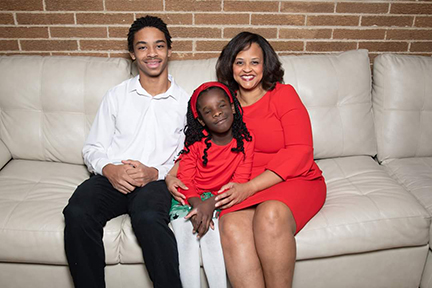 From the Editor: Karin Norington-Reaves is CEO of the Chicago Workforce Partnership, the workforce development administrative agency for the city of Chicago and the surrounding suburbs of Cook County. She is also on the city's steering committee for the 2020 census, and she serves on the board of the Chicago Lighthouse for the Blind. Her daughter, Rachelle, has participated in the Chicago BELL Academy every summer since 2017.
I am a single mom raising my fifteen-year-old biological son, Alex, and my seven-year-old daughter, Rachelle, whom I adopted from Haiti. I am African American, but my son and I are much lighter-skinned than Rachelle, so we get a lot of stares when we're out in public. We also attract attention because Rachelle is blind due to bilateral anophthalmia, which means that she was born without eyes. We are definitely what the adoption community calls "a conspicuous family."
Finding Rachelle
I first met Rachelle when she was a year old. In the summer of 2013 I went to Haiti with a close friend who was adopting a little boy from an orphanage. My friend had to spend a lot of time at the embassy being interviewed and completing paperwork. I couldn't go with her because security was very tight, so I spent most of my time at the orphanage playing with the children. I noticed Rachelle lying in a crib, and I remember commenting that she was always asleep. She was completely bald; her head had been shaved during a ringworm outbreak.
I went over to Rachelle's crib and stroked her head. She grabbed my wrist and wouldn't let me go. Her hand explored up and down my arm and along each of my fingers, and she forced me to give her affection.
When I thought Rachelle had gone back to sleep I tried to slip away, but she flipped over and reached for me again. I picked her up, and she snuggled in my arms.
At that point one of the child-care workers, or nannies, came over and said to me, "You know, she's blind." I said, "So?" Blindness didn't seem like a big deal to me. My stepfather was blind. He was a third-degree black belt in karate, and he taught sign language to deaf children.
During that week in Haiti I fell in love with Rachelle. The nannies let me take care of her whenever I was at the orphanage. I fed her and bathed her and played with her.
On my last morning in Haiti I kissed Rachelle good-bye. I prayed that she would be given a good family and that she would grow up to be a strong, independent woman.
As I turned away in tears, I overheard one of the nannies say in Creole, "She'll be back for that one someday. You watch!"
"I understood you," I said, and she said, "I know."
The Journey to Adoption
Before I left for Haiti with my friend, my son asked me, "When are we going to adopt someone, Mom?" He was eight years old at the time. I pointed out that I'm a single mother, and I didn't think adoption was going to happen for us. "Besides," I said, "I don't know that you'd want to share your mom with someone else." But he argued, "I'd be a terrific big brother!"
When I got home from Haiti, my son looked at my pictures of the kids in the orphanage. He commented that his older brother and sister have been there for him sometimes, and he said, "I'd like to be there for someone else."
Two months later my friend sent me a list of special-needs children in need of a forever family, and I found Rachelle's initials on the list. My friend called and said, "I think that's Rachelle. You should investigate!"
"Listen," I said, "I have a very demanding job, and I'm a single parent. There's no way I can adopt a child, especially a kid with special needs."
My friend said, "You pray for her every day. You talk about her all the time."
Finally I decided to investigate. I got hold of a social worker, and the moment I mentioned Rachelle's name, she put down the phone and ran through the office, shouting that someone was interested in adopting Rachelle.
They gave me a couple of months to think about it because I still had some concerns. One of my worries was money. One day my friend asked me to meet her in a church parking lot. She handed me a check to help me start the adoption process.
In order to adopt Rachelle I had to go through a lot of extra steps. I had to write a letter to the Haitian government, promising that I could give Rachelle everything a blind child would need in order to succeed. Even though I started the adoption process in the fall of 2013, Rachelle and I were not formally matched until April 2015. I didn't see her again until July 2015, and it was another full year before I finally brought her home. That was fast compared to a lot of international adoptions; sometimes it can take as long as seven years before a child comes home!
Beginning a New Life
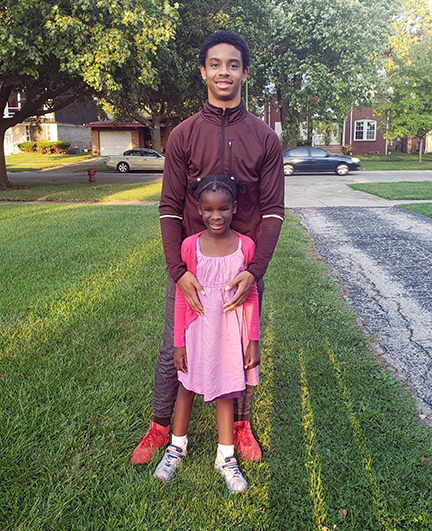 When Rachelle finally came home she was almost five years old. I took off eight weeks from work to help her get acclimated. She could barely walk, and she had never had a cane in her hand. She hardly spoke Creole, and of course she knew no English. She had developed the habit of sucking her thumb to comfort herself, and her teeth were badly skewed as a result. She had intestinal parasites and a host of other health problems, including juvenile arthritis. We made five visits to the emergency room in a period of six months.
In order to communicate with Rachelle, Alex and I learned some Creole before she arrived. At first she would say single words in Creole, such as milk and bed, but she learned English quickly. After four weeks with us she was able to participate in her first evaluation. She could answer some of the questions verbally, and through her behavior she responded to others. For instance, when the evaluator handed her a brush, she put it up to her head. She knew what things were, even though she didn't have the words for them yet.
Unfortunately, one technique that helped Rachelle gain attention at the orphanage was biting. When she first came home she would bite whenever she wanted attention. She'd bite me, and she'd bite Alex. She bit Alex all the time. As soon as I left the room she'd lean over and bite him. She wanted me to come back. She'd bite her brother, he'd scream, and I'd come running—it was a very effective strategy for getting what she wanted!
Not long ago Alex told me, "When I first met Rachelle, I didn't love her. But I love her now." One way my kids bonded was by sitting together in the back seat on car rides. Rachelle hated riding in cars! She would scream and rock and cry whenever we had to drive somewhere. Alex would sit with her to keep her company and comfort her. It really helped. Now they're very close. I tell people, "I knew he'd be a good big brother, but I didn't realize he'd be a great one!"
Alex loves teaching things to Rachelle, even things I might not like. He taught her to climb the ladder to the top bunk in his room before I thought she was ready to do that. He also taught her to open the car door and walk by herself to the house.
Going to School
After she’d been with us for six weeks, I enrolled Rachelle in the preschool run by the Chicago Lighthouse for the Blind. I shadowed her for her first two weeks in the program, stepping back more and more so she could be with the teachers and the other children. The preschool is for children from low-income families. It's an inclusive program, so a number of the children have disabilities. Rachelle was the first totally blind child who had ever been enrolled in the preschool.
Now Rachelle attends Otis Elementary School, a Chicago public school that has a program for blind and low-vision students. She is mainstreamed most of the day, and she is pulled out for things such as Braille and orientation and mobility [O&M]. Actually she has more push in than pull out this year; the teacher of blind students works with her while she's in the regular classroom.
Before Rachelle started kindergarten, the school district set as a goal that she would learn ten Braille letters by the end of the school year. Fortunately she had an excellent Braille teacher, and in October they adjusted her goals. The new goal was that she would learn ten Braille letters by January. By March she had mastered the whole alphabet! She was reading contracted Braille and learning Nemeth Code by June. Academically, she was on track with her typical kindergarten classmates. Now, in first grade, her reading fluency is above grade level.
Relating to peers is still a challenge for Rachelle. She's funny and inquisitive, and she engages very well with adults, but she's still learning to play with other children. When we're at the park, children seldom invite her to play with them, and that breaks my heart.
One of the social challenges for Rachelle is her need to learn boundaries. At the orphanage many staff members took care of her throughout the day. Visitors would come in and play with her the way I did when I met her in 2013. Now Rachelle needs to learn boundaries; you don't hug and kiss everyone who walks into the classroom. Her mom and her brother and her grandmother are her family, and she must not expect to have the same kind of attention and love from everyone she meets. She still grabs people to direct them to what she wants, much as she grabbed my wrist when she was in her crib at the orphanage.
O&M started for Rachelle when she was in preschool. I have a video of her getting her first cane. She knew just what to do with it! She picked it up and explored it from end to end. Then she started trailing the wall, even before she had had any instruction! Now she uses the cane everywhere she goes. It's with her all day at school, and she uses it whenever we go out.
I have a very demanding job, and I'm blessed to have found a wonderful caregiver who fills in when I have to be away overnight. Danielle is a special education teacher, and she has been part of our family ever since Rachelle came to us.
Out in the World
A lot of adoption literature focuses on families that adopt children from a different racial or ethnic background. I think that literature is very relevant to families who adopt children with disabilities. As a parent you have to think carefully about how you will react to people's comments and behavior. The way parents choose to react telegraphs a message to their kids. If you as a parent get super defensive, your reaction may convey to your children that there is something wrong with them. If you're hostile, are you encouraging them to be hostile, too?
Adoption classes encourage parents to think about what their responses will be; but truthfully, nothing can prepare you for some of the experiences you will have. For instance, I think of my friend, who is white, who adopted her son from the orphanage in Haiti. One day they were grocery shopping, and the young man at the register said to her, "Which aisle did you find this one in? I need to get one, too. Are they on sale?" I suppose he thought he was being funny, but the comment was insulting!
People stare at Rachelle when we're out in public. Sometimes Alex steps in front of her to block their view. I'm very aware of the difference between curiosity and judgment. When kids are curious I will say to them, "Do you have a question?" They'll say, "What's wrong with her eyes?" I tell them, "She doesn't have eyes. That's the way God made her. But she can run and jump and play and talk. She can do everything you can do. Would you like to know her name?" I've also seen kids who are just being jerks, and I'll say, "Stop staring at her! That's rude!" I don't engage with them; they're not the children I want her to play with.
I've seen adults who are rude too. One day when we were out Christmas shopping, a young woman walked up to us and asked, "Is she blind?" When I said yes, she said, "Awww!" I've had people burst into prayer. One woman kept hollering, "It's a baby who's blind! It's a baby!" Rachelle doesn't react when people say strange things to her or about her, but I know she notices. She is very aware of people, and she remembers everything.
Looking Ahead
Before Rachelle came home I met with an ophthalmologist at the Illinois Eye Institute. I wondered whether I should have Rachelle fitted for prosthetic eyes. The doctor looked at me and said, "That would be for you, not for her. She is who she is. She's accustomed to being in her body. Prosthetics won't do anything for her."
When Rachelle came to us she had to deal with so many issues that I didn't want to add the process of fitting her for prosthetics on top of everything else. Whenever she wants to get prosthetics, when it comes from her, I'll be totally on board. Probably it will become important to her when she reaches adolescence.
Sooner than later Rachelle will be a teenager, with a whole new set of issues around self-identity and self-awareness. She'll be dealing with all the regular teenage stuff—the pull and the push, I love you, I hate you, leave me alone. She'll be realizing that she's adopted, that I'm not her birth mother, that she doesn't know anything about her birth family and where she came from. On top of that, she'll be grappling with the reality that she can't drive a car because she's blind. I will get the triple whammy of teenage angst! I'll be done for! I just hope I'll be remarried by then so I'll have a partner to help me get through!
In the meantime, we have plenty of things to enjoy, and a lot to look forward to. Rachelle is very musical. She has perfect pitch. She loves singing, guitar, and piano. She plays beep baseball at school and at the park district. She's starting to do track and field for Special Olympics.
Rachelle loved BELL Academy from the beginning, and she can't wait to take part again this summer. One of the BELL volunteers, Chaquita, has been a real mentor to her, and they keep in touch throughout the year. We have a great photo of Rachelle and her friend Charlie giving each other high fives when they got words right. It's the cutest thing ever!
Even though my stepfather was blind and very accomplished, a lot of people in my family were terribly opposed when I announced that I was adopting Rachelle. Two of my aunts were especially hung up on her blindness. Rachelle has shot down every stereotype anyone carries. She's every bit the blessing to us that we are to her. I'm proud of her, and I'm proud to be her mother. I'm proud that she chose me!
Media Share
