American Action Fund for Blind Children and Adults
Future Reflections Spring 2020 INSTRUCTION AT HOME
Cane Travel at Home: Lesson Ideas for Parents and Instructors
by Liz Wisecarver
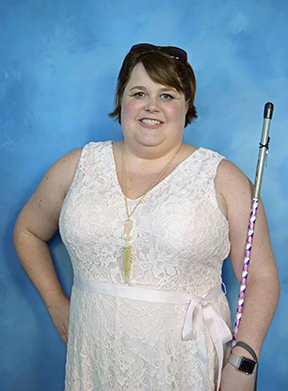 From the Editor: As parents and teachers search for ways to make remote learning work for blind children, orientation and mobility instruction seems to pose serious challenges. How can a child learn effective travel skills without working with an instructor face to face? In this article Liz Wisecarver offers suggestions for teaching important orientation and mobility skills at home. Liz Wisecarver has worked as an O&M instructor with children in Louisiana and currently lives in Houston, Texas.
As the COVID-19 pandemic continues, families of blind children are wondering how Expanded Core Curriculum services such as cane travel can be done remotely. Blind children can engage in many activities at home or in their communities to reinforce concepts such as cane technique, mental mapping, sound localization, and problem-solving. Below are several lesson ideas that are easy to accomplish with only a few supplies. These activities can be enhanced through the use of learning shades (sometimes called sleepshades) and the long white cane. Parents should consider the purchase of a teaching cane, a cane that is sized for them, to help demonstrate proper cane use to their blind child and join in playing games.
Games Using Canes and Learning Shades
Simon Says, Mother May I, and Red Light Green Light are all games that help children develop spatial awareness. Very young children should practice directions such as left, right, up, down, in front, and behind. Older children should practice the cardinal directions: north, south, east, and west. These games are more fun when other family members join in.
Create a scavenger hunt throughout the house and outside with objects for your child to find. Your child might follow a tactile treasure map or look for Braille clues that give directions to the next object.
As a variation, have your child go on a sound scavenger hunt. Walk around the house and outside to find every type of sound you possibly can. Sounds might include the dishwasher, the washing machine, singing birds, or a neighbor's barking dog. Ask your child specific questions about the sounds and their locations. Remember to pay attention to how the cane sounds as it taps on different surfaces, such as carpet, grass, or asphalt. Your child might enjoy recording the scavenger hunt sounds to listen to later—the flushing toilet was always a favorite with my elementary school students!
Play with noisy athletic balls, the kind with bells or rattles inside, to practice sound localization. This game is more fun when other family members join in. Have your child listen to where the ball rolls and find it with their cane. Practice rolling, bouncing, or tossing the ball between players. Let your child run and kick the ball in an open space to get some exercise.
Fire Drills
Practice your household fire drill. Make sure everyone in the house knows where to go in case of a fire emergency. Pick a location outside the house, such as the front gate, where the whole family should meet. Have your child start from their bedroom so they know the best way to get outside. Show your child the smoke alarms, where they are located, and what they sound like when they are activated.
Make a game out of the practice drills by using a stopwatch to time your child. Your child should have easy access to their cane. They should know where it is located at all times for emergencies.
Cardinal Directions
Play a game to practice identifying the location of the sun. Have your child spin in a circle, stop, and locate the sun by feeling the heat on their body. Just don't get too dizzy and fall over!
Streets and Addresses
To reinforce mental mapping skills ask your child to write down as many street names as they can think of in your neighborhood or on a particular route. Ask them to indicate if the streets run north-south or east-west. Have them name any special characteristics about the streets or intersections, such as a boulevard or a T-intersection.
Make certain your child knows your home address and can give meaningful directions to your house. Your child should be able to describe your house, such as saying, "It's a red brick house with a circular driveway." Your child should know the names of nearby streets and landmarks in order to give directions when traveling home with others. You can help your child learn to give specific driving directions, such as knowing the name of the neighborhood and where the house is in relation to main streets and businesses.
Talk about the address system as you are driving or walking. Name the streets as you cross them. Read the numbers on the buildings or houses, and tell your child how the mail carrier uses these numbers to deliver the mail. Explain what a city block is and how the blocks relate to the address system. Point out that even numbered and odd numbered addresses are on opposite sides of the street, and ask your child to look for other number patterns.
Let your child deliver some happy mail to friends and neighbors. Try making some cards or baked goods together to brighten someone's day. Your child can determine the walking or driving route and deliver the packages to front doors or mailboxes. As a bonus they can practice skills such as writing or cooking as they make the presents.
Maps and Mapmaking
Have your child draw maps using cardinal directions. The maps can include details about streets and buildings. Let your child explain how to get from one place to another, based on the directions they have created. Ask them to draw maps of familiar locations, or let them get creative and design a world from their own imagination. Tactile drawing boards such as the Sensational Blackboard and inTACT Sketchpad are useful tools, but your child also can use Wikki Stix, foam stickers, and adhesive-backed sequins to make tactile maps.
Talk to your child about identifiable landmarks in your area and their locations. Examples might include "the mountains are north of us," or "the interstate is west of us." Expand further and talk about other locations in relation to your home, such as "Canada is north of us." Talk about which towns border your hometown, how far away they are located, and which direction you would travel to reach them. Make sure your child knows which states border your home state, and talk about where your state is in relation to the rest of the country.
Expand this conversation to include other countries and continents. Tactile maps, globes, and atlases are helpful if they are available to you. Otherwise, you can make your own simple maps to explain these concepts. Make sure your child knows where your state is in relation to other states, i.e., We’re in Iowa, Minnesota is north of us, and Nebraska is to the west.
GPS and Transportation Apps
Ask your child to put an address in the GPS phone app and give you the driving or walking directions. If your family uses rideshare apps, let your child request a ride from Uber or Lyft. Have them explore direction options within various GPS apps, including walking, driving, or public transportation directions. Ask your child to plan a route from home to a particular destination. Discuss how they gathered information and what transportation options are available. Talk about changes to transportation options that may be related to the COVID-19 shutdown, such as reduced public transit or longer rideshare wait times.
Cane Travel
Let your child be the cane travel teacher and give you instructions. Kids love being in charge, so grab some learning shades and a teaching cane so they can tell you where to go. Make sure they give you clear instructions using words such as left and right. Otherwise you won't know which way to go.
Shopping
Let your child help in the grocery store or with delivery apps. If you are going to the grocery store in person, talk to your child about the changes put in place to help with social distancing, such as marked off aisles, hand sanitation stations, distancing in check-out lines, and wearing masks. Do some role-playing so your child can practice following lines while staying at the proper distance and asking for assistance with shopping. It can be helpful to practice wearing masks at home periodically so your child can get used to how they feel.
If your family uses a grocery delivery app, let your child help by selecting foods on your list and completing the checkout process. Shopping lessons provide an excellent opportunity for you to talk about money and budgeting.
Listening and Learning
Find a successful blind adult and let your child interview them about travel. You can help your child flesh out questions beforehand that can address the curiosities, fears, and hopes they are feeling about their future. Reach out to your local chapter of the National Federation of the Blind to meet a blind adult who would be happy to chat with your family about their lived experiences. The National Federation of the Blind is an excellent resource on any kind of blindness-related information for you and your child.