American Action Fund for Blind Children and Adults
Future Reflections Spring 2020 INSTRUCTION AT HOME
Expect the Unexpected: Creating the 2020 BELL Academy In-Home Edition
by Karen Anderson
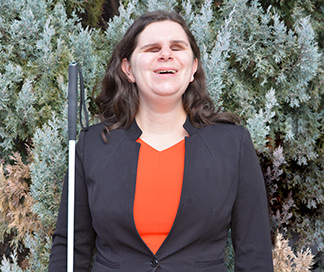 From the Editor: Each summer for nearly a decade, blind children and blind mentors across the country have taken part in the NFB BELL® Academies. BELL stands for Braille Enrichment for Literacy and Learning. BELL Academy was conceived to foster Braille reading and writing through a host of activities such as cooking, crafts, science experiments, and field trips. When the COVID-19 pandemic struck, it was clear that the tried and true BELL Academies could not take place safely. In this article Karen Anderson, national coordinator of the NFB BELL Academies, explains how the program was reconfigured to meet the new demands of our COVID-dominated world.
In January 2020 BELL Academy coordinators and teachers from all over the United States gathered in Baltimore for a packed weekend of planning and brainstorming. We drew upon years of experience as we mapped out the summer ahead. None of us imagined that two months later our careful plans would be completely derailed by the COVID-19 pandemic.
By the middle of March it was clear that safety concerns had to come first, and we would not be able to hold our traditional face-to-face BELL Academies. Would we have to cancel the program entirely? Was there still a way we could hold a program and keep participants safe? I had no earthly idea what we might do!
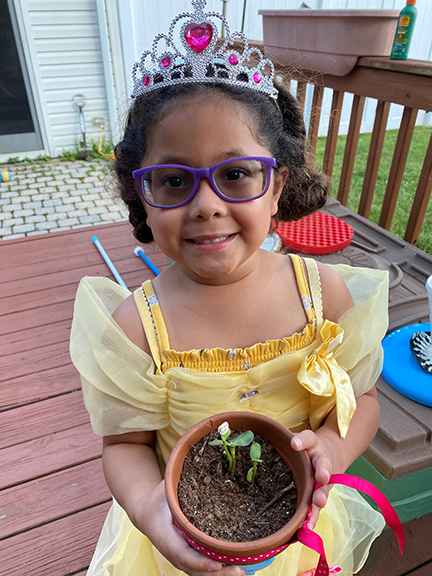 I had several intense meetings with NFB President Mark Riccobono and Anil Lewis, executive director of Blindness Initiatives, trying to imagine what BELL might look like this summer. We wanted to make sure the program wasn't simply another version of the remote learning created by the schools. The program needed to be meaningful for children between the ages of four and twelve, and it had to be fun.
Out of those discussions grew the program we named BELL Academy In-Home Edition. We designed the program to include online sessions with teachers and mentors and hands-on learning activities that children and their families could do at home.
Instead of having each state affiliate schedule its own BELL Academies, In-Home Edition brought together children and their families from all across the United States. We planned three two-week sessions, with the online portion headed by teachers of blind students. Our teachers included Kristen Simms, Stacie Gallegos, Casey Robertson, and Kayleigh Joiner.
Information about applicants from each state was sent to affiliate presidents and state BELL coordinators. Each participant was paired with a blind mentor who made daily contact with the family to serve as a resource.
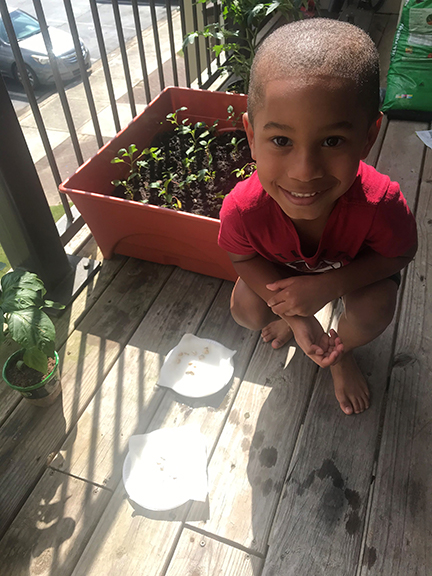 Before each of the three BELL sessions, every participating family received a big box of surprises. Among other things each box contained a slate and stylus, styrofoam plates, drawing paper, bells, paper towel tubes, and a packet of sunflower seeds. We hoped that unpacking the boxes would heighten the children's excitement about the start of BELL. If only we could have come up with a way to send the ingredients for that famous BELL favorite, ice cream in a bag!
BELL lessons fell into four categories: reading, writing, travel, and nonvisual skills. The In-Home curriculum for each of the three BELL sessions consisted of five lessons from each of these four categories. Before each class the students and their families watched a video pertaining to the lesson. We planned for them to do the lesson at home and bring their questions and comments into the Zoom meet-up with the teacher.
Does any program ever work the way you plan it? It turned out that most of the families didn't want to work on lessons by themselves. They wanted to do the lessons together, sharing the experience with other families and getting direction and encouragement from the BELL teachers. Fortunately, our BELL teachers managed to do an instant regroup. BELL lessons immediately became group projects.
BELL activities included making tambourines with bells and paper plates, creating raised-line drawings, and writing stories. Growing sunflower seeds turned out to be one of our most popular projects. The children were amazed when we told them that many kinds of seeds can germinate without being planted in the ground. They wrapped the seeds in damp paper towels and checked each day to discover how much they had sprouted.
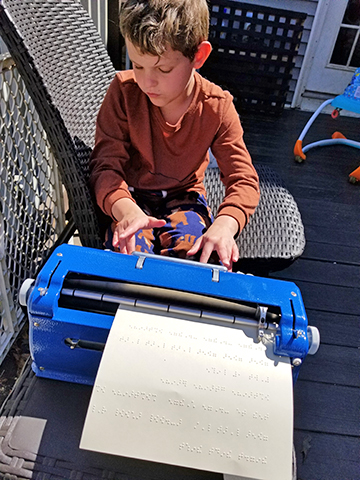 Most of our BELL families had been exposed to a lot of cyber classes since the school shut their doors in March. We were all too familiar with the weary phrase "Zoomed out." Nevertheless, we discovered that our BELL students were highly engaged by the lessons in the program. Every aspect of each lesson was fully accessible. There were no struggles with inaccessible graphics and poorly described video content. This was the world as it was truly meant to be!
However, we recognized that BELL involved much more than lessons. In our face-to-face program kids giggled together waiting for the bus or chattered about their favorite movies as they prepared lunch. BELL was about learning Braille and nonvisual skills, and it was also about making friends and building a sense of community. Somehow we had to make space for that key component in our BELL In-Home Edition.
With a lot of input from folks in our Arizona affiliate, we built a daily social hour into our BELL schedule. Students and their families could gather for casual conversation on any topic they chose. It turned out that some groups were more comfortable than others with this open format. In general we found that we had to provide some structure to get people talking. It helped to toss out a leading question: What does blind mean to you? How do you ask for help when you need it? How do you turn down help that you don't need or want? Even with a bit of structure, group involvement was uneven. Some groups talked eagerly, and others were much more quiet.
When we planned BELL In-Home Edition we wondered how many families would sign up for such a program. As it turned out, enrollment for the new program was about the same as it had been for our face-to-face programs over the past few years. Forty-five students took part in Session 1, eighty-seven in Session 2, and one hundred and forty in Session 3. Nearly half of our 2020 participants were brand-new to the program.
Letters from parents and teachers let us know that, for some families at least, BELL In-Home Edition made a positive difference. One mother emailed to tell us that the video on cane travel gave her the courage to let her daughter use her cane on a walk to the park. Another mom wrote, "My daughter Liz and I are so thankful to have the opportunity to join in on the virtual BELL camp this year. Liz loves all of the activities and having the chance to learn from blind adults who are so encouraging." A teacher from California texted me to say, "I want you to know what a difference you have made for the family of one of my former students. Four years ago he was very isolated and withdrawn. His parents weren't in favor of him learning Braille. This summer he's doing great, and his dad really got on board."
What will BELL look like in the future? We look forward to resuming our face-to-face BELL Academies as soon as it is safe for us to do so. However, we hope to preserve some of the most successful elements of the BELL In-Home Edition. In-Home Edition has allowed the participation of families from places where a face-to-face program has never been available. It has also permitted us to be involved with parents and siblings in ways that were not possible in our traditional program. We hope we can take everything we've learned this summer and build on it in the years ahead. Let the BELLS ring out!