American Action Fund for Blind Children and Adults
Future Reflections Spring 2020 EDUCATION
Teaching from a Distance
by Treva Olivero
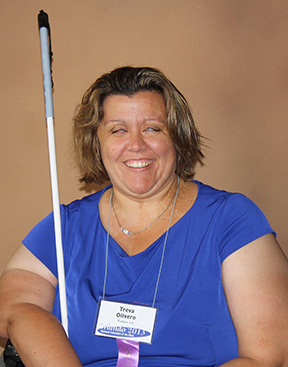 From the Editor: Even before COVID-19 made virtual instruction a household word, distance learning emerged as a valuable means for educators to reach blind and low-vision students. Communities that could not provide a qualified teacher of blind students were able to hire a teacher who might live anywhere in the country. In this article Treva Olivero describes her experience providing remote instruction.
In 2018 I had the opportunity to do distance teaching with a high school student in another state. The student needed some training in assistive technology. As a paraprofessional and as a teacher for summer programs, I was comfortable with in-person instruction. However, I was apprehensive about distance teaching. How could I demonstrate the technology properly? What if the student's computer froze? How well would I be able to hear the student's screen reader? Would they be able to hear mine?
To prepare for this new set of challenges, I talked to some of my colleagues and learned how to use JAWS Tandem and Zoom. JAWS Tandem allows me to connect to another computer using the JAWS screen reader. I can listen to and interact with the student's computer. Zoom is a meeting platform that is very accessible to blind users. I use Zoom to talk to my students and give them instruction.
After the first few lessons I solved some connectivity issues and got over my fear of distance teaching. In fact, I really started to enjoy it. As I became more comfortable with this style of teaching, I started to see the advantages for me and my students.
Learning virtually helps students be more independent. From the beginning I teach my students to log into Zoom by themselves. If an adult is present, I encourage that person to let the student log in independently after the first few lessons.
Virtual learning promotes problem-solving skills. One of my students has frequent connectivity issues. He has learned how to troubleshoot, and he knows what to do if we get disconnected. I teach students how to problem solve and listen to what their device is doing or read the Braille display. I can't rescue them if they press the wrong keys. They learn to fix their own mistakes and get themselves out of trouble. I teach the students where the escape key is on their computers, and I make sure they know how to find the cancel or go back button.
Although I have JAWS Tandem running and can hear what my students are doing, I let them explore and learn about whatever app we are working on. Virtual learning promotes discovery learning.
Teaching virtually has made me a better educator. Instead of just fixing the problems that the students might have with their technology, I take the time to teach them how to get out of the situation. Teaching using Zoom has taught me to be more descriptive and to give more detailed instructions. For example, in teaching iPhone gestures, I am not sitting beside my students, so I can't check their hand positioning. Therefore, I explain the gesture verbally, and the student and I listen closely to the feedback from Voiceover. I taught a student how to use the Victor Reader Stream, and I had to make sure I was descriptive about the physical layout and the buttons. In turn, the student paid closer attention because she really wanted to be able to listen to audiobooks.
Over the past several years I have gained a lot of great experiences through distance teaching. I continue to learn. I am glad I took that initial leap of faith to try a new way of teaching. It has enabled me to be comfortable with distance teaching in our recent months of virtual instruction. Whether I am with my students in person or virtually, I still love teaching!