American Action Fund for Blind Children and Adults
Future Reflections Spring 2020 LIVING AND LEARNING
Education Is the Key
by Roanna Bacchus
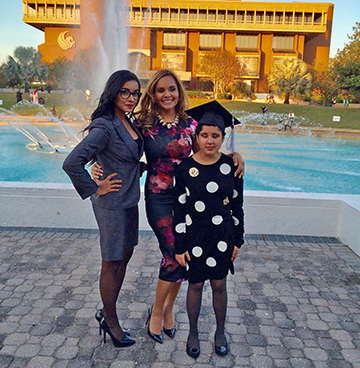 From the Editor: Each time a new issue of Future Reflections appears, Roanna Bacchus sends me a note to let me know she has read it from cover to cover. She tells me which articles she liked best, and sometimes she makes suggestions for future issues. Recently she told me a little bit about her background, and I was delighted when she agreed to share her story with our readers.
When my mom tells the story of my birth, it sounds like nothing short of a miracle. I was born four months premature on February 28, 1990, at Boston City Hospital. I weighed only one pound nine ounces, and I spent the first six months of my life in the hospital. One of my lungs collapsed, and because I received too much oxygen in the incubator, I became totally blind.
My parents immigrated to the United States from the Caribbean islands of Trinidad and Tobago. Growing up on the islands, they had never known any independent blind people. In the West Indies, most blind people are isolated from the rest of the population. If they work at all, they weave baskets or do other handicrafts.
Many members of our extended family lived near us in Boston. When I finally came home from the hospital, some of our relatives were on hand to care for me while my parents worked. As a toddler, I attended the early intervention program at Perkins School for the Blind. I received occupational therapy and audiology services, and I learned to interact socially with other blind children. My early intervention teacher also came to our home to work with me outside of class. After I completed the Infant/Toddler program I attended a pre-school at Perkins, where I continued my educational journey.
In December of 1995 I moved with my family to Florida, where my quest for literacy began. The closest school for the blind was located in St. Augustine, two hours away from us. If my parents enrolled me there, I would have had to live at the school during the week, only coming home on the weekends. My parents felt this separation would not be suitable for me at such an early age. They decided I should attend a local school instead.
In January of 1996 I entered Lake Mary Elementary School, where I met my regular classroom teacher, my Orientation and Mobility (O&M) instructor, and my teacher of blind students (TBS). I rode the bus to school each morning, and I remember being tired on many days as I sat in the classroom.
I was in first grade when Mrs. Susan Hale, my TBS, brought a Perkins Braillewriter to my classroom, and I began learning to read and write Braille. Mrs. Hale helped me master the alphabet, numbers, punctuation, and Braille contractions. Each week I spent hours completing my homework assignments. Since few of my assignments were transcribed into Braille in a timely manner, my mom sat and read my homework to me. Most of my mathematics classes were taught visually, and I was required to demonstrate certain concepts through drawings, charts, and graphs. I am so appreciative of all the time my mother spent with me during the early years of my life.
Before I was able to obtain a refreshable Braille device I relied on the Perkins Braillewriter and the slate and stylus. My textbooks were produced at the Florida Instructional Materials Center for the Visually Impaired in Tampa. I also received instructional materials produced by the American Printing House for the Blind. My textbooks for each grade from third through twelfth had to be ordered several months in advance.
Books in Braille are comprised of many volumes, and they take up a lot of space. I had two sets of each Braille textbook, one at home and one at school. I was glad I did not have to carry those heavy books from home to school in my backpack each day! At the end of the school year, all of my books were boxed up and shipped back to Tampa.
My family worked hard to provide me with normal experiences throughout my childhood. For example, during my fourth-grade year, I played golf along with some blind students from other local schools in the Central Florida area. Practices were held on Saturday afternoons at a driving range in Orlando. I also took piano lessons. My first piano teacher was a man who was blind. He came to our home each week to give me lessons. I practiced the piano before starting my homework, but the lessons did not last for very long.
In 2008, 2009, and 2011 I competed in the East Florida Braille Challenge. The Braille Challenge is a national program sponsored by the Braille Institute in Los Angeles. The program is a series of competitions that reward blind students for their proficiency in reading and writing Braille. Each state holds several regional competitions from January through March every year. Students are tested in the areas of spelling, reading comprehension, charts and graphs, and speed and accuracy. For me, the speed and accuracy section of the contest was the most difficult. The first time I attended this event, I won first place, and I won second place the next time.
In 2017 and 2018 I had the privilege of volunteering at this event in Orlando. After I graduated from college in December of 2016, I googled the 2017 Florida Braille Challenge just for fun. I discovered that the 2017 program was being held at a local church in Orlando, where I lived. I assisted by making sure that the students in the Sophomore category had all of the materials they needed to complete their tests for the day. Participants in the Braille Challenge are divided into five categories: Apprentice, Freshman, Sophomore, Junior Varsity, and Varsity.
My parents came from a culture that was quite different from the culture of the United States. At times their ideas and expectations clashed with those of other parents I knew. One day when I was in sixth grade, a sighted friend invited me to a sleepover. When I got home from school that afternoon, I asked my mom if she would allow me to attend, but she said no. She said I couldn't go because the sleepover was taking place on the same weekend when we were hosting a graduation party at our home. I was sad that I would not be allowed to attend the sleepover. I realized that my parents did not feel comfortable letting me attend because they did not know my friend or her parents. At the same time I think my blindness had something to do with their decision. They just didn't feel comfortable letting me go out into the unknown. I never brought up the subject of sleepovers again.
When I finished high school I told my counselor at the Florida Division of Blind Services (DBS) that I wanted to become a court reporter. My counselor didn't think I needed a college degree to pursue that career goal, and at first DBS refused to help pay for me to go to college. In August of 2011 I finally began my college career at the age of twenty-one. Challenging DBS helped make me stronger and gave me the grit to pursue my education.
Based on their glimpses of blind people on the islands, my parents had no idea what life might hold for me, their blind daughter. Although their fears sometimes held me back, I have been fortunate that they believed in the power of education. I hope readers of Future Reflections have gained a deeper understanding of the struggles I have faced and the positive experiences that have enriched my life.