American Action Fund for Blind Children and Adults
Future Reflections Spring 2020 LIVING AND LEARNING
The Human Body: Unlocking the Secrets
by Jasmyn Polite
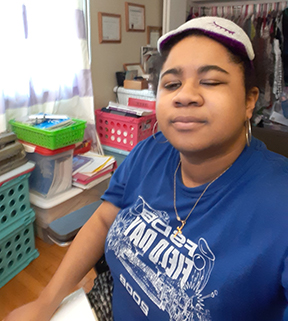 From the Editor: Jasmyn Polite is about to enter Kutztown University in Kutztown, Pennsylvania, where she will pursue studies in early childhood education for blind children. She has served as secretary of the Shoreline Chapter of the NFB of Connecticut, and she recently won an NFB of Connecticut scholarship.
When I was a little girl, my grandma introduced me to the structure of the human body. She encouraged me to memorize all the bones of the body—there are 206 of them!—writing their names on index cards. She quizzed me by having me match each card to the correct bone. I also learned to name the organs such as the heart, lungs, and brain by studying a plastic replica of the body.
As I learned about the human body, I developed a passion for anatomy. I became obsessed with watching episodes of Bill Nye the Science Guy that involved the human body. I watched medical shows such as Dr. G: Medical Examiner, Birth Day, and Babies: Special Delivery on Discovery Health Channel. As I grew older I even thought of pursuing a career in medicine. I wanted to become an obstetrician, neonatal nurse, pediatric nurse, or midwife.
At the Florida School for the Deaf and Blind, my teacher of anatomy and physiology provided fascinating hands-on lessons using an assortment of models and tactile graphics. When we learned about the human eye, I was required to write a report about my eye condition, juvenile glaucoma.
Although I changed my mind about working in the medical field, I still love learning about the human body. I am currently reading a two-volume Braille book about glaucoma to gain tactile knowledge of how glaucoma affects my eyes. I look forward to reading more Braille books involving the human body.
As a future educator of blind and low-vision preschoolers, I would like to share my fascination with the human body through my teaching. I hope my students will learn how their bodies work and how to take care of them.
Since blind and low-vision children rely on tactile and auditory skills, they can learn about the human body through hands-on activities. A toy Halloween skeleton can give children a basic idea of where the bones are located and how the joints operate. Wikki Stix or pipe cleaners can be used to make 3D models or images of the skeleton or of the arteries and veins. The names of the bones or organs can be written on index cards in Braille or large print. The students can put the index cards on the correct location on a model or on their own bodies. Cutout circles of different colors and textures can teach children about the different kinds of blood cells. Many retail and online stores sell educational models of the human body with removable organs for children to touch and manipulate. Amazon and other websites also sell models of body parts such as the eye, heart, and brain.
After the children can name the bones and organs, they can relate the lesson to themselves. They can put their hand in the middle of their chest and feel their heartbeat or rest their hand on their chest and take a deep breath to feel the action of their lungs. The more we understand about our bodies, the better we are equipped to lead healthy lives.
RESOURCES
Doctors, artists, and elementary- and secondary-school students all use models to gain an understanding of human anatomy. Educational models of the human body are available through numerous online stores and websites. Here are just a few options to get you started.
See 3D: 3D Printing for the Blind
https://see3d.org
Contact: [email protected]
See 3D is a nonprofit organization that manages the printing and distribution of 3D printed models for people who are blind. Anyone who is blind or has low vision, or the teacher of a blind student, can request free models. The Anatomy Model Kit is a collection of models of various organs of the human body, including the intestine, inner ear, brainstem, and upper gastrointestinal track.
Anatomic Modeling Solutions
https://www.3dsystems.com
Contact: 888-598-1438
3D Systems offers a range of services for obtaining anatomical models. Submit an STL file to be printed for you or apply to have an already processed file printed and sent to you.
Health Edco
https://www.healthedco.com
Contact: 855-510-6720
[email protected]
Health Edco sells models of anatomical structures including arteries and veins, components of blood, the human brain, the female pelvis representing labor and birth, and the fetal skull.
Learning Resources Human Body Model
https://www.amazon.com/Learning-Resources-Human-Body-Model/dp/B0012OELR6
Designed for children ages eight and up, this model includes thirty-one pieces representing the skull, brain, ribcage, heart, lungs, stomach, liver, pancreas, kidneys, intestines, and spine. Children learn by assembling the model and fitting the pieces where they belong.