Future Reflections
Volume 40, Number 2 Special Issue: COVID and Beyond
A magazine for parents and teachers of blind children published by
the American Action Fund for Blind Children and Adults in partnership
with the National Organization of Parents of Blind Children.
Deborah Kent Stein, Editor
ISSN-0883-3419
Copyright © 2021 American Action Fund for Blind Children and Adults
For more information
about blindness and children contact:
National Organization of Parents of Blind Children
200 East Wells Street at Jernigan Place, Baltimore, MD 21230 • 410-659-9314
https://nfb.org/nopbc • [email protected] • [email protected]
Contents
LETTER FROM THE EDITOR
COVID-19: Lessons for the Future
by Deborah Kent Stein
FEATURE
The Things We Must Dare to Say
by Gary Wunder
REMOTE TEACHING
Collaboration Is the Key
by Jackie Anderson
Back Up Six Feet: Providing Access during a Pandemic
by Janna Kowalik
Structured Discovery Cane Travel in Context: Arguments for Its
Continued Practice in Our Current Environment
by Ryan Carsey
LEARNING AT HOME
Virtual First Grade: The Pandemic Year through the Eyes of a Young Braille Learner
by Carla Keirns
Balancing Acts: The Trials and Joys of Virtual Learning
by Beth Sellers
Remote Learning Revisited
by Penny Duffy and Abby Duffy
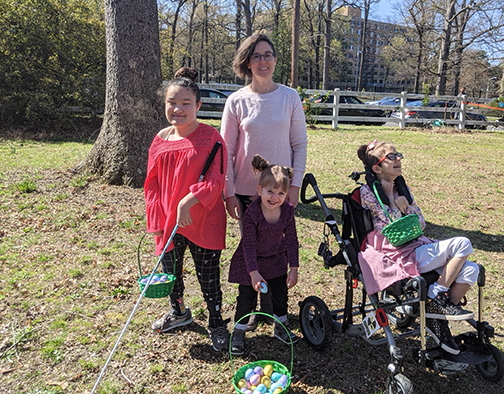
How Does Your Garden Grow?
by Terri Rupp
RESOURCES AND SOLUTIONS
Organizing Your Child's Special Education Files
by Pat Renfranz
During COVID-19 and Beyond: American Printing House for the Blind Is There for Parents and Teachers
by Amy Lynn Smith
REVIEWS
Allies and Obstacles: Disability Activism and Parents of Children with Disabilities
by Allison M. Carey, Pamela Block, and Richard K. Scotch, Reviewed by Carlton Anne Cook Walker
Rosie Loves Jack
by Mel Darbon, Reviewed by Deborah Kent Stein
ANNOUNCEMENTS
The 2021 National Convention is at Hand
by John Berggren
Empowering Our Children: Maximizing Skills, Opportunities, and Dreams
by Carlton Anne Cook Walker
The PAC Mule Stable Grows at the 2020 NFB Convention
2021 BELL Academy In-Home Edition
by Karen Anderson
Free Braille Books Make a Difference
What's Happening?
Why Join the NOPBC?
Are you the parent of a blind/low-vision child? Don’t know where to turn? Have you ever wondered what your child will be capable of when he or she grows up? Are you concerned that your child’s future will be limited by blindness or low vision? Do you have questions about how to parent a blind child? We are here for you.
What is the NOPBC?
Founded in 1983, the National Organization of Parents of Blind Children (NOPBC), a proud division of the National Federation of the Blind (NFB), is a membership organization of families, friends, and educators of blind children. We have thousands of members in all fifty states plus Washington, DC, and Puerto Rico.
Who is the NOPBC for?
We have a very inclusive definition of blindness which includes children who have some usable vision. Instead of focusing on what the child can or cannot see, we focus on the child and what she or he wants to be.
NOPBC is for families, educators, and friends of blind children, including those who have some usable vision. We welcome all families of blind children, and many of our children have both blindness and other disabilities.
We help families and blind children themselves maximize the child’s abilities and opportunities; we hold high expectations for all of our children, regardless of any additional disabilities they may have.
Why is the NOPBC a part of the National Federation of the Blind?
As a division of the National Federation of the Blind (NFB), the largest and most influential organization of blind people in the world, the NOPBC is well informed about the societal, legislative, and technological issues that affect blind people. We enjoy the resources, support, and expertise of fifty thousand blind people who can serve as mentors and role models for us and our children. When we as parents join the NOPBC, our children belong to the Federation family.
What is our mission?
The NOPBC:
- creates a climate of opportunity for blind children in home and society.
- provides information and support to parents of blind children.
- facilitates the sharing of experience and concerns among parents of blind children.
- develops and expands resources available to parents and their children.
- helps parents of blind children gain understanding and perspective through partnership and contact with blind adults.
- functions as an integral part of the National Federation of the Blind in its ongoing effort to achieve equality and opportunity for all blind persons.
Most states have an NOPBC affiliate chapter. You can find your state chapter at http://www.nopbc.org. If your state does not have a chapter and you would like to start one, please contact us. We may be able to offer training and other assistance to start a state NOPBC chapter.
Why Join the NOPBC?
We have been where you are, and we want to support you and your blind child. We know that blindness does not define your child's future. We can connect you with other families and blind adults who can serve as positive mentors and role models. They can teach you the attitudes and techniques that will enable your child to become independent and to succeed in life.
The NOPBC offers hope, encouragement, information, and resources for parents, families, and educators of blind children. NOPBC provides:
- emotional support and a network of other families dealing with challenges similar to those you face;
- information, training, and resources to empower you to take an active role in guiding your child’s development and education; and
- information on your child’s rights and on the laws and legislative issues that will enable you and your child to become strong and effective advocates.
We offer a wide variety of programs, activities, and training to families, children, and youth. One of our most exciting activities is our annual conference. Every year since it was established, the NOPBC has conducted an annual conference for parents and teachers of blind children as part of the national convention of the NFB. This conference has grown to include five exciting days of workshops, training sessions, activities for all family members, including sighted siblings, and countless opportunities to meet blind adults and other families and children from around the country.
Programs, activities, publications, and resources of the NFB and NOPBC
- National and State Parent Seminars and Conferences
- Future Reflections magazine
- NOPBC website
- Books and videos
- Social Media
- NOPBC Facebook group
- NOPBC Facebook page
- NOPBC on Twitter
- Blindkid & other listservs
- Parent Leadership Program (PLP)
- NFB Early Childhood Initiatives
- Early Explorers
- Braille Reading Pals
- Early childhood conferences
- Letters from Santa (seasonal)
- Youth
- National NFB Scholarship program
- National Center for Blind Youth in Science website
- Junior Science Academy
- Youth Slam High School Science Academy
- Youth Track at national convention
- Transition workshops
- Slate Pals pen pal program
- American Action Fund
- Free Braille Books program
- Braille Readers Are Leaders contest
- ShareBraille book exchange
- Writing contests
- NFB-NEWSLINE® newspaper service
- National Federation of the Blind (NFB)
- NFB BELL® Academy (Braille Enrichment for Literacy and Learning)
- NFB-LINK mentoring program
- Free White Cane program
- Free Slate and Stylus program
- NFB Scholarship program
- Straight Talk about Blindness video series
- Where the Blind Work website
Contact Us:
National Organization of Parents of Blind Children
[email protected]
www.nopbc.org
COVID-19: Lessons for the Future
by Deborah Kent Stein
For more than a year now students, parents, and teachers have been coping with a world turned upside down by the COVID-19 pandemic. COVID restrictions shut down schools and left families struggling to manage childcare and online classes. Many blind and low-vision students didn't have the technology they needed at home or lacked the computer skills necessary for handling remote classes.
Nevertheless, the upheavals of the past year have led to breakthroughs for many students and their families. Free from inaccessible print handouts and handwritten assignment sheets, blind students found themselves on a level playing field with their sighted classmates. Without paraprofessionals hovering nearby they grew adept at advocating for themselves, communicating directly with their teachers to explain what they needed.
The articles in this issue of Future Reflections look at our COVID year from many perspectives. Jackie Anderson and Janna Kowalik share the challenges and discoveries of teaching remotely. Beth Sellers and Carla Keirns reflect upon their experiences managing their children's virtual schooling. Terri Rupp explains how remote education has given her family the chance to explore new horizons. Penny Duffy and her daughter, Abby, look back on the past year and offer a glimpse into Abby's experiences returning to in-person school at last.
Leading off this issue of Future Reflections is a thoughtful article by Gary Wunder, "The Things We Must Dare to Say." A longtime Federationist and editor of the NFB’s flagship publication, Braille Monitor, Gary Wunder looks at the ways today's education system fails our blind and low-vision students all too often. Were blind children better served in the years before mainstreaming, when resource rooms and residential schools were the norm? For the chance to live at home with their families and attend their neighborhood schools, must blind students sacrifice intensive instruction in Braille, keyboarding, and the other nonvisual skills they need for success? Perhaps our experiences with remote education offer some exciting new possibilities. We welcome your thoughts and ideas!
In these troubled times I hope that you and yours are well. I look forward to meeting you at the 2021 NFB National Convention, "anywhere and everywhere."
The Things We Must Dare To Say
by Gary Wunder
Reprinted from Braille Monitor, Volume 63, Number 10, November 2020
From the Editor: Long before the COVID-19 pandemic, many educators, parents, and blind adults have been concerned about the quality of education available to blind and low-vision students. In this article Gary Wunder, editor of the Braille Monitor, ponders the changes he has witnessed and calls upon us to enter a thoughtful discussion about ways to meet students' needs in our changing world.
Normally when I write or edit an article for you to read, my hope is that you will come away encouraged, uplifted, and grateful that you took the time with it. In this article that won't be quite so easy. We're going to talk about some difficult things that continue to get in the way of success for our blind children and future blind adults, and it won't all be wrapped up with a tidy bow and a card that says, "We know what to do to fix this, and we're well on our way to doing it."
I am sixty-five years old, so I started school in 1960 and graduated in 1973. At that time there was a discussion involving the teaching community and the parents of blind children about whether children should go to the school for the blind or the public school. In Kansas City, where I lived, several schools had what were called resource rooms. We who were blind spent most of our time in the resource room in first and second grade, learning our Braille; learning to put numbers in columns for addition, subtraction, and multiplication; and learning that strange format that one used for long division. We learned the difference between Nemeth Code and the literary code. Never once did we hear the message that Braille was confusing. There were different grades or levels of it, and they were all a part of learning, which of course we would do. We were learning dots that made shapes that made letters that made words, and people in adjacent classrooms were learning to look at lead and ink that would make shapes and letters and words. We learned that we were fortunate because almost two hundred years ago a man named Louis Braille came along and figured out how we could do with our fingers what other people did with their eyes.
In our resource room we learned physical fitness from a teacher who understood that what she wanted us to do would have to be conveyed by word and sometimes by physically showing us what to do. We learned that we could run as fast as we wanted as long as our hand was on a rope, and later we learned that we could run inside the gymnasium if we paid attention to what we learned through echolocation.
Since the school I attended was not in my neighborhood, I spent forty-five minutes to an hour each way on the bus. But this was not considered a problem; it was considered a blessing. How amazing that the school system in Kansas City cared enough to try to educate its blind students rather than forcing them to travel across the state of Missouri to St. Louis.
In some ways the resource room I attended was like the old schoolhouse featured in so many westerns. There were young first-graders like me, but there were also people who were in the second through the sixth grade. So as I worked, I got to watch them work. Some of them were slow, intellectual disabilities severely restricting what they could do. But others were fast, and it was hard not to be distracted by the interesting stories they were reading to our teacher. Tom Sawyer was a lot more exciting than Dick, Jane, Puff, Spot, and the pony who stole an apple from Mother's purse. These fast-reading children gave me reason to believe that this Braille I was being taught could let me work as quickly and efficiently as I heard my mother and father work when they were reading and writing.
Braille was never considered inferior. It was our path to learning, and what could be more valuable than that? Several times each day I would read aloud to the teacher, and she would correct any errors that occurred in my recitation. If I got stuck on a word, or more correctly I should say when I got stuck on a word, she helped me through it. Even when she moved on to other students, if she noticed my fingers weren't moving or I seemed to be distracted and directing my attention elsewhere, she paid me a brief visit. "What appears to be the problem?" she would say.
"I don't know this word."
"Show me the word. I see. Spell it out for me."
"It is a hard one. It seems to start with a G, then there is the AR sign, and then I think this is a Y."
"You have those letters right, so what does that spell?"
"It is Gary," was my uncertain and sheepish answer.
"Of course it is, so keep going."
So I was moving again, reading and understanding the story until once again I came to that G, the AR sign, and that lonely Y. No other word should have been simpler, but none was harder. When she had me read aloud, I would hesitate when I came to that word, and I'd hear her whispering under her breath, "Gary, Gary, Gary." Then I would pretend I had gotten it and say, "Gary." She masked her relief and frustration with what sounded like excitement.
The more I learned the basics of blindness, the less time I spent in the resource room. At some point it stopped being my school day home and started being the place where I kept books for other classes. It became the place that I would breeze in and out of to drop off geography and grab up my history. Often it is where I picked up something that had been transcribed for me by the resource teacher that I would use in the classes I took with people who had sight.
The point in writing this is not to take you back to some memory of the good old days or to suggest that there weren't problems in my school curriculum. But as I look at what blind children are getting today, I almost feel like I haven't a complaint in the world.
Contrast what I have experienced with what I hear from so many parents of blind children today. Few of them start with getting Braille immediately on entering the first grade. Usually there is a fight because a child can see a bit. The adage that in first, second, and third grade you learn to read, and in every grade thereafter, you read to learn, gets turned on its head. We spend our time in endless evaluations trying to determine whether a child should read Braille, print, or both. What usually happens is that the district decides early on that if the child can read some print, that is the way he or she should learn. When the print gets smaller, the lines get closer together, and the reading load increases, suddenly it is clear that print isn't working. Now the district and the parents start thinking about Braille, but where to work it in? The time set aside for learning to read has already gone by. Now Braille has to come at the expense of some other subject or subjects. Maybe we pull Jimmy out of class fifteen minutes early. Why not history? When he gets a bad grade, we really didn't mean for him to miss that pop quiz or the warning that there would be one or the study material students were told to pay particular attention to in the waning moments of the class. What is to blame for Jimmy's poor score? Why, of course, it is Braille.
Even for children who are totally blind, Braille instruction is not guaranteed, and sometimes it simply can't be provided. Far too often small schools can't find Braille teachers. Sometimes when they do, the blind student gets so little of the teacher's time that learning to read and write is not a basic part of their initial education, but is treated like any other course and gets only a small segment of the day. In far too many cases, our children live in school districts visited once a month by a teacher who knows Braille. Again, I think of myself stuck on the word Gary, and I wonder what my reading speed would be if someone had told me that I would have to wait for three weeks until my Braille teacher could come back and help me.
What happens to our blind student if she does not learn to read and write competitively? She learns to sit in her classroom and be a spectator. She picks up what she can through her ears, but every year she comes to see just how much information is gotten from a worksheet, a book, or Weekly Reader. She learns to be a spectator in her own life. Sometime around age eighteen we transition her to a rehabilitation program. If that program has a good attitude, it tells her she can become anything she wants, that the sky is the limit, that her blindness, with proper training and opportunity, can be reduced to the level of a nuisance and an inconvenience. No matter how good the program, how likely is it that she will get these skills and become proficient in them? How realistic is it to believe that, with all of our one-week, two-week, and eight-week programs, we can turn this around? Nine months of rehabilitation training can work miracles for some people, but we need to work on seeing that those who have our blind children nine months a year for twelve years do a far better job of teaching them how to learn.
In Missouri and in many other states, what happens in the public schools is mostly determined locally. Of course there is some state and local funding, and with that funding comes a few standards. But money from the federal government to supplement the cost of special education has never been what was promised. Interestingly, the government has acknowledged its unhappiness with rehabilitation outcomes by increasing funding for transition services. However, most of this money starts long after one is supposed to be able to read and write efficiently. For the rehabilitation system to get involved earlier seems like a good idea, but my fear is that for most students it is still getting involved far too late.
With too few teachers, too few instructional materials, and too few role models, our children face an excruciating battle to learn what should have been a part of their knowledge and understanding long before. We offer college and other postsecondary training and are surprised when so many students don't complete their course of study. Occasionally postsecondary education is where blind people start to develop their own techniques for learning and head down the long path to catching up. Is it any surprise that some very bright people finish their college education with a lesser grade point average than they would have had if only they could concentrate on the material being taught and not wrestle with knowledge assumed to have been acquired, skills that are likewise presumed, and technology built without them in mind?
In this article you won't find any easy solutions that can be implemented by writing a few letters or visiting a few members of Congress. We have to stand back and take a hard look at what we are getting for blind children and make a valiant effort to go beyond defining the problem. As it always has, a big part of the solution must come from us, first in the form of an idea, then in the form of a commitment, and then through the follow-up and dogged determination that bring about real change. Environmental integration may feel good when we send our children off to the same schools as their siblings, but when there is such a disparity between what our blind children get and what their sighted colleagues receive, we simply have to say that we have a broken system and begin figuring out how to fix it. Let us not be derailed by those who will say that the system is broken for everyone, for we know that is not true. If the system in which blind people function could be easily fixed, someone else would have done it. We must pledge ourselves to a solution, one that clearly prioritizes helping children over supporting the status quo or worrying about offending parents who believe we are trying to make their children different by emphasizing skills and tools their sighted classmates don't use.
What might we put on the table for consideration? This very question is key to why the article you are reading is appearing in the Braille Monitor. Good ideas don't just come from authors. Good ideas come from people who have experience and brains. Positive results come from being willing to share them. If this is the first and last article we see on this subject, I have wasted your time, my time, and our resources. But my most fervent hope is that this is the beginning of something positive.
Who besides us should be involved in our quest to find answers? No one has more daily contact with children than teachers, so they should have a place at the table. School administrators have to decide how to spend precious resources, so they should have a place at the table, too. The legislative and executive branches of government fund what gets done and set the stage for the regulations that implement how it will be done. Certainly they too need a place at the table.
But change won't come from all of these folks. We will have to initiate it, solicit their input, and incorporate it where we can. Most importantly, we have to get them to join with us as allies and start down the long road of fixing education so that our children can achieve the dream of real integration with sighted people. This is where you come in, so please do!
Collaboration Is the Key
by Jackie Anderson
From the Editor: Most Federationists know Jackie Anderson as a founder of the NFB BELL Academy®, a summer program that provides Braille enrichment to blind children throughout the US. Jackie has a deep conviction that families play a crucial role in the education of blind children, and this is especially true when students are taught remotely.
I began my career teaching second and third grades at the Chatsworth School, a multi-age magnet program in Baltimore County, Maryland. While I was at Chatsworth, I taught all subjects. For several years I taught gifted and talented math and reading. I thoroughly enjoyed the ten years I taught at Chatsworth.
In 2008 I helped start the first BELL Academy, a summer enrichment program for low-vision students to learn Braille. I had been battling with my school district to obtain Braille instruction for my daughter, Aunya, who is blind with some residual vision. Working with the children at BELL inspired me to make a career shift and become a teacher of blind students.
During that same summer, I applied to three master's degree programs to become a teacher of the visually impaired. In each interview I explained that I wanted to work directly with the families of my students throughout the education process. In my first two interviews I was told that, as a teacher, working with families would not be my responsibility. I was not accepted into either of those programs.
The response was very different when I interviewed at Louisiana Tech. Dr. Ruby Ryles was enthusiastic when I told her I wanted to involve my students' families. We both agreed that the teacher's job must extend beyond the limits of the classroom. The teacher of blind students needed to help families so that blind children could learn at home and in the community as well as in school. In the fall of 2008 I moved my family to Ruston, Louisiana, and began my studies at Louisiana Tech.
When I entered the master's program, I assumed I would return to Maryland and teach in Baltimore County. I wanted to use the knowledge I had gained to support those first BELL families that had inspired me and the other students who were not receiving appropriate instruction and services. During my last week of classes in July 2010, I received two emails from Dr. Elaine Thagart, the director of the low incidence program in Cobb County Schools, Georgia. Dr. Thagart invited me to interview for a position. I thanked her, but I told her I wasn't interested. She was not easily discouraged, however, and somehow she persuaded me to take the long bus ride to Georgia "just to talk." When I arrived she introduced me to the principal of the elementary school as "the new teacher."
Dr. Thagart wanted me to work in the new elementary resource program for blind students. The resource program at Russel Elementary would serve preschool and elementary age blind and low-vision students. The program would fully integrate the students into the school community. It was everything I could have hoped for. Two weeks after my graduation I moved my family again, this time to Georgia.
I worked under Dr. Thagart and her successor, Dr. Heidi Evans, and with a wonderful team of TBVIs (teachers of the blind and visually impaired) to develop the resource program at Russel. "The Dream Team" of four teachers of blind and visually impaired students worked collaboratively. Blind preschoolers participated in an inclusion program with other special-needs children. As the blind students entered elementary school, Braille was fully integrated into their school day.
I vividly remember the IEP meeting for a third-grader who was learning both print and Braille. She wasn't making progress with her Braille instruction, and some of the teachers recommended that we drop Braille altogether. After I listened to everyone's comments, I recommended that we increase the student's Braille instruction time. I pointed out that she shouldn't simply read Braille in the resource room; she should be using Braille all day in the general-education classroom as well. The student became a fluent Braille reader, and now she uses Braille in nearly every aspect of her life.
While I was teaching at Russel, I established Parents Connect. The group was open to parents of blind/low vision students from across the county. Once per month the group met to learn about different aspects of blindness and to share their experiences. Teachers were invited to listen or to present on parent-directed topics.
Sadly, the program we worked so hard to establish was dismantled. With the new shift in vision for the program, I found myself in situations that did not align with my core values as an educator. I knew that my responsibility to the needs of students would always come before loyalty to the school district. In October of 2018 I came to the realization that it was time for me to move on.
Prior to leaving my teaching position, I entered a doctoral program in inclusive education at Kennesaw State University. The knowledge I gained through my university learning and my teaching experiences helped me form a not-for-profit program called Let's ConnecTVI. Our program works with parents, students, and blind adults. Our parent program continues with the same model that was used with Parents Connect. We help parents support and build upon the skills their children are learning at school. We encourage parents to put on learning shades and learn to perform tasks such as chopping vegetables so they can better help their children understand what to do. Our adult service focuses on assessment and instruction in Braille, technology, and daily living skills. I also have consulted with health-care professionals to help them understand how to work with blind patients.
I was very aware that the shortage of teachers of the visually impaired is a serious problem in the education of blind students. Some school districts, especially those in rural areas, have turned to remote teaching as a solution. I felt very wary about teaching Braille remotely, but I finally decided to give it a try. I started with one student, and it worked extremely well. I added several more students, teaching them Braille, abacus, and Nemeth Code. Right now I'm teaching Braille to five students, and I'm also teaching JAWS and computer skills to several students in Illinois.
Although my experience has been positive overall, I need to emphasize that virtual learning is not for everyone. For blind and low-vision students, in-person learning will always be the ideal situation. Remote teaching works when a cohesive team can be established. Someone who is physically present with the student needs to provide support. That person might be a paraprofessional, a parent, a grandparent, or even an older sibling. It really does take a village!
When I teach remotely the support person needs to understand what the student is learning to do. They must be able to reinforce my instruction without being too controlling. The process doesn't work if the parent takes over. If the parent checks in at the beginning of the session and then disappears, that doesn't work, either. The support person's role is to reinforce, remediate, and expand upon the student's learning.
In the virtual setting an hour of instruction is the maximum; beyond that it's hard for a student to stay engaged. When the lesson is over, the support person must be able to follow up and reinforce what has been taught. As always, true learning continues beyond the classroom or Zoom session.
With beginning Braille readers, as with beginning print readers, the first goal is to get the child to fall in love with reading. The child will not become invested in learning unless the lesson is meaningful. All too often blind and low-vision kids are told they don't belong in the same learning spaces as their fully sighted classmates. They receive the message that the material their classmates are learning is not relevant to their lives.
When I teach Braille face-to-face I prefer to have the child wear learning shades. In virtual learning, though, learning shades aren't always the best option. Sometimes I have the child put the Braille book under the table or under their "Braille stage" to read. We can make a game of it: "Let's hide your book from Mom!" I got one child to read under the table for forty-five minutes! Another simple way to get kids to use their hands is to have the parent turn off the light. I find that parents embrace these strategies if I approach the process in a positive way.
Lessons are filled with the theme, "This is a part of my everyday life." Sometimes parents join in a good round of Braille hokey-pokey. A parent may be playing opposite their child in a Braille scavenger hunt. What about a birthday party? A student used his Braille and other nonvisual skills to plan and set up a birthday party for his sister. Positive outcome happens in virtual learning when there is mutual respect and understanding.
If the parents think Braille is mysterious and hard to learn, they're bound to send that unspoken message to the child. I encourage parents to learn the Braille code so they can reinforce the child's learning. Basic Braille really is not difficult! I have taught parents the Braille alphabet in thirty minutes. Did you know that you can learn the first fifty symbols just by learning the first ten?
In the long run, professionals are only present for a moment in the child's life. Parents are in it for the duration. I can't overestimate the importance they play in the development and learning success of their child.
When a child is learning Braille, parents need to be able to produce Braille materials at home. The teacher can't put Braille materials in the mail and expect the child to receive them in time for the next lesson. It may take up to two weeks for the materials to land in the family's mailbox.
In order to provide Braille materials in a timely manner, families need access to a Braille embosser. Three of the families I work with have Braille embossers at home. When the child wants to read something, the parent simply prints it out. Having immediate access to Braille is very powerful and motivating for the child who is learning to read! As educators, we are taught that progress in reading is impacted by leisure reading more than direct instruction. Braille readers should have access to Braille outside of mere instructional materials. School districts may object to providing a Braille embosser for use at home, but it's very important for children who are learning remotely. Procedure should not be the gatekeeper to Braille!
Technology is another area where blind and low-vision students often fall behind their sighted classmates. Too often I hear teachers claim that blind students shouldn't start learning to use a computer until middle school or high school. Meanwhile, their sighted peers have been learning to use technology since kindergarten and even preschool. Our blind kids need early instruction in technology just as sighted kids do, and technology can be taught remotely if need be.
Remote education will be with us for the long haul. It's not the ideal for every student, but with the necessary supports, it can be highly effective. Collaboration is the key.
Back Up Six Feet: Providing Access during a Pandemic
by Janna Kowalik
From the Editor: What is it like to teach blind and low-vision students during the COVID-19 pandemic? In this article a teacher offers a glimpse into the day-to-day challenges teachers face. Janna Kowalik teaches blind and low-vision students in Yolo County, California.
On a typical morning I log into Google Classroom and connect with some of my students. I share educational YouTube videos and direct my students to assignments I've created for them on topics such as self-advocacy and ZoomText key commands.
"Do you want me to share my screen?" asks one student. "Can I start a jam board?" another asks excitedly.
When the pandemic hit, the schools in my county took two weeks off before beginning online classes. That break gave TVIs two weeks to determine how best to support our students virtually, something most of us had never done before.
My most immediate challenge was to make the curriculum accessible for my students. During in-person school, access to the curriculum is highly individualized. Each student has a different set of skills and different areas of need. This situation was probably the only thing about teaching that hasn't changed during the pandemic. When teaching became virtual each student had a unique set of requirements when gaining access to the online curriculum. Some of my students were already quite tech savvy. Others were more accustomed to using pencil and paper or the Perkins Brailler and paper.
Even my technologically inclined students faced new difficulties. In my county Chromebooks became ubiquitous during the pandemic due to their low cost. Every child was provided with their own Chromebook. They were encouraged to use their Chromebooks for virtual classwork rather than working with a home device such as a laptop. It was a one-size-fits-all solution that did not fit for most of my students.
Chromebooks cannot run software such as JAWS or ZoomText, and they usually have small screens that make viewing difficult for students with low vision. Some of my low-vision students had used Chromebooks intermittently before the pandemic. Now that they were expected to use them all day, however, it was clear that a new solution was needed.
Hand in hand with the Chromebooks came Google Classroom. Every class was being taught via Google Classroom, and assignments were presented in Google formats, usually Google Slides, Google Forms, or Google Docs. This, too, posed problems for many of my students. Depending on the device and the software available, these formats are not always accessible for blind and low-vision students.
The solutions, like the challenges, were varied and individual. I made sure that each of my students had an accessible device with which they could access their classes. For many this consisted of a fifteen-inch touch-screen laptop with the appropriate software. Many of my students already had laptops, but some, especially the younger ones, did not have laptops until virtual learning made it necessary. One student prefers to use an iPad with Voiceover. One uses a BrailleSense Polaris in conjunction with a laptop equipped with Fusion software.
To ensure one student's access to a Spanish class, I emailed voice memos of Spanish listening assignments and dropped off parcels of Braille Spanish vocabulary at the student's door. I have made weekly home visits to some students to drop off large-print copies of textbooks and novels. I asked classroom teachers to add me as a teacher in their Google Classrooms so I could check out upcoming assignments and adapt them as needed for my students. For some students, that entailed downloading assignments and converting them to an accessible format. For others I created a copy of the Google Doc or slide and increased the font size and enlarged images. Then I assigned the copy to my student specifically. Once I became familiar with these processes, I trained paraeducators to do them as well.
Though the pandemic posed huge hurdles for me and for my students, I began to notice some positive side effects of virtual learning. It comes as no surprise that my students became far more technologically savvy during the past year. I've witnessed my students chat casually about file formats and troubleshoot their teachers' tech problems in virtual class.
Another outcome of the pandemic has been the increased accountability for classroom teachers. Unless materials were made accessible ahead of time, visually impaired students faced a new level of exclusion. Gone were the days when material could be read aloud to a student in a pinch, or when a student could step out into the hall with a paraeducator to complete a last-minute assignment orally. Classroom teachers understood this, and they were willing to collaborate with me to ensure that assignments were accessible in advance.
The lack of in-person adult intervention also resulted in increased independence for my students. For the past year none of my students has had a teacher or paraeducator nearby, ready to swoop in at the first sign of trouble. Students are problem-solving their own access issues and advocating for themselves in new ways. When an accessibility issue comes up, my students are emailing teachers, sending messages via Google Classroom, and requesting breakout rooms during virtual lessons. Students who were less than enthusiastic about using accessible formats such as Braille or audio during in-person school are using them consistently now. They realize that, during virtual learning, there is no other option.
As we return to in-person learning, it is my hope that TVIs, classroom teachers, and students can hold onto the gains we've made during the pandemic. I want to maintain and build upon the level of access my students have experienced this year. I want ongoing collaboration with IEP teams to make sure that access continues. And, when all my students are back in person, I want the adults around them to back up six feet and continue to let them solve problems for themselves!
Structured Discovery Cane Travel in Context: Arguments for Its Continued Practice in Our Current Environment
by Ryan Carsey
Reprinted from Braille Monitor, Volume 64, Number 4, April 2021
From the Editor: Ryan Carsey is a member of the National Federation of the Blind of Pennsylvania. He graduated from the Louisiana Center for the Blind in 2012, and he has taught cane travel to blind teens in summer programs at Blind Industries and Services of Maryland (BISM) and the Colorado Center for the Blind. Ryan has a passion for urban design, and he is especially interested in public transit and features that can make cities more walkable.
When I attended the Louisiana Center for the Blind in 2011-2012, I remained at the Center for my training, only returning home for Thanksgiving and Christmas. This immersion training is foundational to the methods used by our NFB training centers, since we believe that proper training and opportunities lead to more independence. It is hard to achieve proficiency and confidence in a practical skill without immersion on a daily basis, and this is especially true when it comes to skills related to cane travel.
For the first time since the National Federation of the Blind began using immersion training at its three training centers, we face a serious and sweeping dilemma because of the novel Coronavirus pandemic. To give one example of the impact, the Colorado Center for the Blind had to make the difficult decision to suspend training and send its residential students home until further notice. Since it is impossible to know how long the virus will continue to be a threat to public health, the center also will have to make a difficult decision about its summer youth program, of which I am a part. Immersion will always be an essential element of our training that simply cannot be replaced. However, even more important right now is the continuation of training through the duration of this pandemic until we can safely begin immersion training. This continuity is possible because of our Structured Discovery model of teaching.
I will briefly go over what Structured Discovery is and add a unique perspective that I have observed. I will show how Structured Discovery is advantageous, specifically during this time, compared to the traditional method of teaching orientation and mobility. Finally, I will mention some specific strategies and areas of cane travel to focus on, and I will point out the areas that will be most challenging in the absence of immersion. Hopefully this will give instructors some ideas, but even more importantly, I hope it will encourage students and travelers alike to keep progressing and learning, despite our current state.
There is already a considerably large collection of literature out there about what Structured Discovery is, why it works, and how to use it. Without going into too much detail and repeating what has already been said, I'd like to talk a little bit about two broad elements underlying Structured Discovery that are relevant to this discussion.
Focus on the Student
The first thing to understand is that Structured Discovery learning is focused on the student, and the goal is to shift the role of the decision-maker from the instructor to the student. The goal of cane travel under the Structured Discovery model is to get students to the point of making decisions as soon as they can. In the beginning of training, the instructor will be more involved, as the student is just beginning to learn concepts such as cane techniques and cardinal directions. Along with its emphasis on nonvisual techniques through the use of sleepshades and the long white cane, this method will gradually shift autonomy to the student as he or she becomes a more proficient and confident cane traveler.
For example, suppose a blind student in training is going to participate in a lesson involving a bus route. Using the Structured Discovery model, an instructor will give the student a destination to go to. Assuming the student has had some prior experience with public transit, and depending on the student's confidence level, the instructor may ask the student how they will get there and which bus they will take, or the instructor may simply say, "Take me there." If the student is pretty advanced and confident, the student may even be taken to an unfamiliar place and asked to meet the instructor somewhere.
Using the traditional model, the instructor will accompany the student to a bus stop or station that they are more than likely going to use regularly. The instructor will describe the layout and explain where certain buses stop within the station. The student will be told which bus goes where and encouraged to focus on one bus route, perhaps a bus route that will be used frequently for travel to work or a medical office.
It is very important to notice the difference between these two teaching methods. Structured Discovery gives more autonomy to the student, while the traditional model does less so.
Attitudes about Blindness
The second element of Structured Discovery is closely related to the element of student-focused learning, and in my experience, it is not a part of the traditional model. The second element of Structured Discovery is an extensive examination of attitudes about blindness. We who teach using Structured Discovery believe that public attitudes about blindness are the biggest barrier that blind people face. We strongly believe that it is important to have regular group discussions about these attitudes. The reason why is simple: despite these attitudes and misconceptions, blind people are normal people. The belief about blindness being a normal part of life, along with my curiosity about walkable cities and my enjoyment of teaching cane travel, sparked an observation that I would like to share.
Walkable Cities
First let me briefly explain some important concepts about walkability.
There is an excellent book written by Jeff Speck called Walkable City Rules. He lists and describes 101 rules that communities should adopt in order to be more walkable. These rules are grounded in what Speck calls the "general theory of walkability." His theory states that a town or city will only encourage people to walk if it provides all four of these elements in its design: a useful walk, a safe walk, a comfortable walk, and an interesting walk. The useful and safe walk have to do with physical aspects of the environment that include things such as mixed-use buildings, places to walk to and a specific "network of walkability" between them, proper widths of lanes to discourage speeding, and reliable public transit. The comfortable and interesting walk are more psychological, as they focus on what comforts pedestrians as they walk and what they find interesting. Things that fall into this category include eliminating front parking lots for businesses, constructing buildings that are proportional to the width of the street or taller, planting street trees and restriping streets to include parking lanes beside sidewalks, and showing a presence of other people by installing benches and windows along building fronts.
In studying Speck's theory of walkability and reflecting on its relevance to orientation and mobility, I realize these are very similar concepts. Since blind people are normal people who are driven by the same motivations as everyone else, it is not unreasonable to say blind people have the same motivations to travel as sighted people do. Structured Discovery cane travel enables those who use nonvisual techniques to experience all four elements of the ideal walking experience. Structured Discovery seeks to give the student a reason to travel, primarily in the beginning as the teacher teaches the student proper cane techniques, the use of cardinal directions, and a basic understanding of intersections and traffic patterns. It enables the experience of a safe walk by encouraging students to focus on nonvisual techniques to interpret their environment and make rational decisions based on what they expect will happen.
This process is in contrast to the student's dependence on someone else to provide information or being reliant on their limited vision. It encourages the student to be interested in traveling and less fearful of the unknown, as oftentimes things can change throughout the travel lesson and in life in general.
Structured Discovery in the Time of COVID
Finally, and perhaps most importantly, Structured Discovery helps the student feel more comfortable as a traveler and with blindness in the long run. Just as the enclosure of buildings, parked cars, and trees along the sidewalks give pedestrians a sense of comfort and security, cane travel taught using the Structured Discovery model helps blind students develop comfort and self-confidence in any number of familiar and unfamiliar situations, and it encourages them to be more accepting of their blindness. Excluding discussions of attitudes about blindness would be like telling a pedestrian to walk along a sidewalk that had a parking lot on one side and a six-lane road on the other, with nothing between the curb and the nearest lane of traffic. You could do both, but both lead to discomfort and discouragement.
With an understanding of two elements of Structured Discovery, is it possible for someone to improve in cane travel during this time of orders to stay at home except for essential travel? As I said, nothing can fully replace the immersion experience that you get from training.
Cane travel is best learned by traveling through the built environment and responding to events in real time. Learning on a conceptual level is not the same. However, learning on a conceptual level is better than learning nothing at all. A big advantage with the Structured Discovery model is that it is very conceptual. Now is a great time for instructors and students to focus on cane travel concepts. Cane techniques and when to use them, cardinal directions, address systems, and public transit systems are a few examples of things to work on mastering.
Cardinal directions in particular are challenging to many people. With many of us having so much extra time on our hands at home, it shouldn't take long to master with consistent practice. Other things that are better learned through experience but can still be taught on a conceptual level include proper cane grip and arc; walking in-step; parallel and perpendicular traffic; various types of intersections and when it is safe to cross them; navigating crowds, malls, and shopping centers; and using public transit. These concepts are certainly better learned while working directly with an instructor, since the instructor can observe an arc that is too wide or narrow, just to give an example.
Due to the current parameters for social distancing, it is not advisable to work in a crowded area. However, it is possible for an instructor to teach these underlying concepts. With concepts such as cane grip, arc, and walking in-step, the instructor will have to be very detailed and specific as to how to hold the cane, how wide the student's arc should be, and what it means to walk in-step. Although nothing works as well at demonstrating these concepts as experiencing them in the real world, it is still very important to learn and understand them.
Pairing the comprehension of these skills with regular philosophical discussions about blindness is the ideal strategy during this time of social distancing, keeping in mind the value of immersion.
Virtual First Grade: The Pandemic Year through the Eyes of a Young Braille Learner
by Carla Keirns
From the Editor: Carla Keirns is a medical doctor who is extensively involved in research. She is co-president of the Missouri Parents of Blind Children, and she serves on the board of the NOPBC.
Spring 2020: Young Worlds Turned Upside Down
In January 2020 the first hints emerged that a dangerous infectious disease outbreak had begun in East Asia. By February the outbreak was causing widespread disruption in Europe, and on March 13, 2020, our son went to kindergarten for the last time.
I have a little boy with albinism (don't tell him I said little), who is now completing first grade. We all had our lives transformed by the novel coronavirus which, to date, has caused roughly three million deaths worldwide. As parents, our instincts were to protect our children from such a scary situation, but that would prove to be impossible.
I am writing this article in my son's home classroom. On a shelf in the corner we have books with titles such as The Social Distance King; A Little Spot Wears a Mask; and You're Mean, COVID-19! Russell was an emerging Braille reader in March of 2020. He could read the alphabet, and he had mastered a few dozen contractions. He was beginning to read Braille books with a few words per page. He was more advanced in reading print. Our child's school closed so abruptly that there was little time to consider whether we should bring home assistive technology, and none to plan for Brailling lessons to come.
Russell finished kindergarten with optional worksheet packets, and after a few weeks he started to have virtual Braille instruction with his teacher. However, he would wait until August to see peers again, this time on Microsoft Teams.
Abrupt Transitions and Lives Disrupted and Lost
During the first year of the pandemic educators and the families they serve lost normal routines, childcare, and in some cases friends and family members. Parks and playgrounds were closed, swings and slides wrapped in caution tape. Play dates with friends became too risky to consider. Grandparents turned into voices on the phone or faces on a screen, and some, like Russell's grandpa, died suddenly. Families like ours had to choose between videoconferencing funerals and having the smallest possible gatherings to avoid getting sick ourselves. Some kids lost parents. A recent study estimated that about forty thousand children in the US have lost a parent to COVID-19 since February 2020.1
The immediate sense was that the children needed normalcy, routines, and a feeling of safety. They needed the ability to share their big feelings. They needed to grieve their losses.
Teachers feared for their lives as well. The New York City schools lost hundreds of teachers and other staff in the first wave of the pandemic in March, April, and May of 2020. While precise figures are hard to come by, the American Federation of Teachers counted at least 530 teachers lost by the end of January 2021.2
How Will They Learn?
With schools closed, the question was how to teach the roughly 50.7 million public-school students. Some called for a jubilee year, arguing that we are chasing arbitrary benchmarks for exactly when students should know which content. Nevertheless, most parents and teachers tried to keep our kids on track. Few teachers of K-12 students had training or experience with distance learning. Some have pointed out that during the flu pandemic a century ago, some school districts turned to the new technology of radio to bring lessons to young students. Thoughts naturally turned to digital technologies.
Some schools sent children home with laptops, tablets, and Chromebooks, only to find that many students did not have reliable access to the internet, especially in urban and rural areas. Some towns in Missouri had to open their school buildings because there was not enough broadband capacity in their communities to hold classes virtually. Other schools did not have enough devices to send home with kids. The rapid shift to work and school from home led to a worldwide shortage of laptops and computer chips, a shortage that is expected to extend into 2022.
Some districts turned to paper worksheet packets for younger students. Some blind students received packets in Braille. Russell did not. Many students were lost to the education system entirely, with estimates claiming one to three million kids unaccounted for when schools resumed.3
Without time, training, and experience to guide them, educators did what any of us would do. They started with what they had. This direct translation of the existing curriculum was sometimes awkward, as when Russell was assigned a worksheet during the first week of classes in August that asked him to "write about a friend you made at school." He responded, "I didn't. I go on the computer." It is not that teachers didn't know that these potential landmines were hiding in the curriculum; there simply were no materials for this unprecedented situation.
Special Education in the Pandemic
The problem of how to educate very young children, especially pre-readers and children in special education, arose immediately. Some school administrators asked for waivers of the requirements of the Individuals with Disabilities Education Act (IDEA), which the Department of Education swiftly refused. Initial guidance issued in March 2020, was reiterated and expanded when US Secretary of Education Betsy DeVos reported to Congress on April 27, 2020 that, "There is no reason that a student's access to FAPE cannot continue online, through distance education or other alternative strategies."
How Do You Teach Blind Kids Online?
Kids with disabilities faced some of the most difficult challenges with remote instruction, especially those with sensory impairments such as deafness and blindness, for whom virtual school presented new access problems. When we talk to other families about the challenges of virtual instruction, all we have to say is "virtual Braille lessons." Our friends' eyes get big, and they generally say, "That's impossible." We are here to tell you it's not.
Before the pandemic many students had assistive technology at school, but they did not have access to this technology at home. Assistive technology was not sent home with the students when the schools closed. Russell had a Perkins Brailler and CCTV at school, and our family bought these devices for home use with grants or personal funds. During our son's kindergarten year we had asked about Braille displays, Braille notetakers, screen readers, and screen enlargement software. We were dismissed with arguments that he would not need those tools until third to fifth grade, if ever.
When I asked the school staff in August how my son was supposed to use Microsoft Teams when he couldn't see the controls, the TVI sent us the JAWS instructions. We reminded her that she had refused to consider teaching Russell to use JAWS when we wrote the year's IEP, even when specifically asked for JAWS training.
The Access & Engagement Survey conducted by the American Foundation for the Blind in spring 2020 found that, "Students had tools at school they did not have access to at home: 17% did not have tablets, 21% did not have laptops, 18% did not have Perkins Braillers, 55% did not have large print books, 50% did not have screen reader software, and 28% did not have recreational Braille books."4 Before the pandemic Russell had neither a digital magnifier, Braille display, Braille notetaker, nor embosser at home. Since all of those devices, purchased new, would cost in the ballpark of $16,000, most students still don't have them.
What Did Work?
First we have to acknowledge the amazing educators and veteran families who developed webinars and videos, custom made materials for home use, shared advice, and just listened to our fears and frustrations. There was so much out there that we appreciated and used, and we knew our son was not alone.
Hats off to Dr. Penny Rosenblum and her partners, who put out an offer to develop materials for students learning at home and worked for free to meet kids' needs.5
The hard-working volunteers who run NFB BELL Academies every summer got together to develop the In-Home Edition. Missouri held three one-week sessions in 2020, and the program will be repeated again in summer of 2021. The key factor that made this program work was the planning by thoughtful, experienced educators of blind students. They developed kits of materials that were mailed to students ahead of time, so that lessons were hands-on, even as instruction was delivered remotely.6
The American Printing House for the Blind partnered with the Perkins School and others to present APH Virtual ExCEL Academy. The program started in the spring of 2020 and continued through the year, with free webinars for students in grades K-12, teachers, parents, and others. The key here is that learning is practical, directed to tasks or lessons, and hands-on.7
Many organizations that have had local programs for years decided they would need to be offered online for safety, and they decided to welcome students from everywhere. Camp Abilities Florida mailed fitness gear to students and ran a week of programs for the students across the country. The TVI training program at California State University/Los Angeles offered a Saturday Extended Core Curriculum program. It provided STEAM (Science, Technology, Engineering, Art, and Mathematics) lessons one-on-one and in small groups via videoconference, supplemented with hands-on activities to make the lessons real for the students.
What Worked for Russell?
Our son was an early print reader, and he was on the verge of being able to read Braille books when the schools closed. What he needed was hands-on instruction. It didn't have to be delivered in person. In fact, he grew tremendously in his Braille skills with the help of experienced teachers who worked with him online. Here's what he did need:
- Rapport with his teachers
- High interest material that he wanted to read—for Russell it was math jokes (you go with what works, right?)
- Material at the appropriate reading level. This need is well understood in the print-reading world. Books that are too hard are frustrating, and those that are too easy are boring. We looked in vain for sets of fully contracted early-leveled readers in Braille.
- Double spaced Braille materials for early readers. APH, National Braille Press, and other organizations produce print/Braille editions of many popular children's books such as Pete the Cat and Llama Llama. However, these books often are transcribed in single-spaced Braille because of the limitations of fitting all of the words on print or interleaved pages. Very early readers struggle to keep track of which line they are on when the lines are close together. Russell's Letter from Santa left him in tears because it was too hard for him to read it in this format.
- Manipulatives—Braille LEGOs, APH materials such as Word Playhouse and Sight Word Express for building words and sentences, peg slates, slate and stylus, APH U-pick.
And What Should We Take Forward, Even After the Pandemic?
Many people will conclude from their pandemic experience that virtual instruction is hopeless for students who are blind or have a range of other disabilities. We have a more encouraging message. Even young students who are not yet reading can learn and thrive with talented and creative teachers working with them at a distance. This means that our rural, urban, or otherwise underserved students could learn with creative partnerships that don't have to be limited by local geography. The keys are thinking through the learning goals, the materials, multi-sensory learning tools, technology, and student engagement. Russell will do anything for his former Orientation & Mobility teacher. When I ask him why, he says simply, "I love her."
References
1. Kidman, Rachel, PhD; Margolis, Rachel, PhD; Smith-Greenaway, Emily, PhD; et al. https://www.washingtonpost.com/opinions/2021/04/05/how-support-children-who-lost-parents-covid-19/
Verdery, Ashton. "Estimations and Projections of COVID-19 and Parental Death in the US," JAMA Pediatrics. Published online April 5, 2021. Doi:10.1001/jamapediatrics.2021.0161
2. https://www.nytimes.com/2021/01/29/us/the-impact-of-teacher-deaths.html
4. https://static.afb.org/legacy/media/AFB_Access_Engagement_Report_Accessible_FINAL.pdf, p. 7.
6. https://nfb.org/nfb-bellr-home-edition
Balancing Acts: The Trials and Joys of Teaching and Working from Home
by Beth Sellers
From the Editor: Beth Sellers is the sighted parent of three children currently living at home, two blind and one sighted. By trade she is a special education teacher with a focus on assistive technology, but currently she works as a case manager for people with developmental disabilities living in the community. She serves as president of the Virginia Parents of Blind Children, a chapter of the parents' division of the National Federation of the Blind.
It's 8:00 a.m. I'm working through a phonics lesson with my kindergartener at the kitchen table, taking advantage of the thirty-second video clips in her lesson to read my work emails. My agency cell phone is beside me, and I hope it doesn't start ringing for at least another hour.
One room over, I hear the familiar sound of my seventh-grade daughter's screen reader as she navigates her first online class of the day. I tune in with one ear every few minutes to make sure she is still engaged with her work.
At the other end of the house, my fifth grader with multiple disabilities is finishing her breakfast by g-tube while she listens to a science podcast on the Amazon Echo. The broadcast ends, and she calls, "All done!" At the same time my kindergartener gets to the assessment part of her phonics lesson, and I'm required to administer and record the results of the assessment. Predictably, that’s when my seventh grader calls out that she can't find the right module in Canvas.
It's now 11:30. I'm on a conference call for work. My kindergartener has finished all of her coursework for the day and is participating in a math enrichment class via Zoom. I'm half watching to make sure she stays engaged while still paying attention to my work call. My middle daughter is signed in to her fifth-grade class in her room, and I can only hope she's engaged in her classwork, which is less than accessible for her. My seventh grader is finishing up her virtual Braille instruction, and I hear her restart her computer. I know she needs to eat before her 12:10 class starts, so in my head I'm planning what type of lunch I can get on the table quickly, as soon as my call ends, so she can eat and get back in front of the computer.
It's finally 5:00. The younger two have been finished with their school day for a few hours, and the kindergartener has her face in the Khan Academy Kids app on the iPad. My seventh grader has just finished her last class of the day, her favorite, assistive technology. I've finally shut down my computer and flipped my cell phone over to "Gone for the Day."
The kids are hungry, so I ignore the giant pile of dishes in the sink and start boiling water for the spaghetti they have requested. It's been a long day, but nothing unusual. We will get up and do it all again tomorrow.
As I write this, we are 398 days into working and learning from home due to the COVID-19 pandemic. On March 13, 2020, the kids came home "for a few days" of virtual learning, and we have been here ever since. Our local school division has allowed students with IEPs to attend school in person all year and is now preparing for many K-8 students to return next month if they choose. My children will remain home due to a variety of factors, mostly related to significant health concerns involving my two youngest children.
Virtual learning has been both a blessing and a challenge for our family. My seventh grader is fully blind and a Braille reader, and she also has an orthopedic impairment. She has risen to the occasion and excelled with virtual learning. The school building was a difficult building for her to access, both physically and academically. The virtual format seems to have leveled the playing field for her.
In the school building she was often late to her classes because of the poor layout of the building and her difficulty walking quickly from place to place. Pencil-and-paperwork was often inaccessible or simply not provided to my daughter at all. She suffered from low expectations, exacerbated by paraprofessionals who hovered over her and wanted to do work for her.
With virtual instruction my seventh grader has been able to keep up during her classes and achieve grades she is proud of. She is able to use her screen reader and Braille display to access her coursework in the same digital manner as her sighted peers. She has also been fortunate to have outstanding teachers who have worked hard to ensure accessibility, both in synchronous classes and asynchronous work. Her English teacher and science teacher have been particularly outstanding in making sure that every single activity is accessible.
The anxiety and pressures she felt when she was in the school building are gone now. She can learn from our living room with her dogs beside her. She is also making great progress in Braille, Nemeth code, and assistive technology, due to virtual services with outstanding providers contracted by the school division. She says she misses seeing her friends and teachers in person, but what she misses most are school parties with food. And that type of school experience most likely isn't happening right now, even for those kids who are attending in person.
Sadly, her younger sister has not had the same positive experience. You would think that two kids from the same household, with the same parent and the same school division, would have similar experiences. But my fifth grader, who always loved school prior to the pandemic, has had an absolutely miserable school year. She has been unable to access her general education curriculum due to lack of accessibility, and she has been reduced to simply sitting in front of her screen during her fifth-grade class so she can be counted as present. As her parent, it has been heartbreaking to watch a child who once adored school slowly lose her motivation to learn and try over the course of a school year.
Fortunately, when I called an IEP meeting to address my concerns, her school agreed to send a paraprofessional into our home to assist with accessibility. It has only been a few weeks since this change was made, but already we are seeing a positive change, now that the paraprofessional is available to assist with materials and accessibility.
We don't yet know what the future will hold for our family in terms of school. The nature of my younger kids' disabilities and health conditions means it may not be safe for them to return to school for quite some time. My older daughter's success with virtual instruction also factors into our decision on what school may look like for us in the years ahead. But even though the last thirteen months of isolation have been hard in many ways, there have also been many hidden blessings, such as the extra time I've had at home with my kids and the ability to see how online school works for our family.
Remote Learning Revisited
by Penny Duffy and Abby Duffy
From the Editor: Last summer, as the COVID-19 crisis deepened and online education became a long-term reality, Future Reflections published an article by Penny Duffy about her daughter's experiences. Penny showed that blind students can learn effectively through remote education when the necessary services are in place. The present article recaps Penny Duffy's earlier piece and brings it up to date with comments from Penny and Abby as Abby winds up the 2020-2021 school year.
Education has changed a lot since COVID-19 shook the world in March of 2020. One day my daughter, Abby, was sitting in a tenth-grade classroom, and the next day she was at home, doing something called remote learning. Abby is blind, and I couldn't fathom how remote learning was going to work for her. How would she get access to her materials? What would happen if a remote platform turned out to be inaccessible?
Prior to COVID-19 Abby had a rigorous academic curriculum, and she was an active member of her high school community. She participated on the high school ski and track teams, and she was involved in student government and other clubs. Then the schools shut their doors, and life changed dramatically for all of us. All of the parents in our district had a three-day window to go to the school and collect their children's things. In our case, I brought home all of Abby's assistive technology.
To my great relief, our adventure into remote learning has gone remarkably well. Abby is able to do most of her online assignments independently. She has all the technology she needs at home: an iPad, a Braille display, and a laptop computer with the JAWS screen reader. When she needs support—usually for her math course—her teacher of blind students, Adrienne Shoemaker, is available to help her.
With remote instruction, Abby receives her assignments at the beginning of the week. She and Adrienne go through each of her classes together and determine which of her assignments are fully accessible with her screen reader and Braille display. If a teacher posts a tool that isn't accessible with JAWS, they try it using VoiceOver. If that doesn't work, Abby emails her classroom teacher to work out an alternative way for her to show her understanding of the content. For some assignments Abby requests to have the content in an embossed copy. Adrienne provides the Braille materials and drops them off on our porch.
Abby's classroom teachers have been amazing. They do their best to make sure materials are accessible, and they've been learning a lot. Recently Abby's Latin teacher even checked with Adrienne to find out how to add alt text to a slide presentation.
Meanwhile, I hear too many horror stories about the problems other families of blind students are having with remote education. Some students are not allowed to bring their technology home from school, so they have no way to access the internet for their online classes. Some are not receiving Braille materials. Some have no services at all.
A lot of parents ask me why everything has gone so well for us. We are extremely fortunate to have an excellent teacher of blind students and a school district that is willing to work with us. Carlton Anne Cook Walker, president of the National Organization of Parents of Blind Children (NOPBC) comments, "Districts that did a good job with a blind student before the pandemic usually do a good job during it, too."
Here are a few tips I have gathered for dealing with remote education now and in the future:
- Technology is not to be left at school. The whole team should have an understanding that blind and low-vision students need the same technology at home that they used in the classroom.
- Many blindness services can be provided remotely. Remote teaching can include instruction in Braille, including Nemeth Code and Braille music; and technology, including the use of JAWS.
- A blind or low-vision student has the right to full access to the curriculum at the same time as everyone else.
- A student who is comfortable asking for help from the teachers will be able to ask for help in a remote learning environment too.
- You can still call for an IEP meeting in the middle of a pandemic.
Even at its best, though, there is no way to make remote education the same as going to school. Orientation and mobility is a real challenge. Abby continues to work on some skills through remote lessons, but it is not the same as practicing skills such as crossing streets, using public transportation, and locating destinations.
Adrienne Shoemaker and other professionals are not only using technology to connect with their students, but to connect with each other as well. In the past teachers and O&M instructors in New Hampshire, where we live, sometimes felt isolated. Now they hold weekly meetings online, where they talk about what is going well and discuss their biggest challenges. "During the first two weeks of remote learning there was a lot of time spent reaching out to families and trying to connect with students," Adrienne Shoemaker says. "This is going to be an evolving process. Many parents have multiple children at home, and they themselves have had to transition to working from home. I want to be supportive and not have them feel overwhelmed. We are all adjusting and learning how to operate in this environment of remote learning."
Adrienne points out that there are some positive aspects to this new mode of learning. "I think students are getting an even stronger idea of what they need in terms of accessibility," she says. "Students are developing stronger self-advocacy skills, and that can be a key part in figuring out solutions." We're all in uncharted territory, and we need to work together to ensure the best outcome for everyone.
Editor's Note: Late in April 2021, I asked Penny Duffy and Abby about Abby's experiences a year into the pandemic. Abby's school had just reopened full-time, and Abby was readjusting to face-to-face classes.
"Remote education worked wonderfully," Penny reported. "Abby became much more proactive in problem solving. She couldn't depend on paraprofessionals, so she learned to ask her teachers to make things accessible."
"Actually, I had a lot fewer access issues when we all were remote," Abby explained. "The teachers couldn't use paper handouts or write on the board. Everything was on Google Classroom or Google Docs, and nearly all of it was accessible, so I didn't need help from a para. Even though we're back in the classroom now, the teachers are still sharing information electronically. At this point I hardly need help from a para except sometimes in math."
Abby explained that even chemistry lab worked out for her in the virtual environment. "The teacher did the experiments himself, and he narrated everything step by step. It was really easy for me to follow along."
Not surprisingly, the hardest part of going to school remotely was the lack of social interaction. "I got together with my friends online, but it wasn't the same as actually being together," Abby said. "Even now that we're back in school, we have to stay six feet apart. We're not supposed to congregate in the halls. It's a whole different atmosphere."
Even so, Abby is glad to be back in school at last. Recently she was inducted into the National Honor Society, along with forty other students from her school. "We had the ceremony in the gym, and our parents sat in the bleachers," Abby said. "They set up chairs on the basketball court for the inductees, all six feet apart. When they called our names we stood up and everybody applauded. It wasn't like a traditional ceremony, but it sure was good to be there!"
You can read more about Abby Duffy and Adrienne Shoemaker in Penny Rosenblum's blog post, "How TVIs and O&M Instructors Are Handling the Challenges of Distance Learning, Part 1," https://www.afb.org/blog/entry/how-tvis-and-om-instructors-are-handling-distance-learning-1.
How Does Your Garden Grow?
by Terri Rupp
From the Editor: Terri Rupp serves as president of the NFB of Nevada, and she is a member of the Board of Directors of the National Federation of the Blind. She recounts the ups and downs of her life in her blog, "Blind Mom in the Burbs," which you can visit at https://blindmomintheburbs.com.
Terri Terri quite contrary
How does your garden grow?
With proactive thoughts
And mindful plots
So vibrant and loved it glows.
Hello, my name is Terri Rupp. I'm known to some as Blind Mom in the Burbs, as president of the National Federation of the Blind of Nevada, or as that crazy lady who runs for hours around the neighborhood. Most importantly, I'm known as Marley and Jackson's mom.
From the outside we probably look like the typical family in the suburbs. However, we are so far from that family as seen on TV or your current Netflix binge, so far that we don't even have a Netflix account of our own. While most families spent the past year struggling to navigate the so-called "new normal" of life during the pandemic, our family made it our mission to continue living actively and loving proactively.
Let me give you a little bit more background about our family. Dad works as a paramedic for the county's fire department. Mom decided that she did not want to pursue a professional career so that she could stay home and raise the kids. Marley is blind just like her mom, and her brother, Jackson, has completely embraced the role of obnoxious little brother, from armpit farts to wet willies.
A few years ago we moved from our dream home in the suburbs to an even more perfect home in the same gated community. We had expanded to become a multigenerational family, and we needed another bedroom and bathroom to accommodate Grandma.
Between 2018 and 2020 I found myself traveling more often on public speaking engagements as part of my work for the National Federation of the Blind. Having my mother-in-law living with us and my parents close by made it possible for me to travel without worrying about the kids. Travel had its perks, and my motivational speaking career was taking off organically. However, the long flights alone soon grew tiring, and the hotel coffee was not so tasty when I woke up and couldn't remember which time zone I was in.
When the world shut down last spring, most people were wishing to get out and get back to normal. I've never been more grateful to be grounded!
We spent the first few, uncertain weeks of the COVID lockdown snuggling on the couch watching movies, strolling the neighborhood, and trying our hands at some experimental baking.
Oh, the baking! The cookies, the cakes, the pies, oh my!
Just as we deal with all the things that come along our path due to my blindness and our daughter's blindness, now we found ourselves dealing with the possibility that my husband would bring home the virus with his job as a first responder. Our family remained true to our values of not living in fear. We continued living the lives we want, but with a few modifications.
With all due respect, I was somewhat hesitant to write this article. I didn't want readers to presume that our lifestyle is careless or that we're not doing our part to flatten the curve. So before you read further, here is my disclaimer: although we continued living actively and loving proactively, we did it respectfully, and we followed whatever guidelines were in place through all of our adventures.
How did we continue living actively and loving proactively?
With proactive thoughts, and mindful plots, so vibrant and loved it glows.
We had tilled the soil and planted the seeds of adventure long before anyone knew what storms awaited us in 2020. Through our efforts in advocacy for Braille and accessible technology for our daughter, we had finally reached a place where she could navigate her last year of elementary school independently. Don't get me wrong—there were still plenty of frustrating obstacles in the soil in the distance learning garden box. Who didn't run into frustrating times with technology? Instead of focusing on the ugly and upsetting trials that tested us, I'd rather highlight the tremendous hard work of the entire educational team. The loss of this team with the transition into middle school gets me all teary-eyed today. A key member of our team is Marley's classroom teacher, who is always asking us what else she can do to make sure Marley has access to everything the other students are doing. Her Braille teacher and her access technology support person drop off materials and make house calls when we can't connect her devices to Dropbox and Bookshare. Her principal and other school administrators go above and beyond, even bringing by a fifty-foot ethernet cord when our wifi wasn't strong enough. Her paraprofessional takes those pesky inaccessible slides and documents and turns them into readable BRL files. All of these wonderful, dedicated folks, and the text thread titled, "TEAM Marley Jane," have made this a truly remarkable year.
All of this schoolwork, though, did not keep us tethered to our home. Just as California and Nevada COVID restrictions were telling everyone to stay home and ordering businesses to shut down, we were in San Diego, getting the last of the installations onto Lady Zephyr, the Mercedes Sprinter van my husband has converted into our family camper. Lady Zephyr and her mobile wifi hot spot have carried us away from the burbs and through deserts, mountains, canyons, lake country, redwood forests, and beyond.
We've long dreamed of one day home-schooling the kids and traveling. Now, with distance learning, that one day is our real life. Our unwillingness to confine ourselves to the boxes that social distancing guidelines put in place has us out and doing.
Distance learning was great for Marley, but it did not work for our other child. Through emotional meltdowns, boredom, isolation, and tears we tried to wait out the kinks in his online classroom. Finally we decided our best choice was to withdraw him from what public school was offering. After much research we found a homeschooling plan that would work better for Jackson, a gifted learner. We subscribed to the Time 4 Learning homeschooling curriculum. We supplement with lots of trips to the library, 180 Days workbooks from Amazon, hands-on creative teaching in the kitchen, and of course our many travels on the road. Jack and Dad take turns reading the signs on the trails we explore.
I have not tested out the Time 4 Learning site to see how accessible it is for blind students yet. As the primary homeschooling parent, and as a blind parent, I haven't run into any problems on my end. Jack is even learning Braille so he can write notes to his sister and make a Mother's Day card for me.
What's that common saying about April showers and May flowers? Soon our backyard garden will be bursting with sunflowers from our Earth Day experiments.
From our family to yours, we wish you a colorful spring filled with plenty of proactive thoughts and mindful plots, so vibrant and loved it glows.
Organizing Your Child's Special Education File
by Pat Renfranz
From the Editor: Preparing for a child's IEP meeting is always important, even or perhaps especially in the midst of a pandemic. This article is based on an NOPBC webinar Pat Renfranz presented on March 18, 2021. While her blind daughter was growing up Pat was active in the NOPBC and the Utah Parents of Blind Children for many years. She worked at the University of Utah as a research scientist and a member of the teaching faculty. She continues to have strong interests in science and math education and in tactile graphics.
We all have or will have concerns about our child's education. Communicating our concerns to the right person is the key to having those concerns addressed. To communicate effectively, we need to organize our thoughts, teasing the facts away from our emotional responses to an issue. An organized set of notes and documents pertaining to our child or student is a strong foundation on which to build effective communication.
This article will discuss how one can keep track of the reams of documents relevant to our child's educational needs and progress, supports and services. Careful record-keeping provides us with a way to organize our thoughts about our child's current and future needs.
An IEP Binder or dedicated file system is a great way to organize all those accumulated papers and records. By making a binder you can be sure that documents will be ready when you need them. Your binder can help you prepare for meetings and think about goals. It can help you communicate and collaborate with your child's teachers and service providers in a way that recognizes achievements and maintains accountability. You need to develop a system that you like to use and that will stay up-to-date.
I belong to the old-school generation of written notes and printed paper. All of my ideas, though, can be translated into a digital format. After all, "folders" and "files" on your computer were designed around the concept of a cabinet or desk drawer. While I like to write notes by hand, you may prefer to write them on your computer or iPad or to dictate them on your phone. The way you record your notes doesn't matter. What does matter is that you are able to keep track of what you have and find what you need.
First, you need a place to keep the documents you gather. Here are some ideas:
How to Keep Notes
During meetings or phone calls, have a way to jot down notes, whether they are handwritten, electronic, or recorded. If handwritten, you can keep them in a bound notebook. If you keep your notes on loose paper or in a digital format, be sure to transfer these notes into your file or binder system as soon as possible so that nothing is lost or forgotten.
- A spiral notebook or bullet journal allows you to keep notes in sequential order.
- Write with a pen, slate and stylus, or note-taking app on a mobile device.
- You can transfer pages into your binder or file directly, or you can write out recorded messages to yourself.
- If you find a method of keeping notes and stick with it, it will be easier to find and refer to the content when you need it.
Include a Communication Log in Your Note System
Many of your notes may be from meetings with school personnel. It can be useful to standardize the content of those notes. You can keep your communication log in a spiral notebook, as described above, or in any other way that works for you. Train yourself to write things down or record an audio note!
Here is a suggestion of what to include in your note system regarding communications:
Parent-School Communication Log
Date: ________
Form of contact: Phone? Email? Letter? In Person?
Who initiated contact: ___________________________
Who participated or attended: ___________________________
What prompted the communication: ___________________________
What was discussed: ___________________________
What was decided or what interventions/accommodations were suggested or tried: ________________
Follow up—who will do what next and by what date? ___________________________
Keep in mind that the log is not just a record of disputes. We want to have positive relationships with our kids' general ed teachers, special ed teachers, and all of the related service providers. Keeping track of informal conversations with them does not mean you are disputing what they say. Record helpful advice the teachers give you on techniques and activities. Document valuable suggestions that come out of a team meeting.
Communication
• Create a provider/educator Contacts list, including "chain of command."
For each contact include name, title, address, phone, email, and which services that person provides.
You might want to tag or organize contacts into categories such as Medical, Educational, Psychological, Advocacy, and Related Services. Think about who you would contact about general-ed teacher issues versus related service providers (TVI/TBS; O&M instructor) versus field trips versus extracurricular programs.
Don’t be afraid to ask school staff about who to contact regarding different issues.
• Insert or refer to the Communication Log
If you keep your notes on loose-leaf paper, insert them into your binder system here. If this record is kept separately, that's fine. Just make a note of that in your binder.
• Letters, notes, and emails to and from the school, including these important items:
Notes from teachers and other staff members
Correspondence, including printed copies of emails and replies
Printed letters from you, certified mail receipts
Printed letters to you
• Other communications
Getting Started
IEP Binder
Get a three-ring binder that you dedicate to materials related to your child's IEP. The following items will be helpful:
- Tab dividers, labelled
- Three-ring pocket folders
- Three-ring page protectors, which save you having to punch holes
- Extra paper for taking notes
- Zippered binder pouch to store a hole punch, highlighter, pen or pencil, sticky notes, etc.
IEP File Drawer
It's amazing how fast reports and other paperwork accumulate! Your binder will fill up quickly. You may need a file drawer or even a whole file cabinet for storing old documents. Here are a few things you might want to use:
- Dedicated file cabinet drawer or plastic file box
- Labeled file folders
- Hanging file folders
- Portable box to hold folders for an IEP meeting
Digital File-folder System
As I mentioned earlier, everything you do with paper documents also can be done electronically. Create a folder on your laptop or phone and add subfolders as needed.
- Name or rename files with titles that you will recognize easily.
- Organize documents into folders and subfolders with appropriate names and labels. It can be helpful to include the time period that is covered in each folder.
- Put your collected documents and downloads in places where they logically belong.
- Back up your documents frequently!
- Have documents on a thumb drive or cloud drive so you can access them at a meeting.
Bullet Journals
Bullet Journals is a system for organizing your life by keeping notebooks. I think some ideas from Bullet Journals can be helpful with IEP/Special Education note-keeping. The following suggestions may be useful.
- Numbered pages. Number as you go or purchase a spiral-bound notebook with numbered pages.
- Index. The index lives at the front of the notebook. Set aside a few pages at the beginning for this index. On these pages you can list an item and the date when it occurred, along with the corresponding page numbers. For example, an index item might be headed, "Notes from talk with guidance counselor on April 22, Page 12," or "Conversation with Braillist Sue Gillespie, October 11, regarding math assignments, Page 26." When you turn to the specified page, you can read the notes you recorded about that conversation or action.
- Collections. You can also create and index "Collections," comprised of information that pertains to a certain topic. You might return to this list and add to it over time. For example, starting on page 31 your index might contain a Collection of stories with blind protagonists. You can add to this collection whenever you come across such a story.
When my daughter was in school I used a spiral notebook and dated every entry. I also had a small file box that I could bring with me to our IEP and other meetings. I put reference materials into the file box as needed.
At high-stakes meetings, I had someone attend with me who could take notes. Our district also had a coordinator who attended meetings and took notes on a form. The form had boxes with labels such as "Discussion items initiated by parent," "Discussion items initiated by school," "Options/alternatives considered," and "Decisions/follow-up." After the meeting we were given a copy of those notes.
Content of Notes
Here is an example of a notebook and what it might contain:
Parent-School Communication Log
Example:
Date: ________
Form of contact: Phone? Email? Letter? In Person?
Who initiated contact: ___________________________
Who participated or attended: ___________________________
What prompted the communication: ___________________________
What was discussed: ___________________________
What was decided or what interventions/accommodations were suggested or tried: ________________
Follow up—who will do what next? ___________________________
Getting Started
- Decide on the method (binder, drawer, digital files, combination) that suits you best.
- Purchase supplies.
- Gather the documents you need to organize.
- Give yourself a few hours to organize your documents, but allow yourself to take breaks. For example, you might sort for twenty minutes, relax for ten minutes, and go back to sorting.
- If you find that you don't have a copy of a particular document, write a letter to request it from the appropriate provider.
- To avoid getting sidetracked don't read the documents as you organize them.
- Print a checklist or master document list.
- Track the date, author, type, and significance of each document. This list will serve as a table of contents.
The Wrightslaw website (listed below) has sample document lists. Make sure every document you save has a date. Some folks suggest keeping all documents in order by date, with the oldest in back. Others prefer to organize documents by type. Whatever system is simplest and easiest for you to use and keep using is best.
Assembling Your Files
Set an appointment on your e-calendar or kitchen calendar showing when you will work on the binder, organize your notes, and transfer documents in and out. This is work, so schedule it as such and give yourself a treat for doing it! Here is a sample binder checklist:
Calendars
- The yearly IEP cycle, reminders to request drafts and the like.
- Monthly school calendar, including your notes regarding when something is supposed to happen.
- IEP disputes reminder: two-year "statute of limitations" to file due process, if needed
Evaluations
- State-mandated assessment results
- Request or referral for special education and the consent to evaluate
- School-based special education evaluations
- Independent and/or private evaluations
- Letters requesting Independent Educational Evaluation
IEP Documents
Keep no more than two IEPs in the binder. For example, keep the current and previous IEPs, or the current IEP and the draft of the one that is being prepared. Keep older IEPs elsewhere.
Prior Written Notice Documents
- IEP meeting notes (or refer to these notes in your spiral notebook)
- 504 Plan, if applicable
- Follow-up and actionable items list
Progress Notes
Student's School File
- Report cards
- Statewide testing scores
- Attendance record, disciplinary records
- IEP Progress Reports (received from school)
You and your child may want to track your own perspective on goals and progress. Doing so can help you identify goals that are problematic, that is, too difficult or not challenging enough. Tracking goals will help you if you need to request additional service time or services that are not yet in place.
Sample Work
- Samples of the student's work may include homework, tests, and other assignments that clearly illustrate success or challenges.
- Samples of accessible documents prepared by teachers and paraprofessionals should include the full range—the good, the bad, and the ugly.
- Documents that have been poorly prepared, such as those badly transcribed from print to Braille or Braille to print
- Documents that lack accessible graphics or include graphics that do not conform to BANA standards
- Examples of documents and graphics that are well prepared and meet high standards
- Addresses of websites that illustrate graphics that will work for your child
Blindness-specific Resources
A second set of files or a separate binder can contain information on resources specific to blindness and blind children. Some examples include the following:
- Notes on available programs and services, such as after-school programs or Saturday Schools
- Residential programs/camps for blind kids
- NFB BELL Academies
- Contests (Braille Challenge, Braille Readers Are Leaders)
- Sports and recreation opportunities such as goalball, beep baseball, and therapeutic horseback riding
- Notes/handouts from meetings at NFB conventions and NOPBC conferences or webinars
- Articles from Future Reflections and Braille Monitor
- Articles from other sources regarding the education of blind children
- Information on your local NFB division and chapter
- Contact information for advocates and role models (add these to your Contacts list)
- Braille provision in IDEA
- Textbooks-on-time provision in IDEA and FAQ sheet
- Braille standards from California or Maryland
- Sample IEP goals
Other Information on Special Education
- Medical diagnosis information and personnel involved
- Parental rights information
You may contact Pat Renfranz at 801-599-3557 or [email protected].
Resources
Bullet Journal https://bulletjournal.com/pages/learn
This website explains the basics of organizing your life through the creation of a bullet journal.
Wrightslaw https://www.wrightslaw.com/info/organize.file.htm
Wrightslaw provides a wide variety of information and resources on special education advocacy, including ways to organize and keep track of your child's records.
A Day in our Shoes (Don't IEP Alone) https://adayinourshoes.com/
This site offers a toolkit of information on preparing for and taking part in IEP meetings.
Understood.org https://www.understood.org/en/school-learning/special-services/ieps
This site is geared toward parents and educators of children with learning and thinking differences, as well as young adults who want to shape their own journeys.
During COVID-19 and Beyond: American Printing House for the Blind Is There for Parents and Teachers
by Amy Lynn Smith
From the Editor: Based in Louisville, Kentucky, American Printing House for the Blind (APH) has been a resource for parents and teachers and blind and low-vision children since 1858. Through its long history APH has evolved to meet the needs of each new generation. In this article Amy Lynn Smith describes what APH is doing to support families and teachers during the COVID-19 crisis. Many of these programs will continue and grow, even when students return to the classroom.
Ever since COVID-19 appeared, the disruption to daily life has impacted everyone. Blind and low-vision students have faced unique challenges, such as not having their accessibility tools at home and having to work with their Orientation & Mobility (O&M) specialists via videoconference, which isn't ideal for a high-touch teaching discipline.
When the country shut down in March 2020, American Printing House for the Blind (APH) leaped into action. APH provided support for parents who were helping their children learn at home and for teachers seeking new ways to work with their students.
Giving Parents a Helping Hand
APH ConnectCenter is dedicated to providing a wide range of year-round supports for parents and for career-age and older adults. During COVID-19 APH stepped up even more in response to families' needs.
For example, the ConnectCenter's Information & Referral (I&R) Line (1-800-232-5463), which provides assistance with a variety of questions, saw a significant increase in calls. Many calls came from parents who wondered how their children would get the services they normally received in the classroom or from other providers that had shut down.
Melanie Peskoe, digital content and engagement specialist at the ConnectCenter, was an I&R representative in the early days of COVID-19. She says I&R often referred callers to the Center's FamilyConnect website. The website offers a variety of helpful hints, including resources parents can create using items found around the home.
In more than one instance APH has shipped products to parents. APH even sent one parent an All-In-One Board, normally used for conferences, at no cost, because her son was struggling without the board he had to leave behind at school. "Through this pandemic, I've seen APH put people over profits time and time again," Peskoe says.
According to Olaya Landa-Vialard, director of APH ConnectCenter, APH has given away other products students needed but didn't have at home. What's more, the center began hosting monthly webinars in May 2020 through its three online channels. FamilyConnect serves parents of school-age children. VisionAware is a channel for older adults facing vision loss, and CareerConnect is tailored to working-age adults.
"One of the webinars was an O&M panel of specialists talking about ways they were trying to approach direct instruction virtually," Landa-Vialard says. "O&M isn't just about independent travel; it's also monitoring and safety, so how do you monitor if you're on the other end of the screen?"
Another APH ConnectCenter webinar introduced parents to the National Homework Hotline for Blind/Visually Impaired Students, which is staffed by professionals trained in all areas of instruction. As a parent of two sons with low vision, Peskoe, who has low vision herself, found this webinar, along with many others, very helpful in providing at-home instruction. The webinar also included offerings provided by other departments at APH, such as Virtual ExCEL Academy. Originally created in partnership with Paths to Literacy, these free webinars are organized by age groups for students learning from home, which included Peskoe's younger son.
Over the summer of 2020, APH offered Virtual ExCEL Summer Camp. Students had the chance to learn, play, and socialize with other kids, with sessions available later for replay. The Virtual ExCEL Academy has proved very popular, with approximately three thousand webinar registrations from twenty countries at the height of the COVID pandemic. As a result APH will provide ExCEL sessions three days a week throughout the 2020-2021 school year, and it will offer the Virtual ExCEL Summer Camp again this year.
APH ConnectCenter plans to continue its webinar offerings even after the worst of COVID-19 is over. What's more, the center is in the midst of building a Transition Hub where families can search for resources nationwide to help their high school and even middle school students prepare to transition from K-12 to college or directly to careers.
"We're creating a one-stop shopping platform that's searchable, so parents can find resources wherever they live," says Kathryn Botsford, digital content strategist and lead researcher at the APH ConnectCenter. "And it won't just be phone numbers—we're vetting the organizations and listing all the services they offer." Expected to launch in July 2021, the Transition Hub is funded by the Gibney Family Foundation.
Guiding Teachers through Uncharted Territory
Students aren't the only ones who have faced school-related challenges during COVID-19. Teachers have had to find new ways to help their students learn, and APH is providing a wide range of support.
For example, APH Access Academy webinars are a virtual version of an offering APH has provided for years. These webinars deliver the education and training teachers, parents, and users need to get the most out of APH products and services, and they offer information on other resources as well. Most webinars also provide ACVREP (Academy for Certification of Vision and Rehabilitation Professionals) continuing education credit.
"Our instructors have primarily been people in the field—whether that's an O&M instructor, a teacher of the blind and visually impaired (TVI), a vision rehabilitation specialist, or really anyone from the field," says Leanne Grillot, APH's national director of outreach services. "A majority of attendees are TVIs. When we offer anything in the realm of vision rehabilitation or O&M, those specialists come out of the woodwork, because their access to professional development is much smaller than TVI offerings."
Educators also have support during COVID-19 through the APH Hive, and that support will continue for the long term. The APH Hive is a new virtual platform that provides e-learning opportunities broken up into short segments. This format makes it easy for educators, professionals, and parents to learn at their own pace, whenever it's convenient.
"Our purpose is to equip and build capacity, so anybody working with students with visual impairments can respond to their unique needs," says Amy Campbell, APH learning management system administrator. "We want to be a single resource for professional development that stimulates background knowledge, provides study in specific content, prompts critical thinking, and offers opportunities for professionals to reflect on new knowledge."
The Hive houses four categories of content: Assessment, Early Childhood, Core Curriculum, and Expanded Core Curriculum, with all courses offering ACVREP credit. Moving forward, APH intends to build a community of practice through The Hive. Instructors will support teachers to improve student outcomes, including sharing tips on adapting APH products to the needs of students with varying abilities.
"In the future, people will be able to come to The Hive to collaborate and support one another, or even provide or receive mentoring," Campbell adds. "Plus, The Hive will expand to offer connections to outside resources called professional communities, where experts can house their content for the greater good of the field."
Getting Products to the People Who Need Them
In addition to assisting teachers and other specialists in adapting to virtual learning, APH is making sure the products students need remain available. In fact, APH released a number of new technology products even as other tech companies were pressing Pause.
"It was really important for us to get those products launched," says Greg Stilson, director of global innovation. "And we had to make a huge change in the way we shipped them, too. Instead of sending them to schools, which were closed, we shipped them to teachers' and students' homes, because we recognized the urgency of getting the products to these kids."
Four of the most significant products APH released during the COVID pandemic were the Mantis®Q40; the Chameleon®20 intelligent refreshable Braille displays; and two Braille embossers, PixBlaster® and PageBlaster®. According to Stilson, these are the first two embossers APH has ever released that schools can buy with the use of Federal Quota funds.
"Timing is everything," Stilson says. "In a year when students were struggling to get Braille-embossed class materials, we were shipping embossers to kids' or teachers' homes. We heard stories of TVIs doing Braille embossing, then dropping off the materials on kids' doorsteps. We couldn't have picked a better year to finally release an embosser on Quota." The Braille displays are also a great help to students, who can hook them up to their computer or smartphone and access course content on demand.
In addition to releasing new products, APH has continued the product training they provide to educators and other specialists—except they're offering them as webinars instead of in-person trainings. "Teachers log in to learn about these new products, so they have an understanding before they go online to teach them," Stilson says. "We went from very broad overviews to introduce the products to task-based webinars that teach the most common tasks students use these products for."
These webinars, which Stilson describes as "impromptu trainings," remain available on demand—a benefit for busy educators who might not always be free to attend live trainings. They also helped populate some of the content on The Hive.
COVID-19 brought challenges for educators, specialists, parents, and students, but it also has created learning opportunities. There's no question that APH will keep thinking creatively about everything from product development to training, to make sure everything they offer is as robust and accessible as possible, no matter how the world continues to evolve.
Allies and Obstacles: Disability Activism and Parents of Children with Disabilities
by Allison C. Carey, Pamela Block, and Richard K. Scotch
Reviewed by Carlton Anne Cook Walker
Allies and Obstacles: Disability Activism and Parents of Children with Disabilities
by Allison C. Carey, Pamela Block, and Richard K. Scotch
Temple University Press, 2020
348 pages
ISBN: 978-1439916322
Available in hardcover, paperback, and Kindle editions
Available from Amazon at
https://www.amazon.com/aLLIES-oBSTACLES-dISABILITY-aCTIVISM-dISABILITIES/DP/1439916322
Available from www.bookshare.org
Allison C. Carey, Pamela Block, and Richard K. Scotch explore an often-overlooked facet of advocacy in the disability field: the role of parents of individuals with disabilities. On the individual level, a parent's inclination to engage in advocacy varies greatly, as does the manner, if any, in which that parent pursues advocacy. Allies and Obstacles examines how parental involvement in their own children's lives and in disability-wide advocacy has impacted and continues to impact disability rights advocacy in the United States.
Allies and Obstacles takes a three-part approach to this examination. Through a thirty-page introduction, case studies in Part One, and a thorough analysis of parental advocacy across disabilities in Part Two, the authors provide an excellent resource for parents and adult disability activists to help each understand more about the other.
First, the authors provide an extensive introduction to their work. The introduction guides us through a brief history of the rise of organized parental activism with regard to their children with disabilities. It recounts the early parental advocacy that secured educational and civil rights for children and adults with disabilities, but it also acknowledges that "Parent activists have a complicated relationship with disability activism and disabled activists." The authors illustrate how overwhelmed parents sometimes have sought support by describing the burdens of raising a child with disabilities. Such pleas are offensive to disabled activists, who take umbrage at being described as burdens. In these cases both sides want change, but neither side feels honored or respected by the other. The introduction provides a foundation for understanding the medical and social models of disability as well as language preferences (person-first versus disability-first or identity-first). It also addresses the ways that systemic biases related to race, gender, and socioeconomic status have affected the disability-rights movement, especially in the parental sphere.
In Part One, the authors take a deep dive into parent activism in each of four areas: intellectual disability, psychiatric diagnosis and disability, autistic identity, and physical disabilities (excluding blindness, deafness, and chronic illness, as noted by the authors in the introduction). In these case studies, the authors document the history of the treatment of individuals with each disability in the United States, the rise of self-advocacy and parent activism in each disability, and the impact of nondisabled professionals and institutions on individuals and their families.
In Part Two, the authors provide insight into the significant differences in the roles of parent activists in different disability areas, and they explore possible reasons for these differences. Throughout their analysis, they note the degree to which parental activism aligns with the positions of self-advocates in each disability area. While blindness was not part of the case studies in Part One, the authors highlight the National Organization of Parents of Blind Children (NOPBC) as "an organization that primarily uses a social model and demedicalized frame." They point out that, as an integrated division of the National Federation of the Blind (NFB), the NOPBC is rooted in a social movement led by blind adults. This movement focuses on fighting low expectations and discrimination and providing blind people of all ages with knowledge about and access to blindness skills and tools.
Should parents of blind/low vision children read Allies and Obstacles? My answer is an emphatic "Yes." While the book's case studies focus on intellectual disability, psychiatric-related disability, and autism disability activist communities, understanding the history of the interaction between self-advocacy and parental activism can be very instructive for parents of blind children. As a preliminary matter, disabilities are not mutually exclusive. Many blind children have additional disabilities, and many of their parents look toward these disability activist communities for information and support. Furthermore, we parents can learn a great deal from the experiences of other parents and from adults with disabilities. I have been a parent advocate for more than fifteen years, primarily in the blindness field, and I found this book to be an excellent resource on parental disability activism in general.
If I have one complaint about Allies and Obstacles, it is that I want more. I want case studies and in-depth analysis on disability activism in blindness, deafness, and deafblindness, particularly with regard to the manner in which institutions and nondisabled professionals influence parental views of disability as well as the growth of self-advocacy in each disability area. I also want to expand the authors' rigorous review of historical and current data into a broad-based inquiry of disability activism and the extent to which it does (or does not) include individuals with concurrent disabilities. I know many individuals with more than one disability, and I have observed the adverse effects of "siloing" each disability—providing instruction and accommodations based on each disability in isolation instead of supporting the whole individual. Disability activists cannot be experts in all areas, but we can and should be welcoming and supportive to each member of our community without regard to additional disability, race, gender, age, sexual orientation, socioeconomic status, or any other characteristic.
In addition to Allies and Obstacles, I urge parents to read Building the Lives We Want. This ebook, available online at: https://nfb.org/about-us/history-and-governance/building-lives-we-want, is an engaging tome that guides its readers through the history of blindness activism, including the establishment of the NFB in 1940 and the NOPBC in 1983. Building the Lives We Want continues our journey through 2015, the seventy-fifth anniversary of the NFB's founding.
Rosie Loves Jack
by Mel Darbon
Reviewed by Deborah Kent Stein
Rosie Loves Jack
by Mel Darbon
Atlanta: Peachtree Publications, 2021
ISBN: 978-1-68263-289-5
First published in the UK in 2018 by Usborne Publishing Ltd.
The hero's quest has been a theme in literature ever since Ulysses set out on his ten-year journey home to Troy. In the typical quest narrative a heroic character braves physical dangers and confronts inner demons in search of treasure, power, love, or redemption. The hero of the quest may be male or female, young or old. Seldom, however, is the seeker a person with a disability. The narrative around disability generally involves a person who is destined to live at the periphery, a passive bystander who is acted upon by others.
In Rosie Loves Jack, Mel Darbon overturns the established narrative of disability. She sends sixteen-year-old Rose Tremayne, a young woman with Down syndrome, on a daring quest to be reunited with the love of her life. Through a daunting series of obstacles and dangers, Rose never falters in her single-minded purpose.
Darbon's awareness of disability issues is rooted in personal experience. Her younger brother, Guy, has a severe form of autism. As a child Darbon understood that the world was a frightening place for her brother, filled with pummeling events beyond his understanding. Later, as a volunteer in programs for young people with developmental disabilities, she came to recognize that disability is not the characteristic that defines personhood. "These young people taught me not to make assumptions, that we all communicate differently but everyone has a voice inside them which needs to be heard," she explains in her introduction. "We experience the same emotions and desires; to be loved, to love, to be accepted without limitations." As Rose points out more than once in the course of her journey, "Down syndrome is not me. I am Rose."
Rose lives with her parents and younger brother in the London suburb of Henley-on-Thames. She attends a program for young people with developmental disabilities, and Jack is one of her classmates. She remembers their first meeting at a school dance: "Then he takes my hand. And I never want him to let it go." In no time Jack becomes "the one who makes the sun shine in my head."
Due to a traumatic brain injury Jack has issues with anger management. When he breaks a window during an argument with a classmate, he is sent away to undergo treatment in a therapeutic community. Rose's father seizes the opportunity to sever the ties between Jack and his daughter. He hides the postcards Jack sends to Rose every day, hoping she will forget about him and move on.
But Rose's father underestimates his daughter's unflagging determination. In the dead of night Rose rummages through his desk and finds Jack's hidden postcards, filled with declarations of love. Each card includes the address of the facility where he is living, Manor House Farm in Brighton. Rose makes up her mind to go to Brighton and find him.
In secret Rose packs a bag for her journey. She persuades a friend to give her a set of instructions about which trains she will need to take. One morning, instead of going to her classes at Henley College, she heads to the railway station and embarks upon her quest.
It doesn't take long for Rose's careful plans to go awry. When she tries to change trains in London's teeming Victoria Station, she discovers that all service has been canceled due to a blizzard. Suddenly she is alone and vulnerable in the big city. Nothing has prepared Rose to manage such a situation on her own.
Some strangers do their best to help Rose find food and shelter for the night. Others take cruel advantage of her naiveté. Rose learns that not everyone is telling the truth when they promise to help her. To save herself from peril and find her way to Brighton and Jack, Rose draws upon inner resources she never knew she possessed.
In a way this novel embodies a parent's worst nightmare—a child lost, victimized, in danger. But at heart this is a story of resilience and determination and a love that prevails against all odds. As she reaches the end of her quest, Rose can say with conviction, "You have to let me grow up."
Rose has Down syndrome, but teens with other disabilities, as well as their parents and teachers, will find a great deal to celebrate in this unique and gripping story. Rose is a young woman who refuses to be sheltered. She reaches toward a future that includes a job, a home, and a loving partner. Sometimes Rose struggles to find words to express herself, but her voice is always strong and true.
The 2021 National Convention is at Hand
by John Berggren
Reprinted from Braille Monitor, Volume 64, Number 4, April 2021
From the Editor: John Berggren heads the Convention Organization and Activities effort of the National Federation of the Blind. Each year he provides convention information that points the way to registration and kindles excitement about the coming events. Here is what lies in store for us at the 2021 NFB National Convention.
About this time last year we made the difficult decision to hold our National Federation of the Blind National Convention as a virtual event. During his December 2020 Presidential Release Live, President Mark Riccobono announced that we will again meet "anywhere and everywhere" for our 2021 annual event. While this was perhaps not our first choice, Federationists knew that the largest gathering of blind people anywhere in the world would once again be an outstanding, not-to-be-missed event.
Last year we registered more than twice as many convention attendees as we did at our largest in-person convention, and President Riccobono's banquet address was heard by more than ten thousand listeners. As we prepare for this July, we know that this year's event will be bigger and better than ever. We intend and expect to register more attendees than last year and to introduce thousands of first-timers to our Federation family.
Make sure that you are a part of history. Register for convention online at https://nfb.org/registration. You can also indicate your interest in participating in the NOPBC annual conference and the NFB career fair. There is always more information about all that will be happening this year at https://nfb.org/convention, with updates throughout the spring.
Participants can engage with us about convention on social media, using the hashtag #NFB21. Start now by posting that you are registered for the NFB 2021 National Convention!
As was true last year, you will be able to join in using Zoom on your desktop computer or your mobile device or by calling on your phone. In the coming months we will be sharing information about the CrowdCompass platform, which allows users to customize a personal agenda and access convention sessions with a single click.
Mark your calendar for the following schedule this July:
- Tuesday, July 6: Seminars and Specialized Meetings
- Wednesday, July 7: Board Meeting and Resolutions
- Thursday, July 8: Division Meetings and Opening Ceremony
- Friday, July 9: Presidential Report and General Session
- Saturday, July 10: Business Session and Banquet
New attendees should plan to attend the Rookie Roundup scheduled for Tuesday, July 6, at 8:30 p.m. ET. Also, check out our convention First-Timer's Guide. Please plan to stop by the Presidential Suite to say hello during convention.
The convention of the National Federation of the Blind is the supreme authority of the organization. Active members who register for the convention by May 31, 2021, and provide a valid telephone number to be used for voting will be eligible to participate in votes during the business meetings of the convention. Further details about the voting process, as well as opportunities to practice the voting system, will be made available in the future. If you have questions about the voting process, please send an email to [email protected].
The NFB is deeply committed to diversity, inclusion, integrity, and respect. Throughout the week, you will have amazing opportunities to network with thousands of blind role models and leaders, attend presentations on a wide variety of empowering topics, and view the latest in technology. To allow all attendees the chance to benefit from all aspects of the convention, we must provide a harassment-free environment for everyone. We appreciate your assistance in cultivating an atmosphere in which participants from diverse backgrounds can learn, network, and share with each other in a spirit of mutual respect. Thank you for doing your part to contribute to our community and the high expectations we strive to maintain.
There may not be a physical entrance to general session, but you can still expect door prizes to be awarded throughout the week. We are now accepting door prizes for this year's convention, and that's where you come in. Cash donations make great prizes and are easy to distribute. Please make your checks payable to National Federation of the Blind and write "Door Prizes" in the memo. You should mail the check to National Federation of the Blind, 200 East Wells Street, Baltimore, MD 21230, Attention: Fiscal Services—DP. You can also send an email to [email protected] to let us know you are sending a door prize, including the full name of the organization making the contribution.
We may not be able to greet people with a friendly handshake this July, but there still will be plenty of opportunities to connect with old friends as well as chances to make new ones. Join us to learn the latest in access technology; participate in meetings of our special interest groups, committees, and divisions; and experience the most stimulating and provocative program items of any meeting of the blind in the world. Do not miss being a part of the 2021 National Convention.
Register now. We'll see you in July everywhere and anywhere.
Empowering Our Children: Maximizing Skills, Opportunities, and Dreams
by Carlton Anne Cook Walker
From the Editor: Carlton Anne Cook Walker serves as president of the National Organization of Parents of Blind Children (NOPBC). She is an attorney, a teacher of blind students, and the parent of a blind child.
"To everything there is a season, and a time to every purpose under heaven." Some view these words, verses from the Old Testament's Book of Ecclesiastes, as advocating a meek acceptance of the status quo, a mechanism to pressure people to accept their lot in life. Others have used these words to advocate for acting to bring about change to tip the scales and create a completely new world. Pete Seeger used this verse to plead for world peace in his famous song, "Turn! Turn! Turn!"
To me these words mean something between these two extremes. Rather than meek acceptance or drastic change, we can assess the positives and the negatives of our lives. We can then make changes to minimize the negatives while ensuring that we preserve the positives.
The current pandemic provides an example of this approach. In a very short time period, the world as we knew it was turned upside down. We could no longer rely on the ways we used to do things. Suddenly we needed to make significant changes in many areas of our lives, including work, school, medical care, and even grocery shopping. We didn't seek out this new world in which we lived, but we could not simply ignore the changes it brought about. Thus, we faced these enormous and unwelcome changes and learned to do things differently. Along the way we found that we actually liked some of the changes we initially resisted.
More time at home has helped me to grow in new ways. I have developed skills such as making sourdough bread—something I never thought I could do and would almost certainly never have tried until the lockdowns prompted many of my friends to share their positive experiences with the process. While I greatly miss in-person gatherings, I have had the opportunity to connect with more people more often through the use of Zoom and other online platforms. And I have made more progress toward my dream of achieving work-life balance than I have in more than a decade.
Are these positive changes? For me, yes, and I plan to keep these changes as part of my life. The pandemic has brought much heartache and pain, but it is a reality we cannot ignore. By recognizing and embracing how new experiences and tools have enriched our lives, we can grow and thrive. We can find purpose and meaning in these new times.
In many ways, my adjustment to pandemic life mirrors my adjustment to becoming the parent of a blind child. My child, Anna Catherine, was a preschooler before we actually understood that the "vision differences" we knew about constituted a significant vision loss and that Anna Catherine was "legally blind." For many months my husband, Stephen, and I didn't know what to do with that information. Anna Catherine was "getting by," but she kept insisting on getting terribly close to things—books, toys, the television, and people. Accidents and injuries were becoming more and more commonplace.
Eventually we became connected with the National Organization of Parents of Blind Children, a proud division of the National Federation of the Blind. This connection was hard for several members of our family. The word blind brought forth feelings of fear and loss. They didn't want Anna Catherine to be blind. They resisted both the word and the blindness skills Anna Catherine was starting to learn.
Of course, refusing to recognize blindness does not make it go way. Like the seasons of the year, blindness (including low vision) is an immutable reality. However, we need not meekly accept this reality. We help our children maximize their efficiency and their enjoyment of life during each season by providing them the clothes, the environments (with heat or cooling), and the knowledge to thrive. We can help our children do the same when they enter the "season" of blindness/low vision.
However, many parents of blind/low vision children have little or no experience with blindness. I could teach Anna Catherine how to dress for rainy days and find safe sledding places to enjoy new-fallen snow. But I did not have the experience to know what blindness skills my child needed or how to teach them.
Luckily, I stumbled into two incredible organizations: the National Federation of the Blind (NFB) and its parents' division, the National Organization of Parents of Blind Children (NOPBC). Together these groups transform the lives of blind/low-vision children and their families. With support from the Federation in terms of expertise, advocacy, and mentorship, we in the NOPBC empower blind children and their families. Instead of concentrating on the use of residual vision, we share knowledge about which blindness skills can help our children maximize their abilities both now and in the future. Instead of focusing on limitations, we explore and create opportunities for our blind children to experience the world in meaningful ways. Instead of erecting obstacles, we encourage our blind children to unleash their imaginations and work toward turning their dreams into reality.
As we have for almost four decades, the NOPBC will host our Annual Conference in conjunction with the NFB National Convention. For the second year in a row the conference and the convention will be held via distance technology. From July 6 through 10 we will offer activities and information for parents of blind and low-vision children birth through high school (and, sometimes, beyond).
We know that many of our children have disabilities in addition to blindness, and we design our sessions and activities to be inclusive. In addition, we have activities for youth ages eleven through eighteen through our Youth Track activities. Besides general and concurrent sessions on a wide variety of topics of interest to parents of blind and low-vision children, we plan to offer informal opportunities for families to mix and mingle, including the highly popular Family Game Night and our Exhibitors Fair.
Our Annual NOPBC Board Meeting includes updates and opportunities for our children as well as our Board of Director elections. As always, we look forward to hosting sessions on IEP meetings—another way we help families empower blind children by maximizing their skills and opportunities so that they may follow their dreams.
In addition to the NOPBC Annual Conference, the NFB Annual Convention offers general sessions featuring nationally renowned speakers who discuss emerging issues in blindness and topics impacting blind individuals of all ages. At General Session we, the membership of the National Federation of the Blind, will vote on the resolutions that set forth NFB policy. You'll hear how the National Federation of the Blind is helping us tear down the obstacles that separate blind people from our dreams. What more could parents want for their children?
We cap off the week with our wonderful Convention Banquet on Saturday evening. At the Banquet we enjoy the company of our Federation friends and hear the Banquet Address from NFB President Mark Riccobono. Also at the Banquet the NFB will award tens of thousands of dollars in merit scholarships to thirty blind college and graduate students from across the nation.
As you can see, we look forward to a week packed with information, ideas, and interaction with parents and experts in blindness. Please join us at the NOPBC Conference and the NFB Convention online this July. Please join our sessions, which will include information and ideas for families of blind students from birth through college.
There is no fee to register for either the NOPBC Annual Conference or the NFB Annual Convention. Even better, you may register for both events using one form found at: https://nfb.org/civicrm/event/register?reset=1&id=432. We look forward to seeing you there, anywhere and everywhere!
The PAC Mule Stable Grows at the 2020 NFB Convention
The National Organization of Parents of Blind Children (NOPBC) is a proud division of the National Federation of the Blind. The NFB provides vital support and resources to the NOPBC as well as to parents and blind children who are not yet members of the NOPBC or the NFB. Members and nonmembers alike can support the efforts of the NFB by joining the Preauthorized Contribution Plan (PAC).
Projects funded by the PAC Plan include free literature on blindness, the Free White Cane program, the Free Slate and Stylus program, the Braille Enrichment for Literacy and Learning (BELL) Academy program for blind children, and STEM (Science, Technology, Engineering, and Math) programs for blind youth. The PAC Plan also helps fund legal battles to ensure the educational and civil rights for blind individuals of all ages.
One way we in the NOPBC show our appreciation of and support for our Federation is through our participation in the NFB PAC Plan. Every year at our National Convention, each NFB division competes for the PAC Mule, an award presented to the division with the most members who increase or start a new PAC Plan pledge during National Convention.
Though we were physically distanced in our first ever online National Convention in 2020, we still gathered to share our ideas and experiences and to support one another. We also gathered to show our appreciation for the unwavering support we receive from the National Federation of the Blind. With support from families and allies of blind children from across the nation, the NOPBC won the PAC Mule this year! This brings the NOPBC PAC Mule herd to six, representing our love for and investment in the National Federation of the Blind—the organization that believes in our children and remains dedicated to helping us provide them with the blindness skills they need to LIVE THE LIVES THEY WANT.
As I prepare for the 2021 NFB National Convention, I reflect on all the services and supports, the information and guidance, the mentors and relationships the NFB and our members freely give each day. I know that I can never repay the debt I owe, but I can pay it forward, including through the PAC plan.
We'll share more about the PAC plan competition as Convention time nears. Just remember: NOPBC has six PAC Mules, and SEVEN is a lucky number!
2021 BELL Academy In-Home Edition
by Karen Anderson
Each summer for more than ten years the National Federation of the Blind has been holding BELL® Academies across the country. BELL, which stands for Braille Enrichment for Literacy and Learning, is a two-week program that gives blind children ages four through twelve the opportunity to work on their Braille skills. Students are mentored by blind adults, and the program is designed to help kids realize that reading can and should be fun.
In 2020, as Covid-19 changed our world, we recognized that the NFB BELL Academy needed to change, too. Though it wasn't safe for students to gather in person, we knew that it was still important for blind children to be exposed to Braille and alternative techniques in a fun way. For this reason we created the NFB BELL Academy In-Home Edition.
Thanks to an incredible team of organizers and teachers, we are bringing back the NFB BELL Academy In-Home Edition this coming summer. Once again families will be able to choose among three sessions. Session One will run from June 7-18, Session Two will run from July 19-30, and Session Three will run from August 9-20. We encourage families to apply for the session that fits best within their summer schedule.
We learned a great deal last year while we conducted our first NFB BELL Academy In-Home sessions. This year we will build upon that learning to offer students a Braille learning experience that will be more tailored to their abilities and needs. Within each session we will divide students into three classes, based on their current knowledge of the Braille code. Families will be sent all of the materials for their class prior to the start of the session, so there is no need for families to go out and shop for materials. Each class will be taught by an experienced teacher of blind students. In addition, families will be connected with blind mentors who can work with them to answer any questions they might have. All of the activities will be fun, and they will continue to grow students' love of reading and of Braille.
For more information about the 2021 NFB BELL Academy, or to apply for the program, please visit nfb.org/bell. We look forward to getting to know your children and your entire family this summer!
Free Braille Books Make a Difference
"I can't tell you enough how grateful we are for the books from the Action Fund. My son looks so forward to receiving his new Here's Hank book every month. Our local library and our school library have no Braille books for him to peruse like the other kids. During school library time he takes a book off the shelf at random and hopes for the best when I read it at home. The Here's Hank series brings much more joy."
— Parent of a blind child
The American Action Fund knows that blind adults and children are fully capable, and that Braille literacy is an important building block of success. We provide Braille books each month to thousands of families across the United States to empower blind people. Our programs are needed now more than ever. Many schools do not distribute hardcopy Braille, and our Braille books are sometimes the only Braille blind children receive.
Blind students depend on parents, teachers, and libraries for learning; and parents, teachers and libraries depend upon the American Action Fund to provide free white canes, Braille calendars, Braille books, tactile art and graphic resources, and more.
The work we do to encourage independent travel, excellence in education, and Braille literacy nationwide must be done. If you are in a position to help, you can make a difference by making a contribution. These programs are made possible through your support. Please help by giving a tax-deductible gift to the American Action Fund.
You can donate online by visiting our new webpage actionfund.org. You also have the option to contribute over the phone by calling 410-659-9315, or you can send a check made out to "American Action Fund" to 1800 Johnson Street, Baltimore, MD 21230.
To learn more about how to receive Braille books in the mail or how to donate a Braille book of your own, visit ShareBraille.org. Through ShareBraille you can donate and receive Braille books, keeping them in circulation for years to come.
Another Way You Can Help—Join Our Legacy Society
Often the simplest and most significant way to make a charitable donation is to plan a legacy gift. It is easier than you might think. You can plan to give all or part of a bank account, insurance proceeds, investment assets, real estate, or a retirement account. You can even give a required minimum distribution from your IRA directly to charity and avoid taxes on the distribution. You could bequeath a specific dollar amount or percentage of your estate, after taking care of your loved ones, to an organization whose mission is important to you. Your bequest carries with it the values and ideals that have been important to you throughout your lifetime and supports an organization whose mission you hold dear. In addition, planning for a legacy gift may reduce the total amount of your taxable estate, which can have a positive impact on any funds you have designated for your heirs.
The American Action Fund for Blind Children and Adults Legacy Society honors and recognizes the generosity and the vision of special friends of the Action Fund who have chosen to leave a legacy through a will or other planned giving option.
If you wish to give part or all of an account, simply fill out a P.O.D. (payable on death) or T.O.D. (transfer on death) form. For pensions and insurance assets, designate a charity as a beneficiary. If you would like to leave a legacy to the Action Fund in your will, please include the following language:
"I give, devise, and bequeath unto the American Action Fund for Blind Children and Adults, 1800 Johnson Street, Suite 100, Baltimore, Maryland 21230, a Maryland nonprofit corporation, the sum of $______________ (or) _________ percent of my net estate" or "the following stocks and bonds: ____________________, to be used for its worthy purposes on behalf of blind persons."
If you have questions or would like more information, please reach out to Patti Chang at 410-659-9315. If you have included the American Action Fund for Blind Children and Adults in your will or have made some other provision for a future gift to us and would like to tell us about it, please contact Patti so we can recognize you as a member of our Legacy Society.
Legacy gifts provide for generations of blind children and adults. Please consider the American Action Fund in your future plans. Thank you so much for your support!
What’s Happening?
TWIG MEMBERSHIP
https://nopbc.org/join
Cost: $12 per year
The board of the National Organization of Parents of Blind Children (NOPBC), a proud division of the National Federation of the Blind, has established a new membership tier called Twig Membership. Benefits of Twig Membership include:
- Membership in the NOPBC
- Free annual home licenses from Freedom Scientific for JAWS, Fusion, or ZoomText (available to individuals in the US only)
- The monthly NOPBC E-Newsletter, The Village
- Early access to NOPBC resources
MEDIA
Ruderman Family Foundation Applauds Inclusivity in the 2021 Academy Awards
www.rudermanfoundation.org
The Ruderman Foundation is an internationally recognized organization that advocates for the full inclusion of people with disabilities in our society. The foundation lauds the Academy of Motion Picture Arts and Sciences for the 93rd Academy Awards as a monumental step toward a more inclusive Hollywood. The Oscars ceremony featured an ASL interpreter in the events media room for the first time, closed captioning, audio description, and the first-ever accessible stage with a ramp. NBCUniversal and CBS Entertainment recently adopted the foundation's guidelines to open auditions to actors with disabilities for each of their new film and television productions. The foundation recently announced a three-year, $1 million grant to the Oscars-affiliated Academy Foundation for an initiative that champions new perspectives on filmmaking and film history as well as an accessible and equitable experience for audiences of all backgrounds. The grant will support content and accessibility services at the Academy Museum, which is scheduled to open in September 2021. It also will help fund Academy Gold Rising, an internship enhancement program for college-age students and emerging professionals from communities underrepresented in the film industry.
BOOKS
Children's Braille Book Club
National Braille Press
88 St. Stephen St.
Boston, MA 02115
www.nbp.org
Contact: 617-266-6160
Thanks to a generous donation of $150,000 from the NewCo Foundation, NBP will begin providing free print/Braille books to blind and low-vision children and their families through the Children's Braille Book Club (CBBC). Since 1983 CBBC has been a subscription-based program that sends a print/Braille picture book each month at the same price as the print title. The new initiative will start by offering free one-year subscriptions to 125 eligible families on a first-come, first-served basis. Within the next five years NBP hopes to offer the program free of charge for all families that qualify.
Potts-Abilities Series
by Liz Cooper
Contact: 301-904-1345
[email protected]
Author Liz Cooper has released Morris Flip Sound Machine, the third title in her Pott-Abilities series. In each book students with disabilities who attend Potts Elementary School have adventures and solve mysteries. The books show characters with disabilities, including blindness, demonstrating leadership and ingenuity. The first two titles in the series will be sent to young Braille readers later this year by the American Action Fund for Blind Children and Adults.
Unique You Books
www.unique-you.net
Parents, relatives, and friends who want to create highly personalized books for the child they love can now offer gifts that provide a unique storytelling experience. Unique-You Books is a start-up that aims to create books that every child can identify with, including children of color, children with disabilities, and children with cancer. Customers can create and order personalized books based on the name, interests, appearance, and personality traits of the child.
BRAILLE PEN PALS
Slate Pals
Contact: Deborah Kent Stein, [email protected]
Would your child or student enjoy exchanging letters in Braille with someone their age? Since 1987 Slate Pals has been matching children with Braille pen pals in their age range who have hobbies and interests in common. The program is also open to sighted children who have an interest in learning Braille and want to practice by writing to someone who is a Braille user. To apply, please send the following information to the email address above.
Name:
Age:
Grade:
Parent's/teacher's name and contact:
Mailing address:
Interests/hobbies
I would like _____ (number) Slate Pals.
I would like my Slate Pals to be _________ (list age range)
I would like my Slate Pals to be male? female? no preference?
Please check one of the following:
___ I am blind and use Braille regularly at home and at school.
___ I have low vision and use both Braille and print.
___ I am sighted, and I am learning Braille. I would like to write to a Slate Pal who is a Braille reader.
PHARMACY
Accessible Pharmacy Services, LLC
https://www.accessiblepharmacy.com
Contact: 215-799-9900
Accessible Pharmacy Services for the Blind is excited to announce upgraded and expanded Braille printing capabilities for medication. The new system allows printed Braille labels to be applied to prescription medications, OTC medication, eyedrops, insulin, vitamins, and nutritional supplements. Braille labels also can be applied to various forms of accessible packaging, including pill organizers and easy-open bottles. Guide-dog and companion pet medications with the same Braille labeling will become available this summer. All Braille labeling, accessible packaging, and delivery are free.
(contents)