American Action Fund for Blind Children and Adults
Future Reflections Special Issue: COVID and Beyond REMOTE TEACHING
Structured Discovery Cane Travel in Context: Arguments for Its Continued Practice in Our Current Environment
by Ryan Carsey
Reprinted from Braille Monitor, Volume 64, Number 4, April 2021
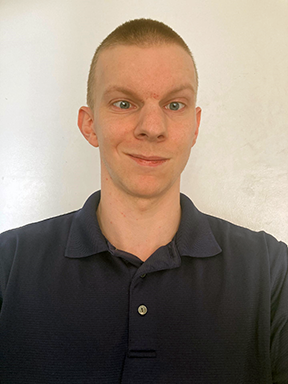 From the Editor: Ryan Carsey is a member of the National Federation of the Blind of Pennsylvania. He graduated from the Louisiana Center for the Blind in 2012, and he has taught cane travel to blind teens in summer programs at Blind Industries and Services of Maryland (BISM) and the Colorado Center for the Blind. Ryan has a passion for urban design, and he is especially interested in public transit and features that can make cities more walkable.
When I attended the Louisiana Center for the Blind in 2011-2012, I remained at the Center for my training, only returning home for Thanksgiving and Christmas. This immersion training is foundational to the methods used by our NFB training centers, since we believe that proper training and opportunities lead to more independence. It is hard to achieve proficiency and confidence in a practical skill without immersion on a daily basis, and this is especially true when it comes to skills related to cane travel.
For the first time since the National Federation of the Blind began using immersion training at its three training centers, we face a serious and sweeping dilemma because of the novel Coronavirus pandemic. To give one example of the impact, the Colorado Center for the Blind had to make the difficult decision to suspend training and send its residential students home until further notice. Since it is impossible to know how long the virus will continue to be a threat to public health, the center also will have to make a difficult decision about its summer youth program, of which I am a part. Immersion will always be an essential element of our training that simply cannot be replaced. However, even more important right now is the continuation of training through the duration of this pandemic until we can safely begin immersion training. This continuity is possible because of our Structured Discovery model of teaching.
I will briefly go over what Structured Discovery is and add a unique perspective that I have observed. I will show how Structured Discovery is advantageous, specifically during this time, compared to the traditional method of teaching orientation and mobility. Finally, I will mention some specific strategies and areas of cane travel to focus on, and I will point out the areas that will be most challenging in the absence of immersion. Hopefully this will give instructors some ideas, but even more importantly, I hope it will encourage students and travelers alike to keep progressing and learning, despite our current state.
There is already a considerably large collection of literature out there about what Structured Discovery is, why it works, and how to use it. Without going into too much detail and repeating what has already been said, I'd like to talk a little bit about two broad elements underlying Structured Discovery that are relevant to this discussion.
Focus on the Student
The first thing to understand is that Structured Discovery learning is focused on the student, and the goal is to shift the role of the decision-maker from the instructor to the student. The goal of cane travel under the Structured Discovery model is to get students to the point of making decisions as soon as they can. In the beginning of training, the instructor will be more involved, as the student is just beginning to learn concepts such as cane techniques and cardinal directions. Along with its emphasis on nonvisual techniques through the use of sleepshades and the long white cane, this method will gradually shift autonomy to the student as he or she becomes a more proficient and confident cane traveler.
For example, suppose a blind student in training is going to participate in a lesson involving a bus route. Using the Structured Discovery model, an instructor will give the student a destination to go to. Assuming the student has had some prior experience with public transit, and depending on the student's confidence level, the instructor may ask the student how they will get there and which bus they will take, or the instructor may simply say, "Take me there." If the student is pretty advanced and confident, the student may even be taken to an unfamiliar place and asked to meet the instructor somewhere.
Using the traditional model, the instructor will accompany the student to a bus stop or station that they are more than likely going to use regularly. The instructor will describe the layout and explain where certain buses stop within the station. The student will be told which bus goes where and encouraged to focus on one bus route, perhaps a bus route that will be used frequently for travel to work or a medical office.
It is very important to notice the difference between these two teaching methods. Structured Discovery gives more autonomy to the student, while the traditional model does less so.
Attitudes about Blindness
The second element of Structured Discovery is closely related to the element of student-focused learning, and in my experience, it is not a part of the traditional model. The second element of Structured Discovery is an extensive examination of attitudes about blindness. We who teach using Structured Discovery believe that public attitudes about blindness are the biggest barrier that blind people face. We strongly believe that it is important to have regular group discussions about these attitudes. The reason why is simple: despite these attitudes and misconceptions, blind people are normal people. The belief about blindness being a normal part of life, along with my curiosity about walkable cities and my enjoyment of teaching cane travel, sparked an observation that I would like to share.
Walkable Cities
First let me briefly explain some important concepts about walkability.
There is an excellent book written by Jeff Speck called Walkable City Rules. He lists and describes 101 rules that communities should adopt in order to be more walkable. These rules are grounded in what Speck calls the "general theory of walkability." His theory states that a town or city will only encourage people to walk if it provides all four of these elements in its design: a useful walk, a safe walk, a comfortable walk, and an interesting walk. The useful and safe walk have to do with physical aspects of the environment that include things such as mixed-use buildings, places to walk to and a specific "network of walkability" between them, proper widths of lanes to discourage speeding, and reliable public transit. The comfortable and interesting walk are more psychological, as they focus on what comforts pedestrians as they walk and what they find interesting. Things that fall into this category include eliminating front parking lots for businesses, constructing buildings that are proportional to the width of the street or taller, planting street trees and restriping streets to include parking lanes beside sidewalks, and showing a presence of other people by installing benches and windows along building fronts.
In studying Speck's theory of walkability and reflecting on its relevance to orientation and mobility, I realize these are very similar concepts. Since blind people are normal people who are driven by the same motivations as everyone else, it is not unreasonable to say blind people have the same motivations to travel as sighted people do. Structured Discovery cane travel enables those who use nonvisual techniques to experience all four elements of the ideal walking experience. Structured Discovery seeks to give the student a reason to travel, primarily in the beginning as the teacher teaches the student proper cane techniques, the use of cardinal directions, and a basic understanding of intersections and traffic patterns. It enables the experience of a safe walk by encouraging students to focus on nonvisual techniques to interpret their environment and make rational decisions based on what they expect will happen.
This process is in contrast to the student's dependence on someone else to provide information or being reliant on their limited vision. It encourages the student to be interested in traveling and less fearful of the unknown, as oftentimes things can change throughout the travel lesson and in life in general.
Structured Discovery in the Time of COVID
Finally, and perhaps most importantly, Structured Discovery helps the student feel more comfortable as a traveler and with blindness in the long run. Just as the enclosure of buildings, parked cars, and trees along the sidewalks give pedestrians a sense of comfort and security, cane travel taught using the Structured Discovery model helps blind students develop comfort and self-confidence in any number of familiar and unfamiliar situations, and it encourages them to be more accepting of their blindness. Excluding discussions of attitudes about blindness would be like telling a pedestrian to walk along a sidewalk that had a parking lot on one side and a six-lane road on the other, with nothing between the curb and the nearest lane of traffic. You could do both, but both lead to discomfort and discouragement.
With an understanding of two elements of Structured Discovery, is it possible for someone to improve in cane travel during this time of orders to stay at home except for essential travel? As I said, nothing can fully replace the immersion experience that you get from training.
Cane travel is best learned by traveling through the built environment and responding to events in real time. Learning on a conceptual level is not the same. However, learning on a conceptual level is better than learning nothing at all. A big advantage with the Structured Discovery model is that it is very conceptual. Now is a great time for instructors and students to focus on cane travel concepts. Cane techniques and when to use them, cardinal directions, address systems, and public transit systems are a few examples of things to work on mastering.
Cardinal directions in particular are challenging to many people. With many of us having so much extra time on our hands at home, it shouldn't take long to master with consistent practice. Other things that are better learned through experience but can still be taught on a conceptual level include proper cane grip and arc; walking in-step; parallel and perpendicular traffic; various types of intersections and when it is safe to cross them; navigating crowds, malls, and shopping centers; and using public transit. These concepts are certainly better learned while working directly with an instructor, since the instructor can observe an arc that is too wide or narrow, just to give an example.
Due to the current parameters for social distancing, it is not advisable to work in a crowded area. However, it is possible for an instructor to teach these underlying concepts. With concepts such as cane grip, arc, and walking in-step, the instructor will have to be very detailed and specific as to how to hold the cane, how wide the student's arc should be, and what it means to walk in-step. Although nothing works as well at demonstrating these concepts as experiencing them in the real world, it is still very important to learn and understand them.
Pairing the comprehension of these skills with regular philosophical discussions about blindness is the ideal strategy during this time of social distancing, keeping in mind the value of immersion.