American Action Fund for Blind Children and Adults
Future Reflections Special Issue: COVID and Beyond LEARNING AT HOME
Virtual First Grade: The Pandemic Year through the Eyes of a Young Braille Learner
by Carla Keirns
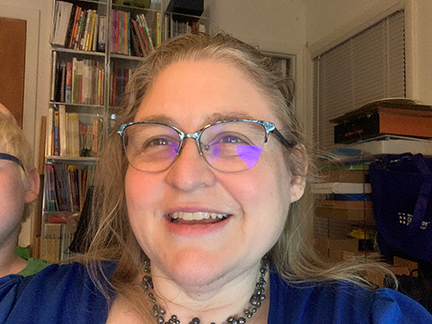 From the Editor: Carla Keirns is a medical doctor who is extensively involved in research. She is co-president of the Missouri Parents of Blind Children, and she serves on the board of the NOPBC.
Spring 2020: Young Worlds Turned Upside Down
In January 2020 the first hints emerged that a dangerous infectious disease outbreak had begun in East Asia. By February the outbreak was causing widespread disruption in Europe, and on March 13, 2020, our son went to kindergarten for the last time.
I have a little boy with albinism (don't tell him I said little), who is now completing first grade. We all had our lives transformed by the novel coronavirus which, to date, has caused roughly three million deaths worldwide. As parents, our instincts were to protect our children from such a scary situation, but that would prove to be impossible.
I am writing this article in my son's home classroom. On a shelf in the corner we have books with titles such as The Social Distance King; A Little Spot Wears a Mask; and You're Mean, COVID-19! Russell was an emerging Braille reader in March of 2020. He could read the alphabet, and he had mastered a few dozen contractions. He was beginning to read Braille books with a few words per page. He was more advanced in reading print. Our child's school closed so abruptly that there was little time to consider whether we should bring home assistive technology, and none to plan for Brailling lessons to come.
Russell finished kindergarten with optional worksheet packets, and after a few weeks he started to have virtual Braille instruction with his teacher. However, he would wait until August to see peers again, this time on Microsoft Teams.
Abrupt Transitions and Lives Disrupted and Lost
During the first year of the pandemic educators and the families they serve lost normal routines, childcare, and in some cases friends and family members. Parks and playgrounds were closed, swings and slides wrapped in caution tape. Play dates with friends became too risky to consider. Grandparents turned into voices on the phone or faces on a screen, and some, like Russell's grandpa, died suddenly. Families like ours had to choose between videoconferencing funerals and having the smallest possible gatherings to avoid getting sick ourselves. Some kids lost parents. A recent study estimated that about forty thousand children in the US have lost a parent to COVID-19 since February 2020.1
The immediate sense was that the children needed normalcy, routines, and a feeling of safety. They needed the ability to share their big feelings. They needed to grieve their losses.
Teachers feared for their lives as well. The New York City schools lost hundreds of teachers and other staff in the first wave of the pandemic in March, April, and May of 2020. While precise figures are hard to come by, the American Federation of Teachers counted at least 530 teachers lost by the end of January 2021.2
How Will They Learn?
With schools closed, the question was how to teach the roughly 50.7 million public-school students. Some called for a jubilee year, arguing that we are chasing arbitrary benchmarks for exactly when students should know which content. Nevertheless, most parents and teachers tried to keep our kids on track. Few teachers of K-12 students had training or experience with distance learning. Some have pointed out that during the flu pandemic a century ago, some school districts turned to the new technology of radio to bring lessons to young students. Thoughts naturally turned to digital technologies.
Some schools sent children home with laptops, tablets, and Chromebooks, only to find that many students did not have reliable access to the internet, especially in urban and rural areas. Some towns in Missouri had to open their school buildings because there was not enough broadband capacity in their communities to hold classes virtually. Other schools did not have enough devices to send home with kids. The rapid shift to work and school from home led to a worldwide shortage of laptops and computer chips, a shortage that is expected to extend into 2022.
Some districts turned to paper worksheet packets for younger students. Some blind students received packets in Braille. Russell did not. Many students were lost to the education system entirely, with estimates claiming one to three million kids unaccounted for when schools resumed.3
Without time, training, and experience to guide them, educators did what any of us would do. They started with what they had. This direct translation of the existing curriculum was sometimes awkward, as when Russell was assigned a worksheet during the first week of classes in August that asked him to "write about a friend you made at school." He responded, "I didn't. I go on the computer." It is not that teachers didn't know that these potential landmines were hiding in the curriculum; there simply were no materials for this unprecedented situation.
Special Education in the Pandemic
The problem of how to educate very young children, especially pre-readers and children in special education, arose immediately. Some school administrators asked for waivers of the requirements of the Individuals with Disabilities Education Act (IDEA), which the Department of Education swiftly refused. Initial guidance issued in March 2020, was reiterated and expanded when US Secretary of Education Betsy DeVos reported to Congress on April 27, 2020 that, "There is no reason that a student's access to FAPE cannot continue online, through distance education or other alternative strategies."
How Do You Teach Blind Kids Online?
Kids with disabilities faced some of the most difficult challenges with remote instruction, especially those with sensory impairments such as deafness and blindness, for whom virtual school presented new access problems. When we talk to other families about the challenges of virtual instruction, all we have to say is "virtual Braille lessons." Our friends' eyes get big, and they generally say, "That's impossible." We are here to tell you it's not.
Before the pandemic many students had assistive technology at school, but they did not have access to this technology at home. Assistive technology was not sent home with the students when the schools closed. Russell had a Perkins Brailler and CCTV at school, and our family bought these devices for home use with grants or personal funds. During our son's kindergarten year we had asked about Braille displays, Braille notetakers, screen readers, and screen enlargement software. We were dismissed with arguments that he would not need those tools until third to fifth grade, if ever.
When I asked the school staff in August how my son was supposed to use Microsoft Teams when he couldn't see the controls, the TVI sent us the JAWS instructions. We reminded her that she had refused to consider teaching Russell to use JAWS when we wrote the year's IEP, even when specifically asked for JAWS training.
The Access & Engagement Survey conducted by the American Foundation for the Blind in spring 2020 found that, "Students had tools at school they did not have access to at home: 17% did not have tablets, 21% did not have laptops, 18% did not have Perkins Braillers, 55% did not have large print books, 50% did not have screen reader software, and 28% did not have recreational Braille books."4 Before the pandemic Russell had neither a digital magnifier, Braille display, Braille notetaker, nor embosser at home. Since all of those devices, purchased new, would cost in the ballpark of $16,000, most students still don't have them.
What Did Work?
First we have to acknowledge the amazing educators and veteran families who developed webinars and videos, custom made materials for home use, shared advice, and just listened to our fears and frustrations. There was so much out there that we appreciated and used, and we knew our son was not alone.
Hats off to Dr. Penny Rosenblum and her partners, who put out an offer to develop materials for students learning at home and worked for free to meet kids' needs.5
The hard-working volunteers who run NFB BELL Academies every summer got together to develop the In-Home Edition. Missouri held three one-week sessions in 2020, and the program will be repeated again in summer of 2021. The key factor that made this program work was the planning by thoughtful, experienced educators of blind students. They developed kits of materials that were mailed to students ahead of time, so that lessons were hands-on, even as instruction was delivered remotely.6
The American Printing House for the Blind partnered with the Perkins School and others to present APH Virtual ExCEL Academy. The program started in the spring of 2020 and continued through the year, with free webinars for students in grades K-12, teachers, parents, and others. The key here is that learning is practical, directed to tasks or lessons, and hands-on.7
Many organizations that have had local programs for years decided they would need to be offered online for safety, and they decided to welcome students from everywhere. Camp Abilities Florida mailed fitness gear to students and ran a week of programs for the students across the country. The TVI training program at California State University/Los Angeles offered a Saturday Extended Core Curriculum program. It provided STEAM (Science, Technology, Engineering, Art, and Mathematics) lessons one-on-one and in small groups via videoconference, supplemented with hands-on activities to make the lessons real for the students.
What Worked for Russell?
Our son was an early print reader, and he was on the verge of being able to read Braille books when the schools closed. What he needed was hands-on instruction. It didn't have to be delivered in person. In fact, he grew tremendously in his Braille skills with the help of experienced teachers who worked with him online. Here's what he did need:
- Rapport with his teachers
- High interest material that he wanted to read—for Russell it was math jokes (you go with what works, right?)
- Material at the appropriate reading level. This need is well understood in the print-reading world. Books that are too hard are frustrating, and those that are too easy are boring. We looked in vain for sets of fully contracted early-leveled readers in Braille.
- Double spaced Braille materials for early readers. APH, National Braille Press, and other organizations produce print/Braille editions of many popular children's books such as Pete the Cat and Llama Llama. However, these books often are transcribed in single-spaced Braille because of the limitations of fitting all of the words on print or interleaved pages. Very early readers struggle to keep track of which line they are on when the lines are close together. Russell's Letter from Santa left him in tears because it was too hard for him to read it in this format.
- Manipulatives—Braille LEGOs, APH materials such as Word Playhouse and Sight Word Express for building words and sentences, peg slates, slate and stylus, APH U-pick.
And What Should We Take Forward, Even After the Pandemic?
Many people will conclude from their pandemic experience that virtual instruction is hopeless for students who are blind or have a range of other disabilities. We have a more encouraging message. Even young students who are not yet reading can learn and thrive with talented and creative teachers working with them at a distance. This means that our rural, urban, or otherwise underserved students could learn with creative partnerships that don't have to be limited by local geography. The keys are thinking through the learning goals, the materials, multi-sensory learning tools, technology, and student engagement. Russell will do anything for his former Orientation & Mobility teacher. When I ask him why, he says simply, "I love her."
References
1. Kidman, Rachel, PhD; Margolis, Rachel, PhD; Smith-Greenaway, Emily, PhD; et al. https://www.washingtonpost.com/opinions/2021/04/05/how-support-children-who-lost-parents-covid-19/
Verdery, Ashton. "Estimations and Projections of COVID-19 and Parental Death in the US," JAMA Pediatrics. Published online April 5, 2021. Doi:10.1001/jamapediatrics.2021.0161
2. https://www.nytimes.com/2021/01/29/us/the-impact-of-teacher-deaths.html
4. https://static.afb.org/legacy/media/AFB_Access_Engagement_Report_Accessible_FINAL.pdf, p. 7.