American Action Fund for Blind Children and Adults
Future Reflections Special Issue: COVID and Beyond LEARNING AT HOME
Balancing Acts: The Trials and Joys of Teaching and Working from Home
by Beth Sellers
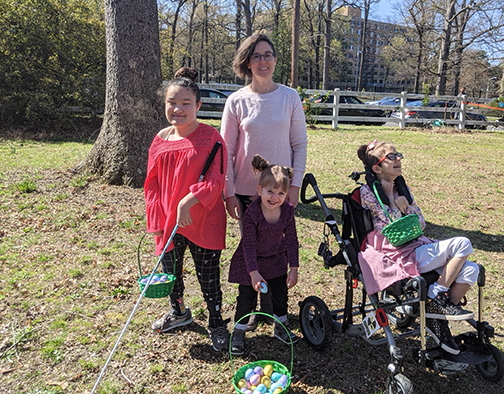 From the Editor: Beth Sellers is the sighted parent of three children currently living at home, two blind and one sighted. By trade she is a special education teacher with a focus on assistive technology, but currently she works as a case manager for people with developmental disabilities living in the community. She serves as president of the Virginia Parents of Blind Children, a chapter of the parents' division of the National Federation of the Blind.
It's 8:00 a.m. I'm working through a phonics lesson with my kindergartener at the kitchen table, taking advantage of the thirty-second video clips in her lesson to read my work emails. My agency cell phone is beside me, and I hope it doesn't start ringing for at least another hour.
One room over, I hear the familiar sound of my seventh-grade daughter's screen reader as she navigates her first online class of the day. I tune in with one ear every few minutes to make sure she is still engaged with her work.
At the other end of the house, my fifth grader with multiple disabilities is finishing her breakfast by g-tube while she listens to a science podcast on the Amazon Echo. The broadcast ends, and she calls, "All done!" At the same time my kindergartener gets to the assessment part of her phonics lesson, and I'm required to administer and record the results of the assessment. Predictably, that’s when my seventh grader calls out that she can't find the right module in Canvas.
It's now 11:30. I'm on a conference call for work. My kindergartener has finished all of her coursework for the day and is participating in a math enrichment class via Zoom. I'm half watching to make sure she stays engaged while still paying attention to my work call. My middle daughter is signed in to her fifth-grade class in her room, and I can only hope she's engaged in her classwork, which is less than accessible for her. My seventh grader is finishing up her virtual Braille instruction, and I hear her restart her computer. I know she needs to eat before her 12:10 class starts, so in my head I'm planning what type of lunch I can get on the table quickly, as soon as my call ends, so she can eat and get back in front of the computer.
It's finally 5:00. The younger two have been finished with their school day for a few hours, and the kindergartener has her face in the Khan Academy Kids app on the iPad. My seventh grader has just finished her last class of the day, her favorite, assistive technology. I've finally shut down my computer and flipped my cell phone over to "Gone for the Day."
The kids are hungry, so I ignore the giant pile of dishes in the sink and start boiling water for the spaghetti they have requested. It's been a long day, but nothing unusual. We will get up and do it all again tomorrow.
As I write this, we are 398 days into working and learning from home due to the COVID-19 pandemic. On March 13, 2020, the kids came home "for a few days" of virtual learning, and we have been here ever since. Our local school division has allowed students with IEPs to attend school in person all year and is now preparing for many K-8 students to return next month if they choose. My children will remain home due to a variety of factors, mostly related to significant health concerns involving my two youngest children.
Virtual learning has been both a blessing and a challenge for our family. My seventh grader is fully blind and a Braille reader, and she also has an orthopedic impairment. She has risen to the occasion and excelled with virtual learning. The school building was a difficult building for her to access, both physically and academically. The virtual format seems to have leveled the playing field for her.
In the school building she was often late to her classes because of the poor layout of the building and her difficulty walking quickly from place to place. Pencil-and-paperwork was often inaccessible or simply not provided to my daughter at all. She suffered from low expectations, exacerbated by paraprofessionals who hovered over her and wanted to do work for her.
With virtual instruction my seventh grader has been able to keep up during her classes and achieve grades she is proud of. She is able to use her screen reader and Braille display to access her coursework in the same digital manner as her sighted peers. She has also been fortunate to have outstanding teachers who have worked hard to ensure accessibility, both in synchronous classes and asynchronous work. Her English teacher and science teacher have been particularly outstanding in making sure that every single activity is accessible.
The anxiety and pressures she felt when she was in the school building are gone now. She can learn from our living room with her dogs beside her. She is also making great progress in Braille, Nemeth code, and assistive technology, due to virtual services with outstanding providers contracted by the school division. She says she misses seeing her friends and teachers in person, but what she misses most are school parties with food. And that type of school experience most likely isn't happening right now, even for those kids who are attending in person.
Sadly, her younger sister has not had the same positive experience. You would think that two kids from the same household, with the same parent and the same school division, would have similar experiences. But my fifth grader, who always loved school prior to the pandemic, has had an absolutely miserable school year. She has been unable to access her general education curriculum due to lack of accessibility, and she has been reduced to simply sitting in front of her screen during her fifth-grade class so she can be counted as present. As her parent, it has been heartbreaking to watch a child who once adored school slowly lose her motivation to learn and try over the course of a school year.
Fortunately, when I called an IEP meeting to address my concerns, her school agreed to send a paraprofessional into our home to assist with accessibility. It has only been a few weeks since this change was made, but already we are seeing a positive change, now that the paraprofessional is available to assist with materials and accessibility.
We don't yet know what the future will hold for our family in terms of school. The nature of my younger kids' disabilities and health conditions means it may not be safe for them to return to school for quite some time. My older daughter's success with virtual instruction also factors into our decision on what school may look like for us in the years ahead. But even though the last thirteen months of isolation have been hard in many ways, there have also been many hidden blessings, such as the extra time I've had at home with my kids and the ability to see how online school works for our family.