American Action Fund for Blind Children and Adults
Future Reflections Special Issue: COVID and Beyond LEARNING AT HOME
Remote Learning Revisited
by Penny Duffy and Abby Duffy
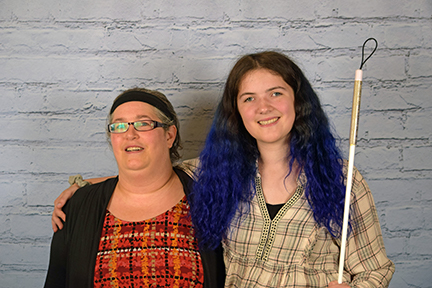 From the Editor: Last summer, as the COVID-19 crisis deepened and online education became a long-term reality, Future Reflections published an article by Penny Duffy about her daughter's experiences. Penny showed that blind students can learn effectively through remote education when the necessary services are in place. The present article recaps Penny Duffy's earlier piece and brings it up to date with comments from Penny and Abby as Abby winds up the 2020-2021 school year.
Education has changed a lot since COVID-19 shook the world in March of 2020. One day my daughter, Abby, was sitting in a tenth-grade classroom, and the next day she was at home, doing something called remote learning. Abby is blind, and I couldn't fathom how remote learning was going to work for her. How would she get access to her materials? What would happen if a remote platform turned out to be inaccessible?
Prior to COVID-19 Abby had a rigorous academic curriculum, and she was an active member of her high school community. She participated on the high school ski and track teams, and she was involved in student government and other clubs. Then the schools shut their doors, and life changed dramatically for all of us. All of the parents in our district had a three-day window to go to the school and collect their children's things. In our case, I brought home all of Abby's assistive technology.
To my great relief, our adventure into remote learning has gone remarkably well. Abby is able to do most of her online assignments independently. She has all the technology she needs at home: an iPad, a Braille display, and a laptop computer with the JAWS screen reader. When she needs support—usually for her math course—her teacher of blind students, Adrienne Shoemaker, is available to help her.
With remote instruction, Abby receives her assignments at the beginning of the week. She and Adrienne go through each of her classes together and determine which of her assignments are fully accessible with her screen reader and Braille display. If a teacher posts a tool that isn't accessible with JAWS, they try it using VoiceOver. If that doesn't work, Abby emails her classroom teacher to work out an alternative way for her to show her understanding of the content. For some assignments Abby requests to have the content in an embossed copy. Adrienne provides the Braille materials and drops them off on our porch.
Abby's classroom teachers have been amazing. They do their best to make sure materials are accessible, and they've been learning a lot. Recently Abby's Latin teacher even checked with Adrienne to find out how to add alt text to a slide presentation.
Meanwhile, I hear too many horror stories about the problems other families of blind students are having with remote education. Some students are not allowed to bring their technology home from school, so they have no way to access the internet for their online classes. Some are not receiving Braille materials. Some have no services at all.
A lot of parents ask me why everything has gone so well for us. We are extremely fortunate to have an excellent teacher of blind students and a school district that is willing to work with us. Carlton Anne Cook Walker, president of the National Organization of Parents of Blind Children (NOPBC) comments, "Districts that did a good job with a blind student before the pandemic usually do a good job during it, too."
Here are a few tips I have gathered for dealing with remote education now and in the future:
- Technology is not to be left at school. The whole team should have an understanding that blind and low-vision students need the same technology at home that they used in the classroom.
- Many blindness services can be provided remotely. Remote teaching can include instruction in Braille, including Nemeth Code and Braille music; and technology, including the use of JAWS.
- A blind or low-vision student has the right to full access to the curriculum at the same time as everyone else.
- A student who is comfortable asking for help from the teachers will be able to ask for help in a remote learning environment too.
- You can still call for an IEP meeting in the middle of a pandemic.
Even at its best, though, there is no way to make remote education the same as going to school. Orientation and mobility is a real challenge. Abby continues to work on some skills through remote lessons, but it is not the same as practicing skills such as crossing streets, using public transportation, and locating destinations.
Adrienne Shoemaker and other professionals are not only using technology to connect with their students, but to connect with each other as well. In the past teachers and O&M instructors in New Hampshire, where we live, sometimes felt isolated. Now they hold weekly meetings online, where they talk about what is going well and discuss their biggest challenges. "During the first two weeks of remote learning there was a lot of time spent reaching out to families and trying to connect with students," Adrienne Shoemaker says. "This is going to be an evolving process. Many parents have multiple children at home, and they themselves have had to transition to working from home. I want to be supportive and not have them feel overwhelmed. We are all adjusting and learning how to operate in this environment of remote learning."
Adrienne points out that there are some positive aspects to this new mode of learning. "I think students are getting an even stronger idea of what they need in terms of accessibility," she says. "Students are developing stronger self-advocacy skills, and that can be a key part in figuring out solutions." We're all in uncharted territory, and we need to work together to ensure the best outcome for everyone.
Editor's Note: Late in April 2021, I asked Penny Duffy and Abby about Abby's experiences a year into the pandemic. Abby's school had just reopened full-time, and Abby was readjusting to face-to-face classes.
"Remote education worked wonderfully," Penny reported. "Abby became much more proactive in problem solving. She couldn't depend on paraprofessionals, so she learned to ask her teachers to make things accessible."
"Actually, I had a lot fewer access issues when we all were remote," Abby explained. "The teachers couldn't use paper handouts or write on the board. Everything was on Google Classroom or Google Docs, and nearly all of it was accessible, so I didn't need help from a para. Even though we're back in the classroom now, the teachers are still sharing information electronically. At this point I hardly need help from a para except sometimes in math."
Abby explained that even chemistry lab worked out for her in the virtual environment. "The teacher did the experiments himself, and he narrated everything step by step. It was really easy for me to follow along."
Not surprisingly, the hardest part of going to school remotely was the lack of social interaction. "I got together with my friends online, but it wasn't the same as actually being together," Abby said. "Even now that we're back in school, we have to stay six feet apart. We're not supposed to congregate in the halls. It's a whole different atmosphere."
Even so, Abby is glad to be back in school at last. Recently she was inducted into the National Honor Society, along with forty other students from her school. "We had the ceremony in the gym, and our parents sat in the bleachers," Abby said. "They set up chairs on the basketball court for the inductees, all six feet apart. When they called our names we stood up and everybody applauded. It wasn't like a traditional ceremony, but it sure was good to be there!"
You can read more about Abby Duffy and Adrienne Shoemaker in Penny Rosenblum's blog post, "How TVIs and O&M Instructors Are Handling the Challenges of Distance Learning, Part 1," https://www.afb.org/blog/entry/how-tvis-and-om-instructors-are-handling-distance-learning-1.