American Action Fund for Blind Children and Adults
Future Reflections Summer 2021 WHAT'S HAPPENING
Touching The News
by Lee Kumutat
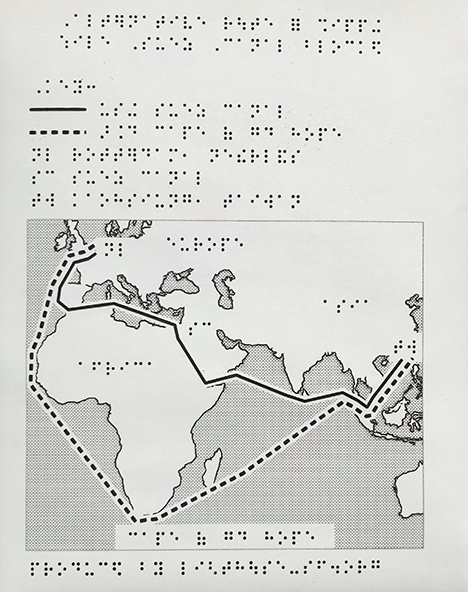 From the Editor: The sighted public is bombarded with images all day long, from the news media, from advertisers, and from friends on social media. Yet those of us who are blind or have low vision have little or no opportunity to experience such images in a tactile form. In this article Lee Kumutat, vice president in charge of communications for the LightHouse-San Francisco, describes a new program that provides blind people with the chances to explore some of these images in a tactile format.
Have you, your child, or your student ever read a news item or watched a news bulletin on TV and thought, “I would love to know exactly what that picture is!”? During your meanderings through the world of social media, have you ever encountered a meme that's gone viral? Everybody's talking about it, and you've wanted to get your hands on it to understand why it's causing such a buzz!
Those of us who are blind or have low vision are surrounded by visual information. Sometimes the only way for us to grasp this information is to have somebody interpret it for us. Usually this interpretation is done through verbal description. Some people are amazingly skilled at explaining things with words, but verbal description remains an indirect experience.
Suppose a file containing a tactile graphic associated with a news story were delivered into your inbox? You could emboss the file yourself or have it raised on swell paper anywhere that provides access to the necessary equipment.
At the LightHouse for the Blind and Visually Impaired-San Francisco, we believe in the extra dimension a tactile representation can add to many tasks, games, recreational activities, and studies. That's before we even mention how useful tactile maps and diagrams are for learning to navigate streets or the layout of a building or for understanding how the roads connect in a tricky intersection. Of course orientation and mobility (O&M) instructors and teachers of the visually impaired know that these resources are integral to learning, but what about all the popular, incidental information people who are blind or have low vision often miss out on?
The LightHouse Media and Accessible Design Laboratory is a group of passionate, dedicated designers and producers. They want to bring graphic elements of current events to your fingertips. They also want you to be involved in choosing the graphics to be made available.
Enter Touching The News, a brand-new initiative from the LightHouse for the Blind and Visually Impaired-San Francisco.
Every two weeks we send out a poll via email, offering three choices of tactile graphics with a link for you to vote on which one you'd like to receive in your inbox.
You might find yourself thinking: I wish I could get my hands on one of those Oscar statues! Well, now you just might, without ever being at the Academy Awards ceremony. Space travel might be your obsession, and you're itching to know what the helicopter is like that recently landed on Mars. Now you might get the answer to your questions.
Greg Kehret, director of MADLab at the LightHouse, explains why this initiative is so important. "Tactile graphics are often viewed as necessary rather than incidental and fun. Of course they are absolutely essential for teaching science, math, and difficult visual concepts. But we think that by adding some fun and general interest to tactile graphics, they will become more accessible to people who can experience them in a less formal and, dare I say, more fun way."
The project has received some great feedback from users during the short time it has been up and running. One couple who are both blind or have low vision shared how useful they find the graphics. They bought a machine for raising tactile graphics but had never really found a good use for it until now.
Over the few weeks that Touching The News has been operating, users have voted for the smiley face emoji, the International Space Station, and what the Harriet Tubman twenty-dollar bill is proposed to look like, just to name three examples.
Senior Designer Naomi Rosenberg loves the challenge of not knowing what she'll be designing until the votes are all in. "We try to choose graphics we know we can make meaningful for people. We are very careful to go to more than one source for the visual information we will then work from to create something meaningful for the tactile sense. It's a challenge, but it's an interesting one."
Presently, subscribers to Touching The News are emailed a digital tactile graphic file every two weeks, and they must print the graphic on their own. However, we're aware that the average blind person still can't get their hands on these tactile images. Very few people have access to a graphics embosser or swell machine at home. We are exploring how to distribute these images by US mail as hard copy tactile graphics, embossed on paper. Your answers on this brief survey at https://bit.ly/3jZ99JS will help us determine potential funding sources and distribution logistics. We really appreciate your time and input. And if you would like a free sample of the Touching The News tactile graphic, email [email protected] with an address, and we will get one in the mail to you.
If you would like to sign up to receive emails so you too can begin to touch the news, you can subscribe by emailing us at [email protected]. Or if you'd just like to read more information, visit the Touching The News page on the LightHouse website, www.lighthouse-sf.org/ttn.