American Action Fund for Blind Children and Adults
Future Reflections Summer 2021 WHAT'S HAPPENING
STEM EQ: Origami and Spatial Thinking
by Andrea Cataquiz
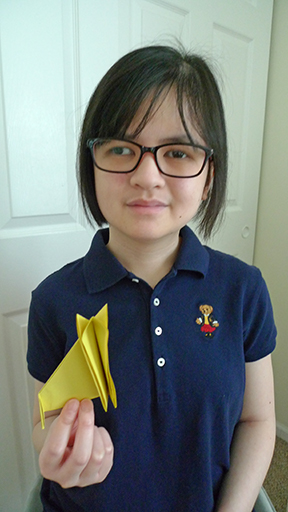 From the Editor: During the summer of 2021 the NFB sponsored STEM EQ, a virtual program that provided blind high school students with hands-on experiences in the sciences. Students met online and worked on projects that focused on spatial thinking.
In the following article STEM EQ participant Andrea Cataquiz shares her thoughts about STEM opportunities for blind students and explains how the art of origami can enhance spatial awareness. Andrea is a high school senior from Illinois.
The world and its opportunities for success are ripe for the taking for anyone who dares to take that leap of faith. However, jumping wildly into every situation isn't always the best idea. There may be multiple opportunities, but which one should a person take? What kind of knowledge does an individual need in order to succeed? Most importantly, where to start?
Perhaps we can start with children, students, and today's youth. After all, they will be the ones battling tomorrow's challenges. We can start by finding the interests and passions of these young people. Do they like sports or art? Could they spend all day surrounded by their LEGO bricks? Being blind doesn't stop us from having fun, so it is silly to believe that disabilities can keep us from our dreams.
Next we need to nurture and strengthen the passions of these children. Let them explore their world to the fullest. When something is not accessible to them, then we advocate for its correction or fix it ourselves.
Experiences of all kinds help people to grow. As blind individuals we need even more of these experiences to make up for the things we miss. I am writing to share some of my experiences with specific activities that I have enjoyed. These activities are not for everyone, but I want to share them for two reasons. First, these ideas don't generally break the bank, and they are simple enough to do with children in the safety of a home or classroom. Second, I hope that these experiences will enrich the minds of young people out there, or at least bring them some enjoyment.
The Japanese art of folding paper, origami, has a long history, but it has only become accessible to people with visual impairments in recent times. Some websites, such as the Accessible Arts and Crafts blog, provide verbal instructions for a few origami models. With these text instructions people who cannot access or do not wish to use traditional origami instructions can read the text instead. The text explains how to fold and/or orient the paper to make an origami model successfully.
While doing origami an individual, especially a blind individual, has to be aware of the changes the paper goes through as it is folded. This awareness is necessary to make sure that the instructions are carried out correctly. Otherwise, the model you set out to make will not end up the way you expected.
This awareness, known as spatial thinking or spatial reasoning, is the ability to understand the position of objects within a given space and to manipulate that information inside your head. This skill is important in such activities as mental mapping and designing objects. Spatial thinking is an especially important skill for those of us who are blind or have low vision. It helps us while navigating or when we need to understand verbal descriptions of visual information. Some good ways to practice spatial thinking are by drawing, building, dancing, playing video games, and folding origami.
Spatial thinking is a useful skill for many applications. It also happens that a lot of the things a person can do to practice spatial thinking are fun activities that you may or may not do every day. These activities can introduce young blind children to new learning experiences and prepare them for whatever the future brings.
Below are text instructions I wrote for an origami model I enjoy making. I hope you and whomever you choose to do it with will enjoy it as much as I have. Have fun!
Origami Fox Text Instructions
Place a square piece of paper on a flat surface with the south edge parallel to you. Note: While folding this project, do your best to keep the edges of the paper as aligned with each other as possible. This will enable the fox to stand up when you are finished.
1. Bring one corner of the paper up to meet the opposite corner in a diagonal. Align the edges and crease the paper firmly.
2. Turn the paper so that the longest side of the triangle is parallel to you. Fold it in half by making the left and right corners meet and crease.
3. Take the top layer of folded paper and bring it up to the corner pointing north. After creasing firmly, flip over the paper and repeat the previous step for the remaining layer of paper.
4. Locate the corner on the lower right side of the model. Rotate the model so that this corner points North.
5. Estimate about an inch to an inch-and-a-half, starting from the right side of the model. Fold all the layers of the model at the same time at this point. Make sure that during and after folding this step the paper remains as aligned as possible. This is especially important for the bottom of the model that will become the legs of the fox. Note: Take your time, because this step is quite difficult to do right.
6. Move your hands along the section you just folded to the top. Carefully, partially separate the three layers of paper you find there. Each layer is made of your paper folded once. The two outermost layers will become the pointed ears of your fox. Locate the innermost layer. Find its pointed tip and the crease that slants to the left along the left side of this layer of paper. Gently press downward along the crease. When you remove your finger, the paper should bounce up just a little, and the tip of this inner layer of paper should protrude east.
7. Now, starting from the left side of the model, estimate about an inch, and fold the paper so that it is pointing to the right. As before, make sure that the bottom of the model remains aligned, because this tail after being creased will help your fox stand up.
8. Finally, hold your fox upright, and put it on your flat surface. If all went well, the fox will stand up on its own.